Imagine knocking out a wall in your basement during a home project and finding a mysterious room behind it. Then a tunnel. Then another. That's roughly what happened to a resident of a small town in central Turkey in 1963, and what he found turned out to be one of the most astonishing places on Earth.
Here's the short answer. He had stumbled into Derinkuyu, an ancient multi-level underground city in the Cappadocia region. It reaches about 280 feet deep and was large enough to shelter as many as 20,000 people, along with their livestock and food. For centuries, local people hid there from invading armies.
Carved From Volcanic Ash
The secret to Derinkuyu is the rock. It was carved mostly into tuff, a soft stone made from compacted volcanic ash that's common in the region. Its old Greek name, Malakopia, likely relates to the Greek word for "soft." The Turkish name Derinkuyu means "deep well."
Tunnels and rooms may first have been cut by the Phrygians in the 8th or 7th century BC. Much later, during the Christian era of the late Roman Empire, people expanded the caves into deep, multi-level structures with chapels. The city was fully formed in the Byzantine era.
A Whole Town Below Ground
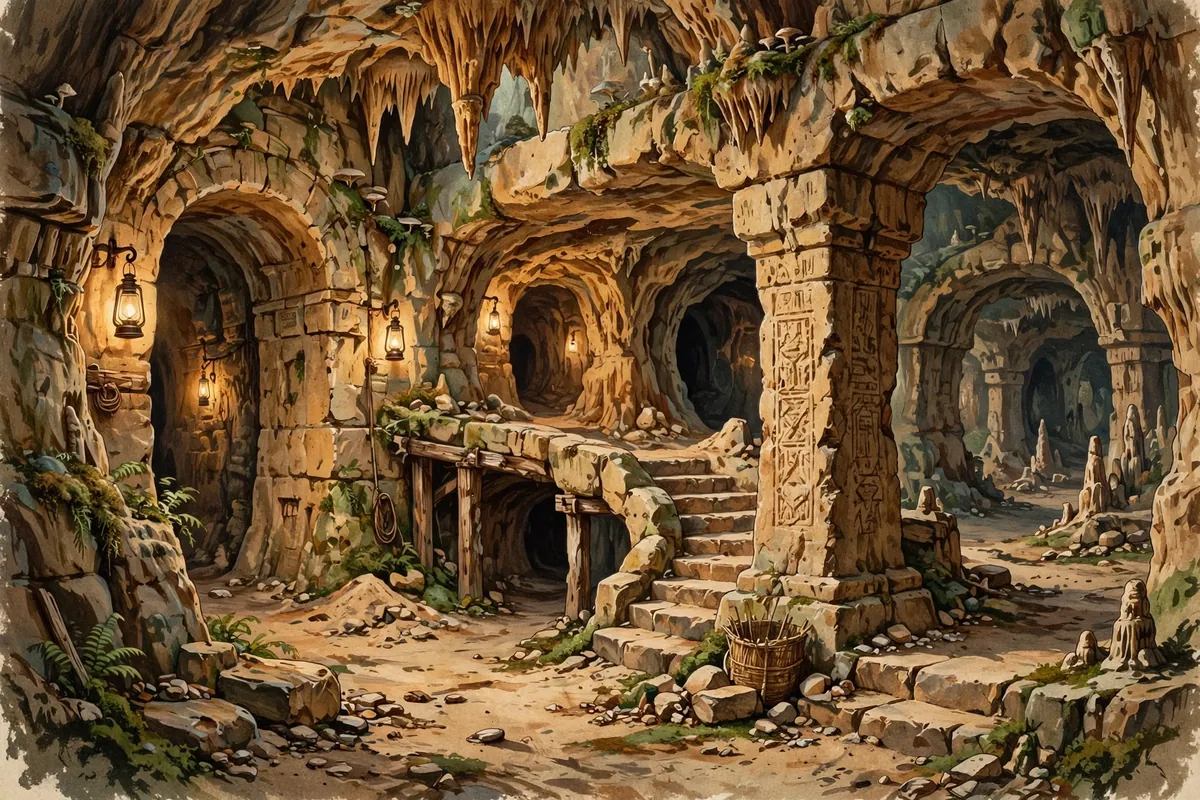
Derinkuyu wasn't just a hiding hole. It had wine and oil presses, stables, cellars, storage rooms, dining halls, and chapels. Kitchens held tandoor ovens like the ones still used in Cappadocian villages today. A large vaulted room on the second level is reported to have served as a religious school.
Fresh air was engineered in. Many vertical shafts brought air down through the levels, and the main shaft was laid out so openings on different levels never overlapped, which appears designed to maximize airflow. A 180-foot shaft seems to have served as a well for both the village above and the people hiding below.
Derinkuyu was even linked to another underground city, Kaymaklı, by about 5 miles of tunnels.
Built for Defense
The city could be sealed from the inside with huge rolling stone doors, and each floor could be closed off separately. That meant one section could be isolated if attackers broke in. Other underground cities in the region had traps, including holes in the ceiling through which defenders could drop spears.
Derinkuyu was greatly enlarged during the Arab-Byzantine wars, roughly from 780 to 1180, when local Christians sheltered there from raiding armies. That's likely when it came closest to holding its full 20,000 people. Later, it offered refuge during Seljuk invasions in the 11th century and Mongol incursions in the 14th century.
Forgotten, Then Found Again
People kept using it well into modern times. In 1909, a Cambridge researcher recorded villagers in the area hiding underground for several nights after news of massacres nearby. In 1923, the region's Christian inhabitants were moved to Greece in a population exchange, and the underground city was abandoned.
Its memory faded until that 1963 renovation. Since then, more than 600 separate entrances have been found, some hidden under the basements of private homes in the town above.
Today, Derinkuyu is one of the most visited underground cities in Cappadocia. Walking its narrow passages, you can almost hear the footsteps of the families who once waited out danger in the cool, quiet dark. It's a reminder of how far people will go to keep each other safe.