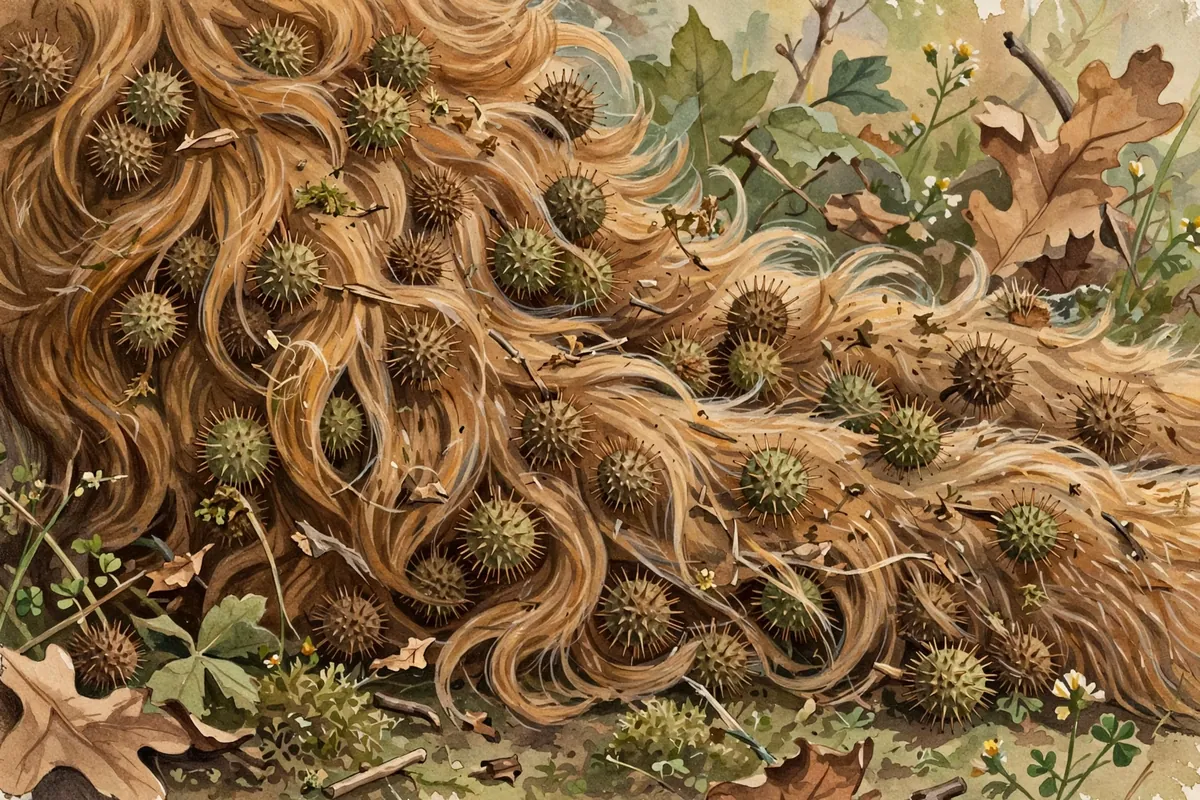
Anyone who's walked a dog through tall weeds knows the routine. You get home, and your furry friend is covered in little prickly seed heads that cling like glue. Picking them out is a chore. But for one engineer, that chore turned into a world-famous invention.
Here's the short answer. In 1941, Swiss engineer George de Mestral returned from a hunting trip in the Alps with his dog and noticed burdock burrs stuck to his clothes and the dog's fur. Under a microscope, he saw that each burr was covered in hundreds of tiny hooks that caught on anything with a loop. He set out to copy that design, and the result was the hook-and-loop fastener he named Velcro.
Nature's Tiny Hooks
The burrs worked because their hooks snagged on loops, like the fibers in clothing, animal fur, or hair. De Mestral realized he could join two materials in a way that could be undone and redone again and again, if he could recreate those hooks and loops.
His big leap was shrinking the idea. Hook-and-eye fasteners had existed for centuries, but each hook needed its own eye. De Mestral imagined a surface covered with thousands of tiny hooks meeting a surface covered with loops. Because the hooks were so small, they didn't need to line up perfectly. Some would always find a loop.
Today, Velcro is often held up as a classic example of copying nature's designs, an idea known as biomimicry.
Years of Trial and Error
Turning the idea into a product was hard. When de Mestral took it to Lyon, France, then a center of weaving, industry leaders rejected it. One weaver helped him make cotton strips, but the cotton frayed and wore out quickly.
So he turned to nylon, a material that had only recently been invented. It didn't fray easily or attract mold. He discovered that nylon woven into loops and heat-treated would hold its shape. On the verge of giving up, he had one more idea: he bought a pair of shears and trimmed the tops off some of the loops, turning them into hooks.
The name itself is a blend of two French words: velours, meaning velvet, and crochet, meaning hook. De Mestral filed for a Swiss patent in 1951, and it was granted in 1955.
A Lift From the Space Program
At first, the fastener didn't catch on in fashion. Early versions looked like they'd been made from scraps of cheap fabric. Its big break came in the aerospace industry, where it helped astronauts get in and out of bulky spacesuits.
Velcro-brand fasteners were used on suits, sample bags, and lunar vehicles on the Apollo missions to the Moon. Astronauts also used patches to keep objects from floating away, and one inside the helmet even served as a nose scratcher. Because of all that attention, many people wrongly believe NASA invented Velcro.
Skiers caught on next, followed by makers of scuba gear and children's clothing. When de Mestral's patent expired in 1978, low-cost imitations flooded the market, and hook-and-loop fasteners went on to become a familiar part of everyday life. Today the Velcro trademark is registered more than 300 times in over 159 countries.
So the next time you pick a burr out of your dog's coat, take a closer look. That annoying little seed helped inspire one of the most useful inventions of the 20th century.