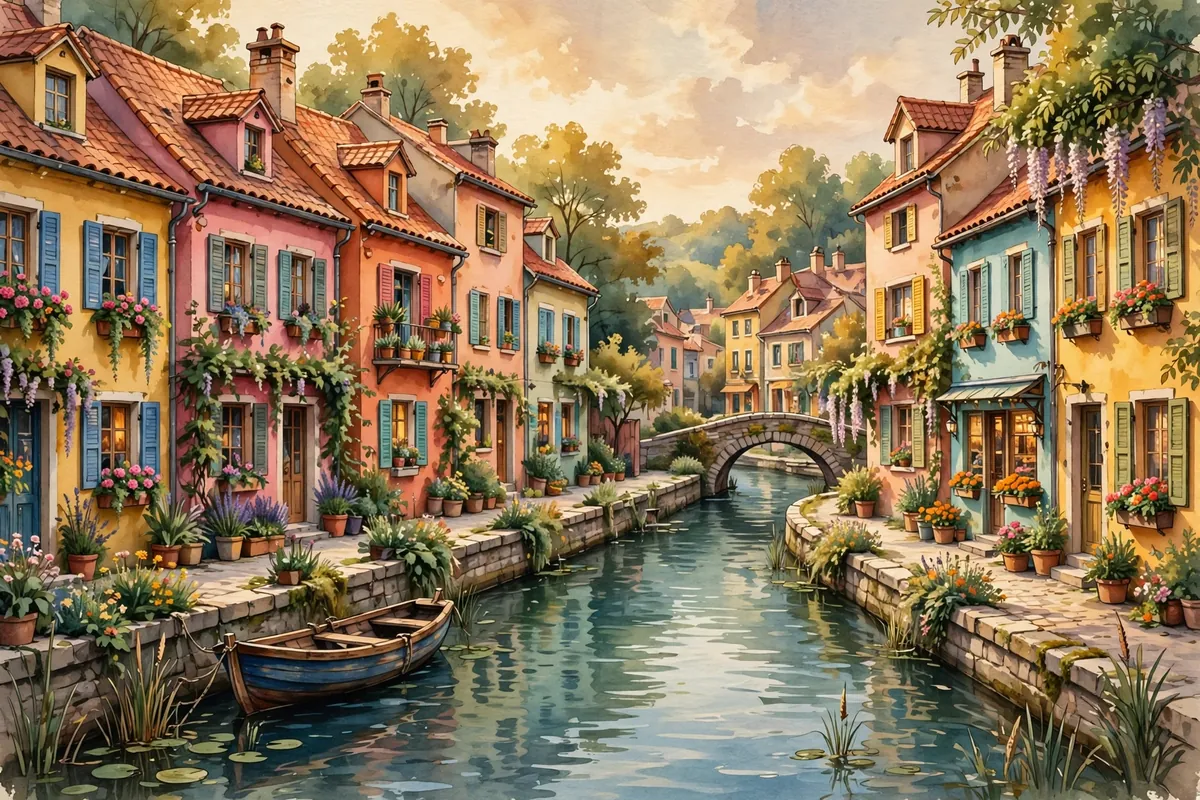
Imagine stepping off a water bus onto an island where every street looks like a box of crayons. Bright pink next to sunny yellow, deep blue next to lime green. The canals reflect the whole rainbow. It's no wonder artists love it.
That island is Burano, in the lagoon near Venice, Italy. It's famous for its small, brightly painted houses, and it's considered one of the ten most colorful places in the world. The surprise is that the colors aren't random. They follow a specific system dating back to the island's golden age. If you want to repaint your home, you have to send a request to the government, which tells you which colors are allowed for your lot.
An Island Village in the Lagoon
Burano sits about 4 miles from Venice, roughly a 45-minute ride from St. Mark's Square by vaporetto, the city's water bus. It's linked by a bridge to the neighboring island of Mazzorbo. It lies near the island of Torcello at the northern end of the Venetian Lagoon. For centuries Burano was governed from Torcello and had none of the privileges enjoyed by Torcello or Murano.
Originally, Burano was made up of five small islands. One of its canals was later filled in to create a street, and the old islands still correspond to the island's five districts, called sestieri, just like in Venice. Today about 2,800 people live there, packed tightly together. Burano is almost entirely covered with homes, with very few green spaces.
A Rainbow With Rules
The bright houses are part of what makes Burano special, and locals keep it that way. Because colors are approved lot by lot, the island's famous look carries on, even as individual houses get a fresh coat.
It's a good example of how a community can protect its character. Instead of beige subdivisions, Burano offers street after street of color, with each house adding its own note to the bigger picture.
Famous for Lace, Too
Long before tourism became its main business, Burano was known for something else: lace. The island rose in importance in the 16th century, when women there began making lace with needles. The craft reached them by way of Cyprus, which was then ruled by Venice.
Burano lace was soon exported across Europe. The trade declined in the 18th century and didn't revive until 1872, when a lacemaking school opened. Today few people make lace the traditional way, because it's so time-consuming and therefore expensive. You can learn all about it at the island's Lace Museum. It's a true labor of love.
What to See
The heart of the village is Piazza Baldassare Galuppi, the only square on the island. It's named for the composer Baldassare Galuppi, born on Burano in 1706, and his statue there was made by Remigio Barbaro, a sculptor born on Burano in 1911. The square also holds the Town Hall and a well made entirely of Istrian stone. Nearby is the church of San Martino, with a leaning bell tower and a 1727 painting of the Crucifixion by Giambattista Tiepolo.
Burano's neighbor Murano is famous for glass, ever since Venice ordered its glassmakers to move there in 1291 for fear of fire. Visit both, and you'll see how a few small islands turned craft and color into a way of life.