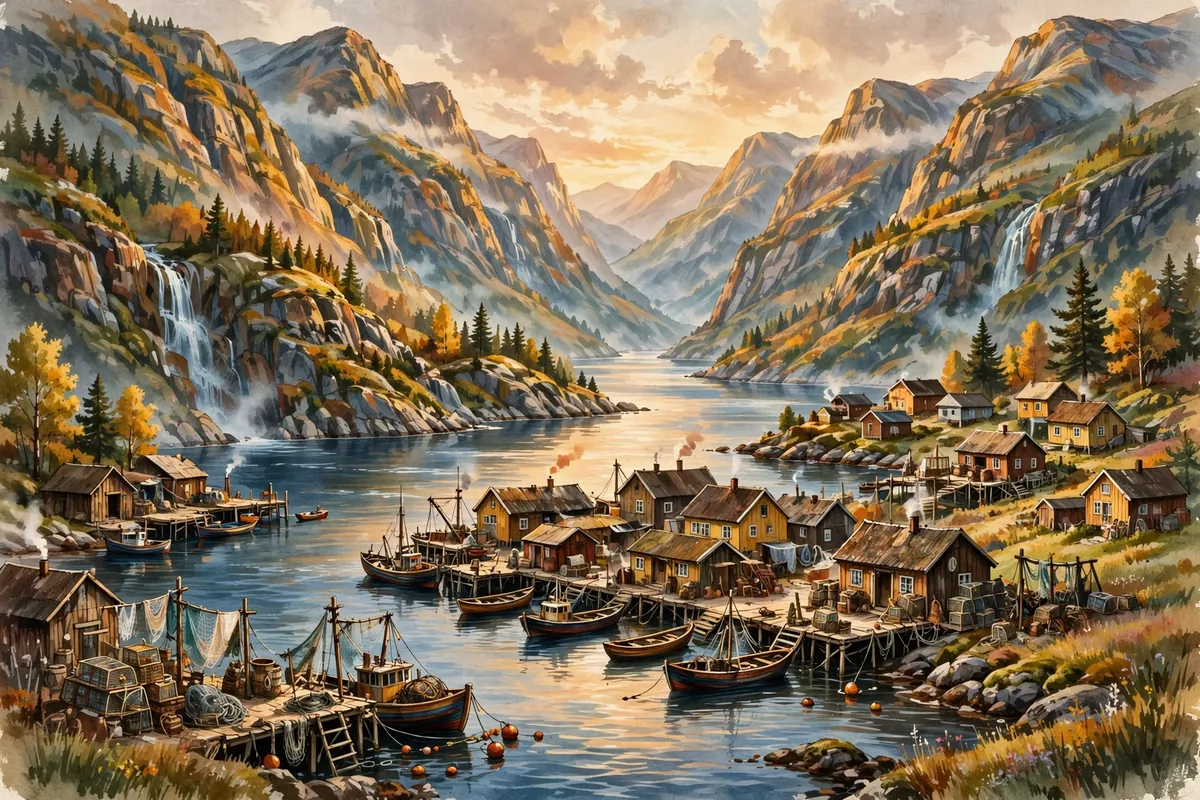
Most of us can't picture life without a road to the grocery store. But on Canada's Atlantic coast, there's a village tucked at the end of a small fjord with no road leading in. To get there, you usually take a boat.
Here's the short answer. The village is Francois, pronounced fran-SWAY, on the south coast of Newfoundland. It sits on Francois Bay at the end of a small fjord and can't be reached by road. Visitors and supplies arrive by ferry or helicopter, and in winter, by snowmobile. At the 2021 census, it had just 64 residents.
Life Without Roads
With no roads inside or out, people get around Francois on concrete pathways and boardwalks. The village no longer has a general store, but it does have a post office and a small museum.
Its lifeline is the water. Francois is served by a provincial ferry connected to the town of Burgeo. The nearest community along the coast, Grey River, is about 36 kilometers, or roughly 22 miles, to the west.
The name often surprises visitors. Although it comes from French, locals pronounce it fran-SWAY, and it's properly spelled without the little hook, called a cedilla, found in the French name François.
One of Newfoundland's Outports
Francois is what Newfoundlanders call an outport, a small coastal community. Outports are some of the oldest European settlements in Canada. Explorer John Cabot visited Newfoundland in 1497, and word spread that he'd caught cod just by lowering and lifting a weighted basket.
Fishing crews from across Europe soon followed, including the French by 1504, Basque whalers by 1527, and Spanish fishermen by 1540. They built small wharves and wooden platforms on shore, where they salted and dried their catch for weeks before sailing home. The fish were covered with sailcloth every night and in foggy or rainy weather, until they hardened enough to be stacked like boards. Shore crews also traded with First Nations people who brought furs, and to hold on to the best harbors, some volunteered to spend the winter keeping the wharves and sheds in repair. Over time, some of those seasonal fishing stations grew into year-round villages, many of them reachable only by water or by hiking trails.
Francois was first settled in the 1700s, and fishing shaped its life for generations.
The Village That Wouldn't Move
Serving isolated villages is costly. As of 2017, the province's marine transportation system cost $76 million a year. Decades earlier, the government had tried to centralize people into larger growth areas. Between 1954 and 1975, resettlement programs led to the abandonment of 300 communities, and nearly 30,000 people moved. The program is still remembered as one of the most controversial in the province's history.
Francois held on. It resisted resettlement in the mid-20th century. Under a newer voluntary program, residents reconsidered relocating and rejected it in 2013, and once more in 2021.
Life hasn't been easy. When a ban on cod fishing began in 1992, outports across Newfoundland lost a key source of income, and many people moved away. Francois has shrunk too. Its population fell by about 28 percent between 2016 and 2021.
Still, the people who stay have made their choice clear. Tucked away on the Atlantic coast, Francois is a reminder that some places are worth the extra effort to reach. Just remember to check the ferry schedule.