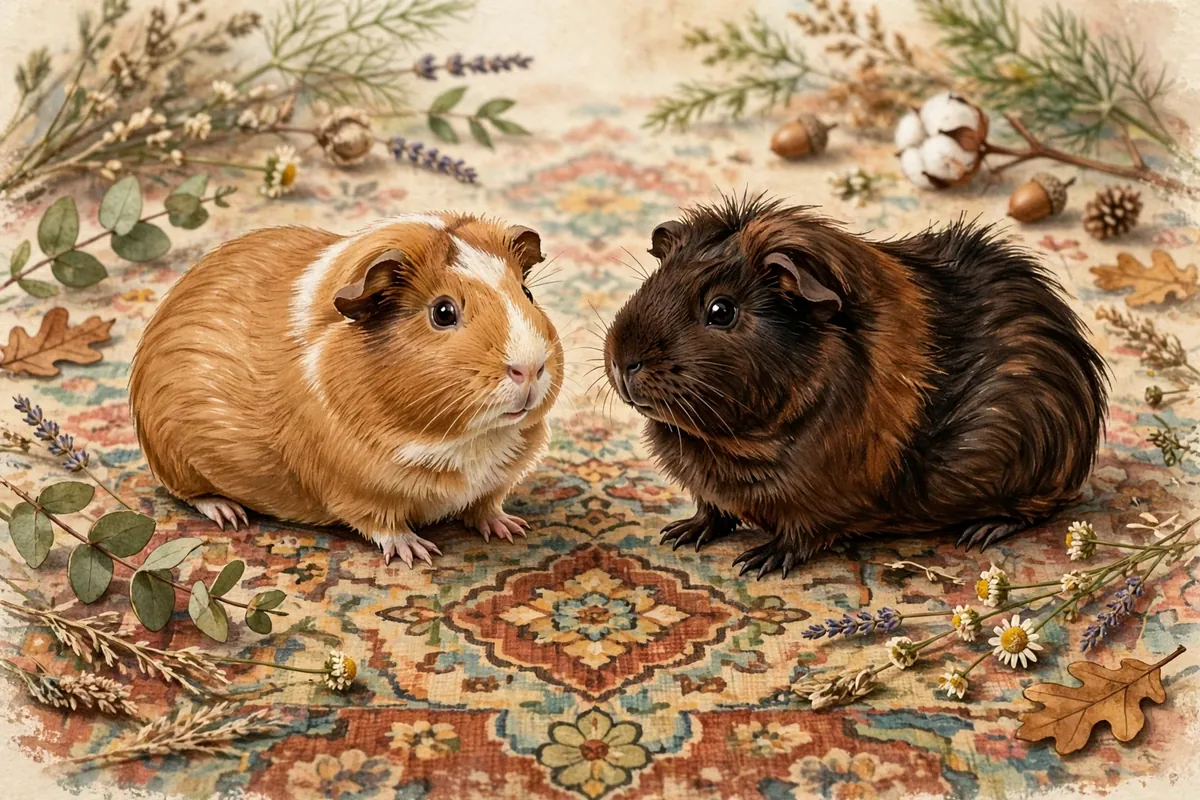
Most pet rules are about things like leashes, licenses, and vaccinations. Switzerland has one that surprises nearly everyone who hears it. If you keep a guinea pig there, you can't keep just one. The little rodents are legally entitled to company.
Here's the short answer. In Switzerland, owning a single guinea pig is considered harmful to its well-being, so keeping a guinea pig without a companion is illegal. Guinea pigs are highly social animals that thrive in groups of two or more. Sweden has similar laws against keeping a guinea pig by itself.
Guinea Pigs Need Their Friends
Guinea pigs aren't loners. They do best living with others of their kind. Common pairings include groups of females, or a few females with a neutered male. Males can sometimes live together too, if they have enough space, meet at a young age, and there are no females around to compete over.
They also form real bonds. Guinea pigs learn to recognize and attach to particular companions. In tests, a male's stress response to a strange new place dropped significantly when a bonded female was with him, but not when an unfamiliar female was there instead.
Interestingly, they don't usually do well with other species. Rabbits, for example, have different nutritional needs, and can carry germs that make guinea pigs sick.
Rent-a-Guinea-Pig
The Swiss rule creates an awkward problem. What happens when one guinea pig in a pair dies? The survivor can't legally stay alone, and the owner may not want to start over with a whole new pair.
The solution is charmingly practical. There's a service in Switzerland that rents out guinea pigs to temporarily replace a cage-mate that has died. That way, no guinea pig has to spend its final days by itself.
The Language of Guinea Pigs
Anyone who has lived with guinea pigs knows they're chatty. Their most famous sound is the wheek, a loud whistle. They often make it when they're excited, like when their owner appears or it's feeding time. A guinea pig that gets lost may wheek for help.
Happy guinea pigs also do something delightful called popcorning. They hop straight up into the air, sometimes again and again, a bit like a rabbit's happy jumps. When startled, a group may stampede in random directions to confuse a predator.
They're smarter than they look, too. Guinea pigs can learn complicated paths to food and remember them accurately for months. And they keep unusual hours. Pet guinea pigs tend to be active for long stretches broken up by short naps, scattered randomly through the day and night, rather than following a regular daily schedule.
From the Andes to the Living Room
Guinea pigs were first domesticated as early as 5000 BC by people in the Andes of South America, in parts of what are now Colombia, Ecuador, Peru, and Bolivia. They were raised for food, and they still are in that region, where they're known as cuy. The ancient Moche people of Peru often showed guinea pigs in their art.
Like humans, guinea pigs can't make their own vitamin C, so they need it from fresh foods like broccoli, cabbage, and carrots. Pet guinea pigs typically live four to five years, and sometimes up to eight. The Swiss idea seems simple enough: if you're going to share your home with one, make room for two.