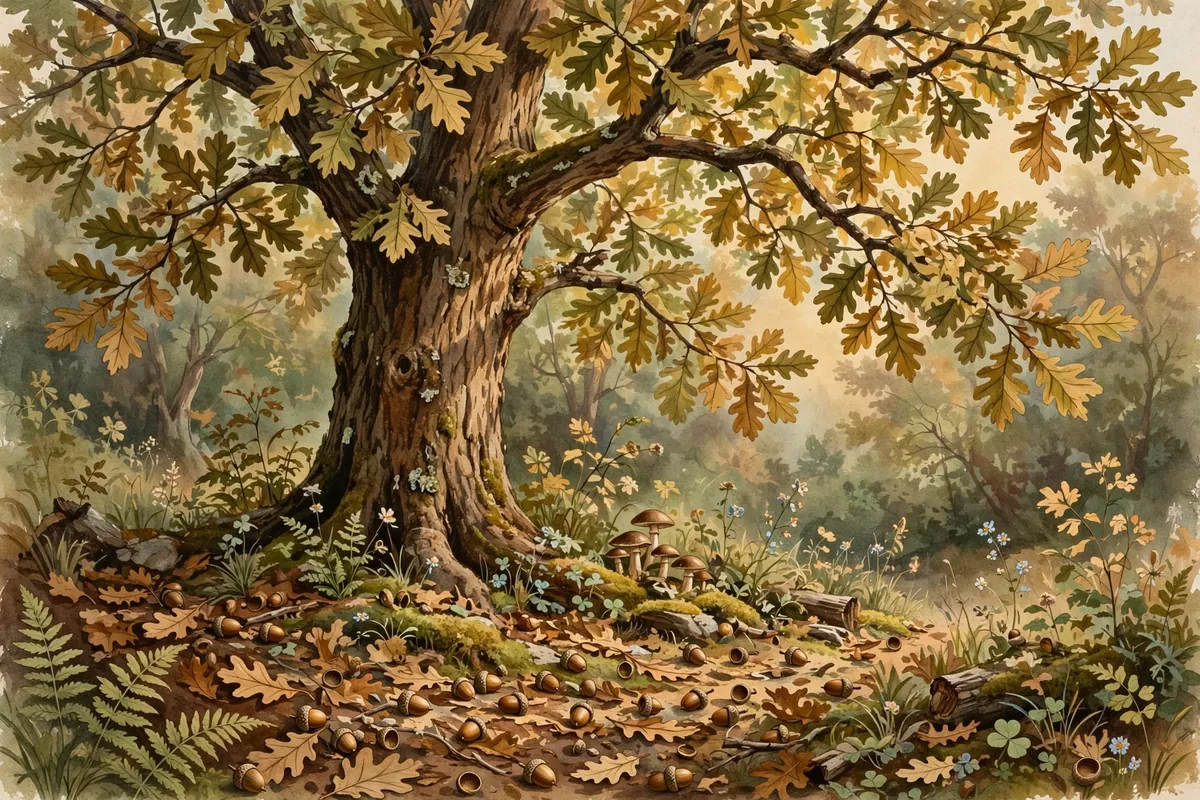
If you have oak trees nearby, you've probably noticed it. Some autumns the acorns rain down on the roof, the deck, and the car, crunching under every step. Other years there are hardly any. The trees haven't changed, so why does the crop swing so wildly?
Those bumper years are called mast years. Many trees, including oaks, hickories, and beeches, produce highly variable crops, with huge pulses of nuts in some years and small crops in between. Scientists think it's partly a survival strategy, possibly helped along by weather, though the full explanation is still being studied.
What Mast Means
Mast is the fruit of forest trees and shrubs. The word comes from the Old English mæst, meaning nuts that pile up on the forest floor. Acorns, hickory nuts, and beechnuts are called hard mast, while berries such as raspberries and blueberries are soft mast.
In the old days, farmers turned their pigs loose in the woods to fatten up on fallen nuts, a practice called pannage. The difference between a mast year and an ordinary year can be thousands of acorns from a single area.
Oaks also differ in timing. White oak acorns ripen in a single growing season and can sprout right away in the fall, putting out a root before winter. Red oaks need two years to mature their acorns, so a big crop is set in motion well before it falls.
Feast or Famine on Purpose
The leading idea is called predator satiation. Squirrels, mice, deer, birds, and insects all eat acorns. If oaks produced the same modest crop every year, the animals could eat nearly all of them.
Instead, the trees starve the seed-eaters in lean years, keeping their numbers down. Then, in a mast year, they release so many acorns that the animals simply can't eat them all. More acorns survive to sprout into new oaks.
There's evidence this matters. For white oaks, all the acorns may be eaten by insects and animals in years of small crops, leaving none to become new trees.
Weather and Timing
Another idea is that making a big crop takes a lot of energy and nutrients, so trees may need to save up resources between big years. Weather plays a part too. For some oak species, mast years are linked to regional cues such as spring temperatures, summer drought, and spring frost.
Many masting trees are wind-pollinated. If all the trees in an area bloom heavily in the same year, pollination may work better. Some researchers have even proposed disease as a factor. Scientists are still sorting out how much each one matters, and it likely varies by species.
Ripples Through the Forest
A mast year affects the whole forest. Gray squirrels breed more in years with plenty of food, and their litters shrink in lean years.
White-footed mice boom after a mast year too. That has a downside for people, because these mice carry the ticks that spread Lyme disease, and more mice has been linked to more Lyme cases. On the bright side, the mice also eat gypsy moths, a major forest pest in the eastern United States.
So the next time you're sweeping a mountain of acorns off the patio, you can blame the oaks for being clever. They're playing a long game, and this is one of their big years.