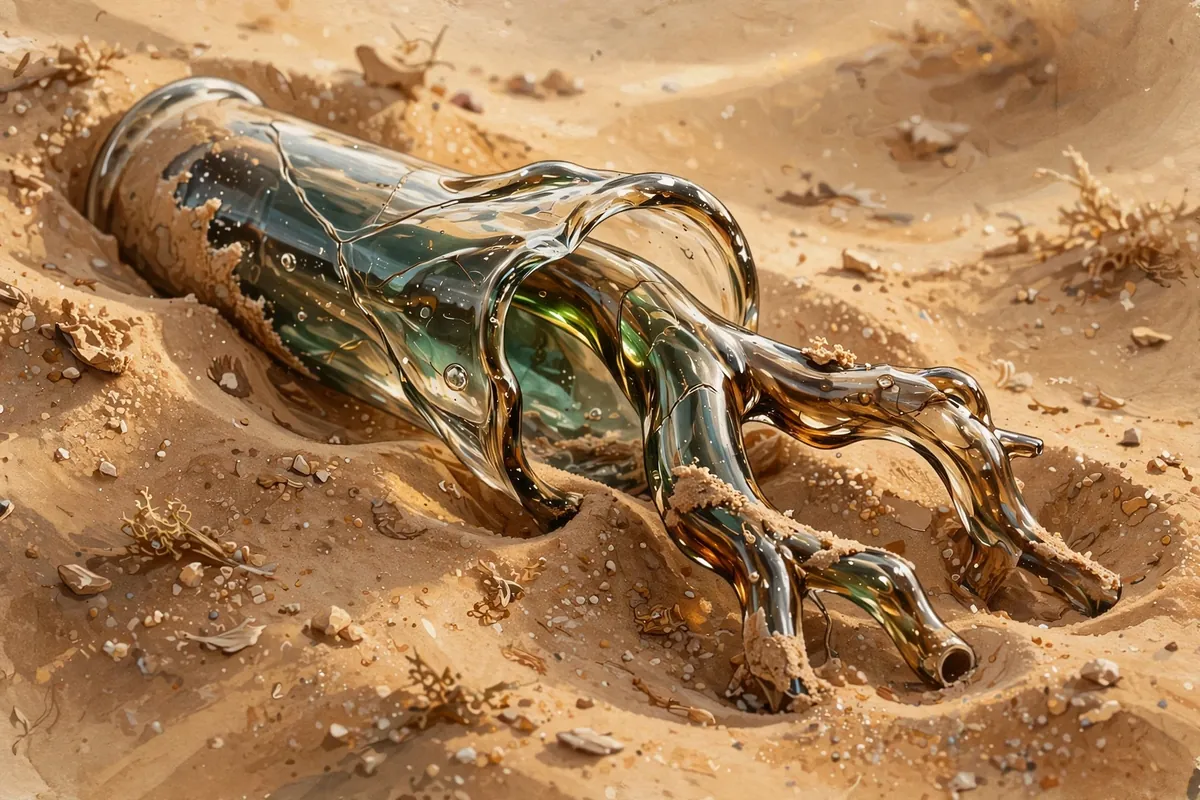
A lightning bolt lasts only a split second. You see the flash, hear the boom, and it's gone. But sometimes, when lightning strikes sand or soil, it leaves behind a lasting souvenir hidden in the ground: a twisting tube of glass shaped like the path the electricity took.
These objects are called fulgurites, from the Latin word for lightning, and people often call them fossilized lightning. When lightning hits the ground, the enormous heat melts and fuses grains of sand, soil, or rock. The melted material cools almost instantly into glass, usually forming hollow, branching tubes that trace where the bolt traveled underground.
A Flash Hotter Than the Sun's Surface
Lightning carries staggering energy. An ordinary cloud-to-ground strike can bridge a difference of more than 100 million volts. Temperatures inside the lightning channel can climb above 30,000 kelvins, which is hotter than the surface of the Sun.
When that much energy rushes into silica-rich sand, it rapidly vaporizes and melts the grains along its path, often leaving a hollow tube behind. The result is a fulgurite that's usually smooth or lined with tiny bubbles inside and rough and sandy on the outside.
No Two Are Alike
Fulgurites have no fixed recipe. Their makeup depends entirely on what the lightning hits, whether that's sand, clay, soil, or solid rock. Most range in color from white to black, and iron in the ground can give them a deep brownish green.
Scientists sort them into types: sand fulgurites, soil fulgurites, ones formed in calcium-rich sediments, rock fulgurites that look like glassy crusts, and even tiny droplets of melted material thrown out by the strike. Many branch out like tree roots in a fractal pattern, similar to the feathery marks lightning can leave on other surfaces.
They're also very fragile, so digging up a large one in one piece is tricky. That makes the big ones especially impressive.
Record-Setting Glass Tubes
Fulgurites can reach more than 8 inches across and burrow as deep as 49 feet below the surface. One of the longest found in modern times, a little over 16 feet long, came from northern Florida. Yale's Peabody Museum of Natural History displays one about 13 feet long.
Charles Darwin wrote about them too. In The Voyage of the Beagle, he recorded that tubes found in Drigg, in northern England, reached about 30 feet in length. Among the famous naturalists who studied these tubes, Darwin was the one who linked them to lightning. He even mentioned experiments in Paris where strong electric shocks passed through finely powdered glass produced similar tubes.
Clues to the Past
People noticed these odd tubes long before they understood them. Persian scholars Avicenna and Al-Biruni mentioned them in the 11th century. For centuries afterward, they were blamed on underground fires and even thought to have healing powers. It wasn't until 1805 that researchers identified lightning as the true cause.
Today, fulgurites help scientists estimate how often lightning struck an area long ago, which offers clues about past climates. They also contain rare materials, including shocked quartz and tiny carbon structures called fullerenes, that otherwise form in extreme settings like meteorite impacts.
So the next time a thunderstorm rolls over a sandy beach, picture what might be happening below the surface. Somewhere down there, a bolt may be sculpting a one-of-a-kind glass treasure, waiting for a lucky beachcomber to find it.