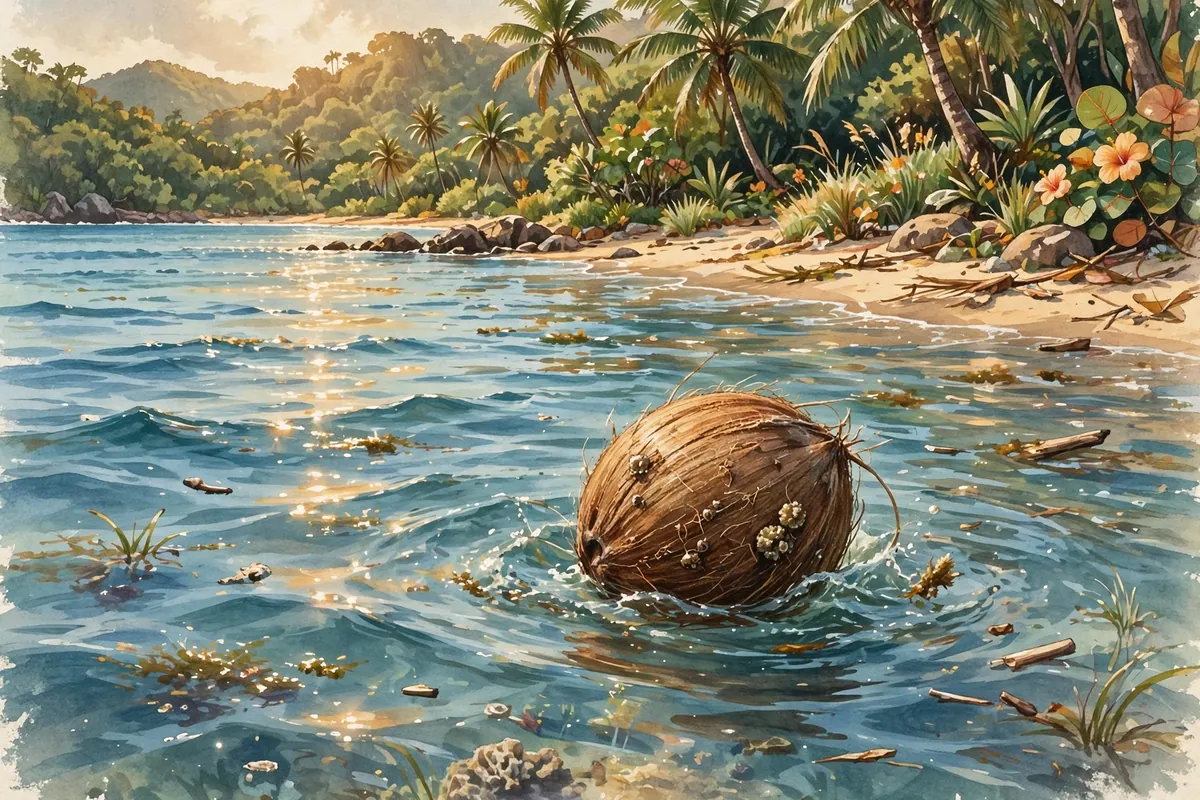
It's one of nature's classic images. A coconut drops from a palm, rolls into the surf and floats away, drifting for weeks until it washes up on a distant island and sprouts into a new tree. It explains why coconut palms seem to grow on every tropical beach on Earth.
The truth is a little different. Wild coconuts really are built for ocean travel, with thick, buoyant husks. But drift models based on winds and ocean currents show coconuts could not have crossed the Pacific on their own. Their spread around the world was largely the work of people, especially the seafaring Austronesian peoples of Southeast Asia and the Pacific.
A Fruit Made for the Sea
First, a surprise: a coconut isn't a true nut. Botanists call it a drupe, a fruit with three layers. There's a glossy outer skin, a thick middle layer of fiber called coir, and the hard inner shell most of us picture.
Wild coconuts, a type known as niu kafa, are long and angular, with a thick husk, a heavily ridged shape and less meat inside. All of that makes them more buoyant, which is ideal for drifting at sea. Wild coconut palms grow only along coasts, in sandy, salty soil, and without human help they couldn't reach places inland. Getting started is easy, too. Heavy fruits like coconuts fall when they ripen, and their hard shells can roll away from the parent tree, setting them up for a later trip by water.
Where Coconuts Came From
Genetic studies point to the Central Indo-Pacific as the coconut's original home, around the islands of Southeast Asia and Melanesia. That's where coconuts have the greatest genetic diversity.
From there, people took over the job of spreading them. Austronesian peoples domesticated coconuts in Southeast Asia and carried them on their long sea voyages, as far east as the Pacific islands and as far west as Madagascar. Coconuts gave sailors a portable supply of food and water, and their husk fibers were used for rope in building houses and boats.
The Rounder, Juicier Coconut
Over time, those sailors bred a different kind of coconut. The domesticated Pacific type, called niu vai, is rounder, with a thinner husk and more meat and coconut water inside. That made it better as a travel snack, even though it doesn't float as well.
Being less seaworthy didn't matter anymore, because people were now planting coconuts on purpose. Archaeologists have found pieces of these domesticated coconuts on islands in the Bismarck Archipelago dating to around 1000 BCE.
How Coconuts Reached the Americas
Coconuts were growing in Panama before Columbus arrived, but they aren't native there. Genetic tests show they're most closely related to coconuts from the Philippines. That suggests they didn't simply float over on ocean currents. Instead, they were likely brought by early Austronesian sailors at least as far back as 300 BCE.
Later, South Asian, Arab and European sailors spread coconuts along the coasts of the Indian and Atlantic oceans. Spanish galleons even carried Pacific coconuts to Mexico from the Philippines. Because of these different routes, scientists divide coconuts into two big groups, Pacific and Indo-Atlantic.
So the next time you see a postcard palm leaning over a perfect beach, remember the full story. The coconut is a fine little sailor, but its greatest voyages were made with a human crew.