It's a classic trivia question, and most of us learned the answer in grade school: the Nile is the longest river in the world. That's still the usual answer today. But behind it is a surprisingly lively debate, with a rival on another continent and some very tricky measuring problems.
The short answer: the Nile is generally recognized as the world's longest river, at about 4,404 miles by one detailed 2009 measurement. But the Amazon in South America has a real claim to the title. Depending on how you measure, the two can swap places, and geographers have argued about it for years.
The Case for the Nile
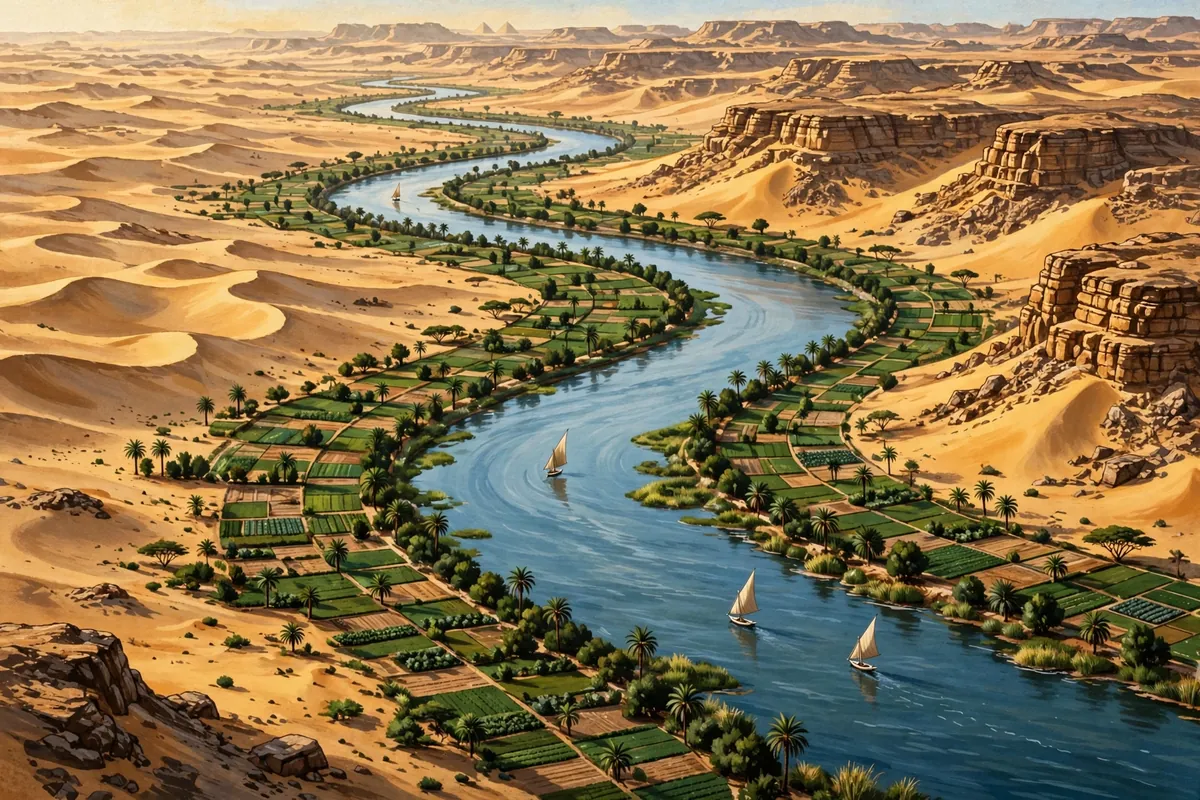
The Nile flows north through northeast Africa and empties into the Mediterranean Sea. Its basin stretches across eleven countries and covers about 10 percent of the African continent. Most of its water comes from rain falling on upstream countries such as Ethiopia, Kenya, Tanzania, and Uganda. Downstream, Egypt and Sudan are mostly desert.
The river has two main branches. The White Nile, which starts in the region around Lake Victoria, is longer and is considered the headwaters. The Blue Nile begins near Lake Tana in Ethiopia and actually carries more than twice as much water. The two meet in Khartoum, Sudan, and continue north through the desert to Cairo and the sea.
Its most distant source has been traced to a stream in Nyungwe National Park in Rwanda. In 2009, a peer-reviewed study used satellite images and fieldwork to measure the Nile at 7,088 kilometers, or 4,404 miles. The same study put the Amazon at 6,575 kilometers, about 4,086 miles.
The Case for the Amazon
In 2008, Brazil's space research institute announced that by its calculations, the Amazon was 87 miles longer than the Nile. It measured the Amazon from a distant source called Apacheta Creek and included a long route through tidal canals and bay waters at the river's mouth. Using the same methods, it found the Nile was longer than previous estimates, but still a bit shorter than the Amazon.
Those results weren't formally published, and other experts questioned the methods. So for now, the traditional view holds: Nile first, Amazon a very close second.
Why Is Measuring a River So Hard?
You might think measuring a river would be simple. It isn't. Published lengths for the Nile range from about 3,417 to 4,404 miles. The Amazon has been listed anywhere from about 3,899 to 4,345 miles.
The results depend on where you decide the river begins, where it ends, and how closely you follow its twists and turns. Picking a different stream as the source, or deciding where a river stops and the sea begins, can change the answer by hundreds of miles.
Longest Isn't Biggest
Even if the Nile wins on length, the Amazon wins easily on size. It carries more water than the next seven largest independent rivers combined and accounts for about 20 percent of all the river water flowing into the world's oceans. The Nile carries only about 1 percent as much water as the Amazon.
So who's the real champion? It depends on what you're measuring. The Nile can keep its trivia crown for now, but the Amazon is the undisputed heavyweight. Either way, both are mighty rivers that have shaped the lives of millions of people, and both are well worth bragging about.