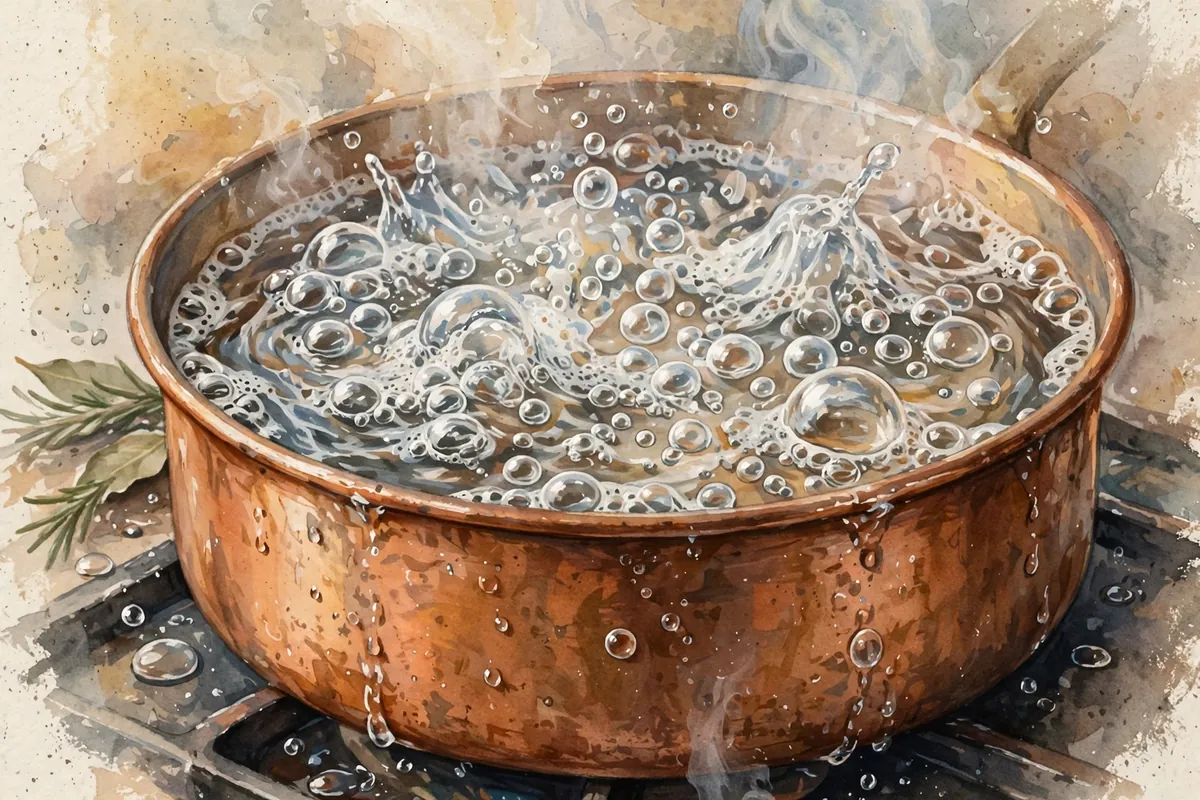
Few kitchen sounds are as familiar as a pot coming to a boil. First come a few tiny bubbles on the bottom, then a soft hiss, and finally a rolling, splashing churn. We've all watched it a thousand times while waiting to drop in the pasta. But what's actually inside those bubbles?
The big bubbles in boiling water are filled with water vapor, which is water in gas form. When water gets hot enough, its vapor pressure grows strong enough to push back against the air pressing down on it. At that point, pockets of vapor can form inside the liquid itself. Those pockets are the bubbles, and they rise because the vapor is far lighter than the water around it.
The Tug-of-War Inside Your Pot
Scientists define the boiling point as the temperature where a liquid's vapor pressure equals the pressure around it. Think of it as a tug-of-war between the water trying to escape as vapor and the atmosphere pushing down on it. At sea level, water wins that contest at about 212 degrees Fahrenheit.
Below that temperature, molecules still escape from the surface as steam, but the water can't form vapor bubbles deep inside. Once it reaches the boiling point, bubbles can form throughout.
Why Bubbles Start on the Bottom
Bubbles usually appear first on the bottom and sides of the pot, at specific spots. This is called nucleate boiling. The heated metal is the hottest part, and tiny scratches or imperfections give bubbles a place to get started. As the burner gets hotter, more of these starting points come alive.
Those early tiny bubbles aren't all steam. Heating also drives out gases that were dissolved in the water, such as oxygen and nitrogen. And that hiss you hear before a full boil? It comes from bubbles forming and collapsing, an effect related to what engineers call cavitation, before they're able to rise all the way to the surface.
Mountain Cooks Have It Harder
Because boiling depends on air pressure, it changes with altitude. Higher up, there's less air pressing down, so water boils at a lower temperature. At about a mile high, water boils at roughly 203 degrees Fahrenheit. That's why cooking at high elevations often takes longer, and boiling water may not get hot enough to cook some foods properly.
A pressure cooker uses the same idea in reverse. By sealing in steam and raising the pressure, it pushes the boiling point higher, so food cooks hotter and faster.
When Water Forgets to Boil
Sometimes water gets hotter than its boiling point without bubbling at all. This is called superheating, and it can happen in a microwave. The microwave heats the water but not the container, and a smooth cup offers few spots for bubbles to start.
The surface looks calm, but jostling the cup, stirring it, or adding instant coffee or sugar can make some of the water suddenly flash into steam and spray out. Reheating the same cup over and over makes it more likely. Experts suggest putting a non-metal stir stick in the cup and not overheating water in the microwave.
So the next time you're waiting on a pot of water, you'll know exactly what's going on. That rolling boil is water turning itself into gas, one bubble at a time.