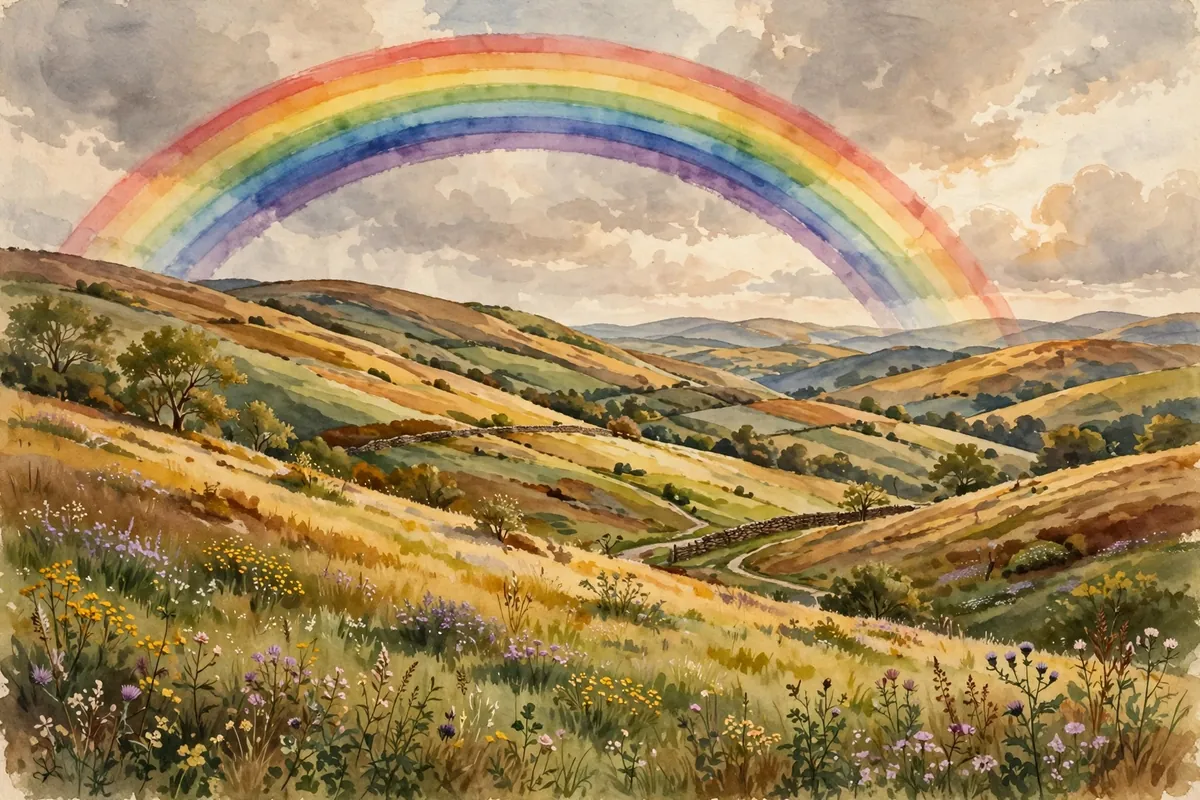
After a summer storm, the clouds part, the sun comes out, and there it is: a perfect arch of color stretching across the sky. Kids draw them as half circles, and that's exactly how they look. But have you ever wondered why a rainbow bends instead of running in a straight line?
The short answer: in theory, every rainbow is a full circle. Raindrops send colored light back toward you at a specific angle, about 42 degrees from the point directly opposite the Sun. All the drops at that angle form a ring around that point. From the ground, the bottom of the ring is hidden below the horizon, so you only see an arch.
The Magic Angle
When sunlight enters a raindrop, it bends, bounces off the back of the drop, and bends again on the way out. The light comes back toward you across a range of angles, but it's brightest at about 42 degrees. That's the angle that creates the rainbow.
Each color bends by a slightly different amount, a process called dispersion. That's why red ends up on the outside of the arch and blue on the inside.
Why It Makes a Circle
Here's the clever part. Only certain drops send light to your eyes at just the right angle. All of those drops sit on an imaginary cone with your eye at the tip. The base of that cone forms a circle, centered on the line from the Sun through your head to your shadow.
Since the Sun is behind you, the center of the circle is always in front of you, below the horizon on the ground near your shadow. That's why usually half or more of the rainbow's circle is hidden. It's also why you see rainbows with the Sun at your back, and why, when the Sun is higher than 42 degrees, there's no rainbow in the sky at all.
A fun twist: no two people see exactly the same rainbow. Each person's rainbow comes from a different set of raindrops, depending on where they're standing.
Seeing the Whole Circle
If you get high enough, you can sometimes see the missing part. From an airplane, with enough mist, a rainbow can appear as a full circle. You might also catch a complete circle in the spray of a waterfall or fountain if you stand in just the right spot.
Double Rainbows and a Dark Band
Sometimes a second, fainter rainbow appears outside the first, about 10 degrees farther out, with its colors in reverse order. It's caused by light bouncing twice inside each drop. The darker strip of sky between the two bows is called Alexander's band, named after the ancient thinker Alexander of Aphrodisias, who first described it.
In 1637, the French philosopher René Descartes studied rainbows by shining light through a large glass sphere filled with water. He worked out that a single reflection inside the drop makes the main bow and two reflections make the second one, and he calculated the angles for both.
Where to Look
Because the Sun has to be low and behind you, rainbows tend to show up in the western sky in the morning and the eastern sky in the early evening. The best shows come when rain clouds darken half the sky while the Sun shines from the other side.
So the next time you spot a rainbow, remember you're only seeing the top of a giant circle of light, one made just for you.