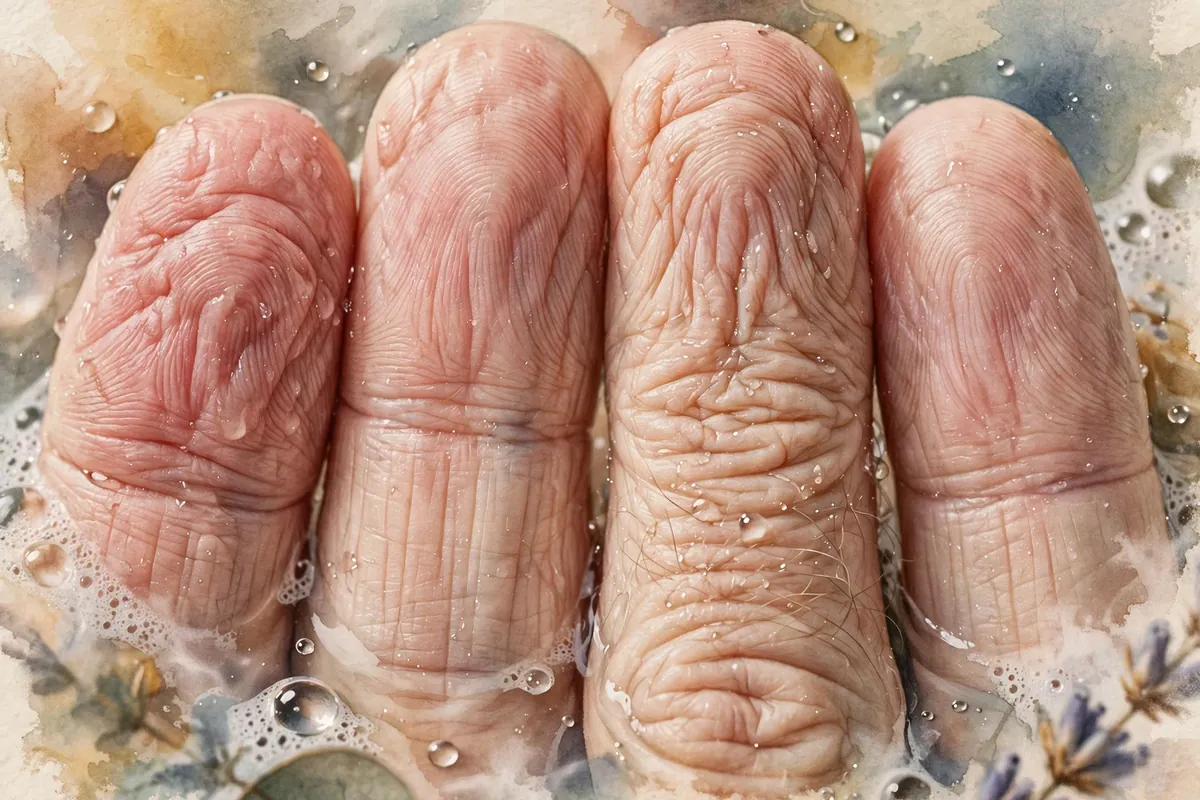
Stay in the tub a little too long and your fingertips start to look like raisins. Toes too. It happens to nearly everyone, and most of us were told the same simple explanation as kids: the skin soaks up water and puckers.
That explanation turns out to be wrong. Water-wrinkled fingers aren't caused by skin swelling up with water. They're caused by your nervous system, which makes tiny blood vessels under the skin tighten when your hands are wet. With less fluid underneath, the skin pulls into wrinkles.
The Old Sponge Theory
For a long time, the sponge idea made sense. The thought was that the tough outer layer of skin, which is packed with a protein called keratin, absorbed water, expanded, and had nowhere to go but into folds.
It even explained why fingertips and toes wrinkle first. Those spots have an extra-thick layer of keratin and no hairs, so they lack the protective oil, called sebum, that hair follicles produce elsewhere on the body.
The idea was so tidy that it stuck around for generations. Even today, the sponge explanation is common enough that it shows up on lists of popular misconceptions about science. But a curious medical observation had already poked a hole in it decades earlier.
The 1935 Clue
Then came a surprise. In 1935, two researchers named Lewis and Pickering were studying patients who had damage to the median nerve, a major nerve in the hand. They noticed that skin served by the damaged nerve didn't wrinkle in water, even though the rest of the hand did.
If wrinkling were just about soaking up water, a damaged nerve shouldn't make any difference. The finding showed that the nervous system plays an essential role, and the sponge theory couldn't be the whole story.
What Really Happens Under the Skin
Here's the current picture. Water seeps into the skin of your hands and feet through their many sweat ducts. This likely shifts the balance of salts, called electrolytes, in the skin. That change can make nearby nerves fire faster.
Those nerves connect to small blood vessels just below the surface. As they fire, the vessels narrow, a process called vasoconstriction. Less fluid sits under the skin, the tension drops, and the surface folds into those familiar ridges.
Because the process depends on working nerves, doctors have even used it as a simple bedside test. Hands are soaked for about 30 minutes, and the wrinkles are counted along the way. Not every healthy person wrinkles, though, so it's only one clue among many. If you ever have concerns about numbness or nerve problems, talk to your doctor.
Do Pruney Fingers Have a Purpose?
This is where scientists are still debating. One idea is that wrinkly fingers act a bit like the tread on a tire, giving us better grip on wet objects. If so, the wrinkling may have helped our ancestors in damp conditions.
The evidence has gone back and forth. A 2014 study failed to find any improvement in handling wet objects with wrinkled fingertips. But a 2021 study of gripping found that wrinkles cut the force needed to hold wet objects by 20 percent, which supports the traction idea.
So the next time you climb out of a long bath with raisin fingers, give your body a little credit. That wrinkling isn't a sign of soggy skin. It's your nerves quietly at work, and they may be giving you a better grip at the same time.