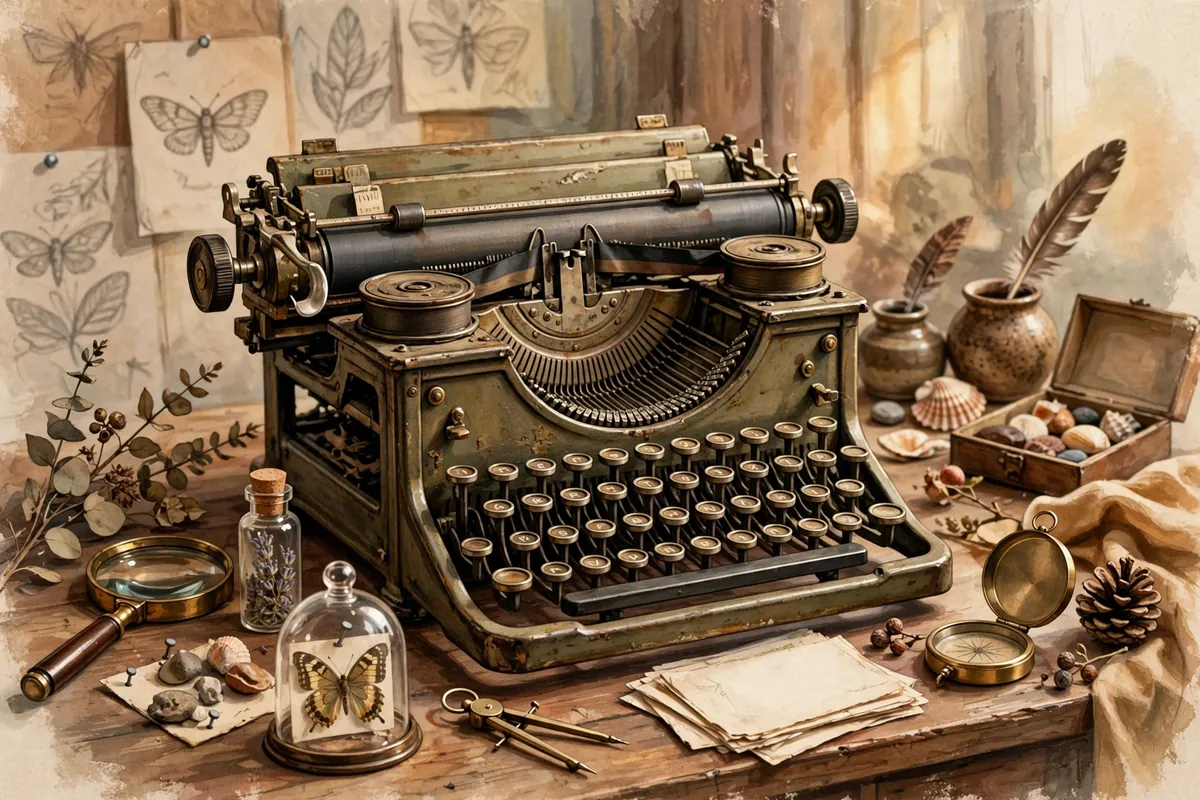
Every day, millions of us tap away at keys arranged in an order that seems to make no sense. Q, W, E, R, T, Y. Why not just A, B, C, D? It would surely be easier for beginners to find each letter.
Here's the short answer: the first keyboard was alphabetical. The QWERTY layout came out of years of trial and error by typewriter inventor Christopher Latham Sholes in the 1870s, followed by final tweaks from the Remington company. Exactly why he chose each spot isn't fully known, and the most popular explanation may not be true. QWERTY stuck because the Remington typewriters that used it became hugely successful.
It Started Out Like a Piano
Sholes was a newspaper editor and printer living in Kenosha, Wisconsin. In October 1867, he filed a patent application for an early writing machine he had developed with the help of friends Carlos Glidden and Samuel W. Soulé.
His first model had a piano-like keyboard with two rows of characters arranged alphabetically. Then Sholes spent about five years rearranging it. In 1868, he flipped the second half of the alphabet. By 1870 he had a four-row keyboard with the vowels moved to the top row. Bit by bit, the ABC order dissolved.
Remington Puts On the Finishing Touches
In 1873, Sholes's financial backer, James Densmore, sold the manufacturing rights to E. Remington and Sons. Within a few months, Remington's mechanics finalized the layout, producing essentially the QWERTY keyboard we know today. One change moved the R key into the spot once used for the period.
A popular story claims this was done so salesmen could impress customers by typing the brand name TYPE WRITER using only the top row. It's a fun tale, but nobody has ever formally proved it.
If you look closely at your keyboard, you can still find a leftover from the original ABC layout. On the middle row, the letters D, F, G, H, J, K, L still run in alphabetical order.
The Famous Explanation Might Be Wrong
You may have heard that QWERTY was designed to slow typists down or to stop the metal arms inside typewriters from jamming. The idea is that letters often typed together were placed far apart. But historians describe this explanation as popular but possibly invented, or even incorrect.
There are other theories. One says the layout was influenced by a study of common letter pairs by Amos Densmore, the backer's brother. Others think it grew out of feedback from telegraph operators, noting how the common pair E and R ended up side by side. Experts still disagree.
Why We Never Switched
QWERTY took off with the Remington No. 2 in 1878, the first typewriter to offer both uppercase and lowercase letters using a Shift key. Once typists learned the layout, it became the standard, and it carried over to computers. Alternatives such as Dvorak and Colemak exist, but QWERTY remains the norm.
Early typewriters had their quirks, too. Many left out the keys for 0 and 1 to save money. Typists simply used a capital O for zero and a capital I or lowercase L for one, a habit some people kept for decades.
So the keyboard under your fingers isn't random, and it isn't quite the engineering masterpiece of legend either. It's the result of one inventor's tinkering, one company's tweaks, and a whole world that got used to it.