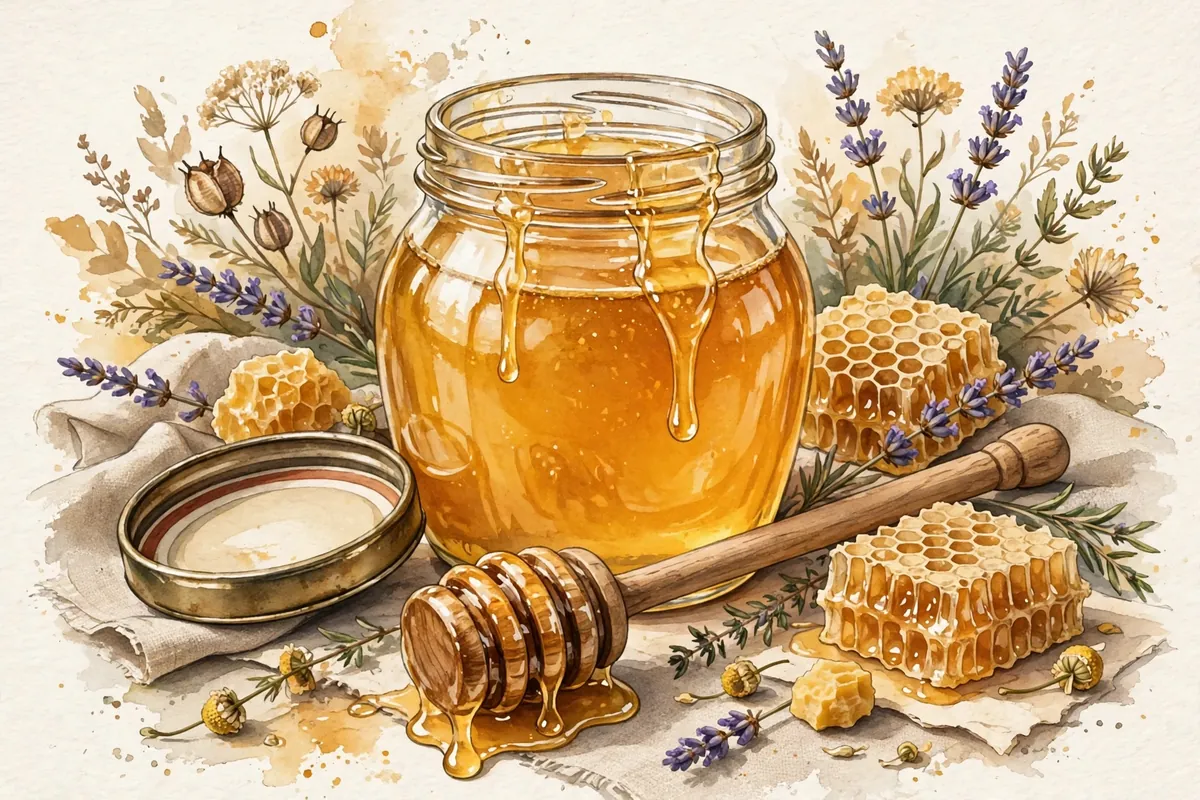
Most foods in your kitchen are in a quiet race against time. Bread goes stale, fruit gets soft, and leftovers grow fuzzy. Then there's honey, sitting calmly in the back of the cupboard year after year, looking exactly the same. What makes it so different?
Here's the answer. Honey is packed with sugar and holds very little water, and it's naturally acidic. Most microbes simply can't grow in those conditions. On top of that, bees add an enzyme that produces a small amount of hydrogen peroxide, which helps hold back bacteria. As long as it's stored properly, honey doesn't spoil.
Too Sweet for Germs
Flower nectar starts out runny, with about 70 to 80 percent water. Bees work hard to change that. They pass nectar from bee to bee, add enzymes, and fan it until much of the water evaporates. Finished honey usually ends up around 15.5 to 18 percent water.
That leaves far more sugar packed into the remaining water than plain water could normally hold. Such a concentrated sugar solution pulls water away from microbes, making it extremely hard for them to multiply. Once the honey is ready, bees cap each cell with wax, sealing it from contamination.
The Bees' Secret Ingredient
The bees also add their own preservative. They mix an enzyme called glucose oxidase into the nectar. It creates two byproducts: gluconic acid and hydrogen peroxide. Both help make honey acidic and help suppress bacterial growth.
That antibacterial power has been studied for a long time. A Dutch scientist named Bernardus van Ketel first demonstrated honey's antibacterial effects in 1892, and many studies since have backed it up, though the strength varies from one honey to another.
The One Thing That Can Ruin It
There is a catch. Honey can absorb moisture right out of the air. Because honey naturally contains yeast, if it soaks up too much water, it can start to ferment. That usually happens when the water content climbs much above 25 percent.
So the key is simple: keep the lid on tight. A sealed jar in a dry spot is honey's best friend. A wet spoon dipped in now and then isn't helping. Honey stored in an open or leaky container is the one most likely to go wrong.
If your honey turns thick and grainy, don't toss it. That's crystallization, not spoilage. Honeys high in glucose crystallize quickly, while some, like tupelo honey, hardly crystallize at all. Gently warming crystallized honey turns it smooth again, since the crystals melt somewhere between about 104 and 122 degrees Fahrenheit, depending on the honey.
What About Honey From Ancient Tombs?
You may have heard that archaeologists found edible honey in Egyptian tombs. That popular story doesn't hold up. Claimed cases turned out to be other substances or only chemical traces.
Ancient honey does turn up, though. The oldest known honey remains were found in Georgia, in the Caucasus, inside clay vessels from a tomb that's between 4,700 and 5,500 years old. People there buried several kinds of honey with the dead for their journey into the afterlife.
One important safety note: honey shouldn't be given to babies under one year old because of a small risk of infant botulism. If you have questions, talk to your doctor. For everyone else, that patient jar in the pantry is a sweet reminder of just how clever bees are.