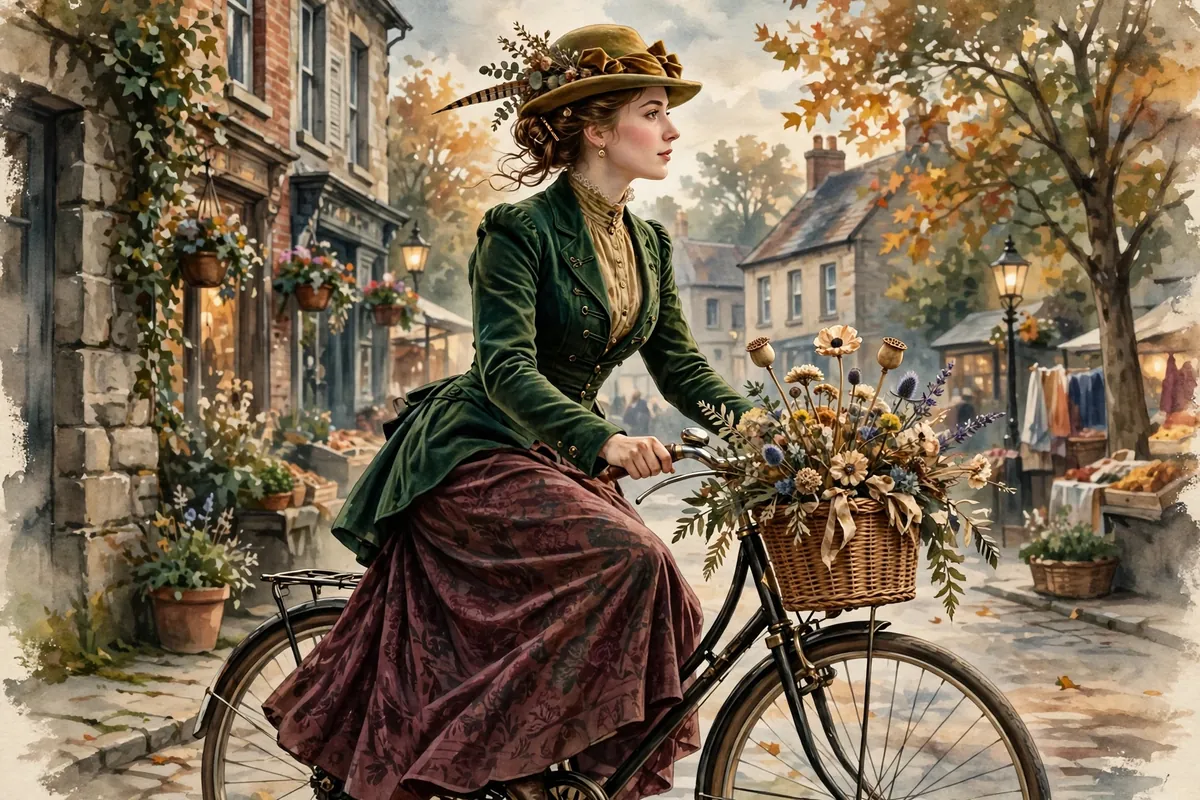
Picture a woman in the 1880s. If she wanted to go somewhere, she usually needed a carriage, a train, or a companion. Her long skirts and tight corsets made even a brisk walk a chore. Then a new machine rolled into town and changed everything.
The short answer is that the bicycle gave women freedom to move on their own. When the safety bicycle, the design we still ride today, became cheaper and more common in the late 1800s, women could suddenly travel without a chaperone or a horse. It helped loosen restrictive clothing and became a symbol of the confident "New Woman" in Britain and the United States.
A "Freedom Machine"
Suffragists and early feminists saw the bicycle as a "freedom machine." In a February 1896 newspaper interview, Susan B. Anthony said it had "done more to emancipate woman than any one thing in the world." She added that she rejoiced every time she saw a woman ride by, because it gave her "a feeling of self-reliance and independence."
Frances Willard, the president of the Woman's Christian Temperance Union, wrote a little illustrated book in 1895 about learning to ride. She even named her bicycle "Gladys" and praised it for its "gladdening effect" on her health and spirits.
Goodbye, Corsets. Hello, Bloomers.
You can't pedal well in an ankle-length skirt and a tight bodice. So the 1890s bicycle craze helped spark a movement for "rational dress." Women tried divided skirts, skirts that shortened with drawstrings, and skirts that turned into bloomers.
The bloomer outfit became the best known: full trousers gathered at the ankle, worn with a calf-length skirt and a smart jacket. At the time, it was shocking. Elizabeth Cady Stanton had a simple view: let women ride, and let each choose the outfit she prefers.
Bike makers adapted too. Women's bicycles were built with a step-through frame, with the top bar set low, so riders could get on and off gracefully in a skirt. Many bikes still use that design today.
Doctors Worried About "Bicycle Face"
Not everyone was thrilled. Some writers in the 1890s warned of a supposed condition called "bicycle face." A flushed or pale face, drawn lips, dark shadows under the eyes, and a weary expression were blamed on too much cycling, especially by women and girls. Today it sounds silly, but it shows how unsettling a woman on wheels seemed to some people.
Around the World on Two Wheels
No one captured the spirit of the age better than Annie Kopchovsky, a Latvian immigrant to the United States. On June 27, 1894, the 24-year-old set off from the Massachusetts State House on a bicycle, wearing a long skirt, a corset, and a high collar, and carrying a pearl-handled pistol.
A spring water company paid her $100 to carry its sign and use its name, so the world knew her as Annie Londonderry. She made her trip around the world in 1894 and 1895, though much of it was by ship, and she paid her way by selling advertising on her bike and her clothes. In Chicago, she picked up a new sponsor, Sterling Cycle Works, and switched to a new bicycle and more practical clothes.
So the next time you see someone pedaling down a quiet road, think of the women of the 1890s. To them, a bicycle wasn't just a way to get around. It was a ticket to independence, one turn of the pedals at a time.