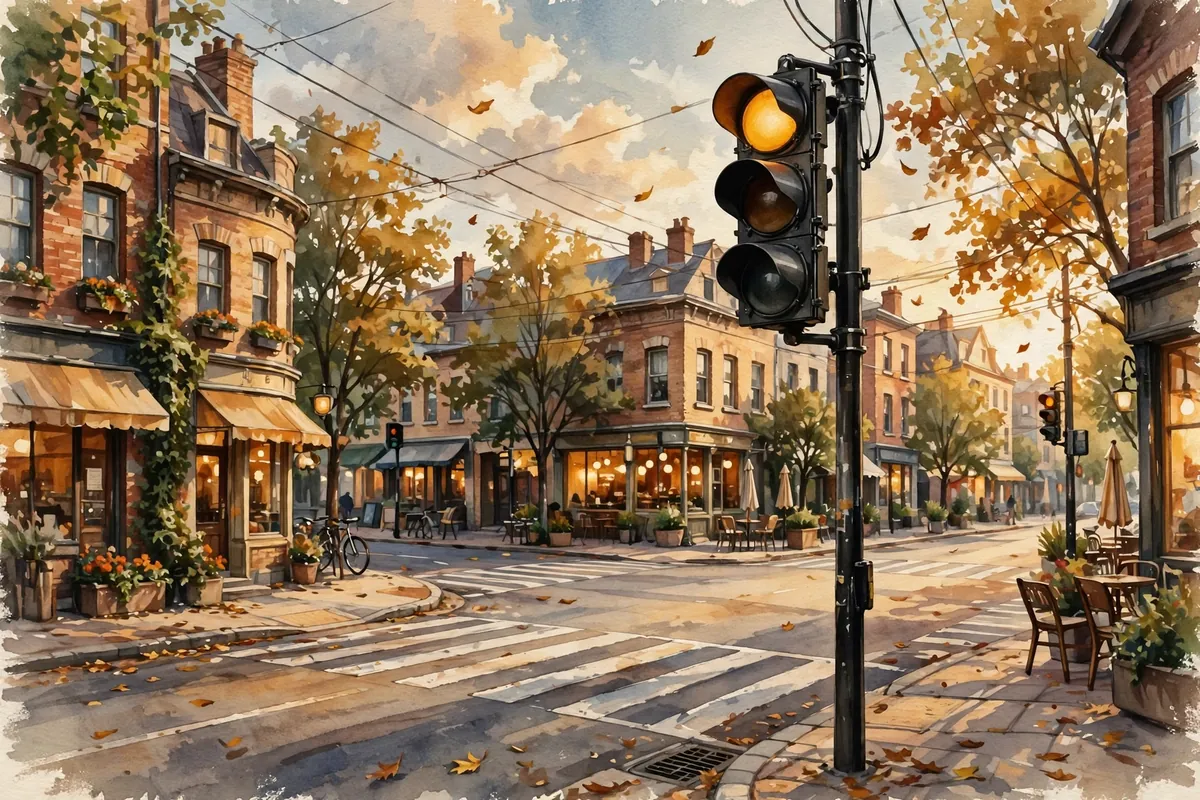
Red means stop. Green means go. Yellow means slow down, even if some drivers treat it as speed up. We learn these rules as children and follow them almost without thinking. But why these three colors? Why not blue for stop, or purple for go?
Here's the short answer. Traffic lights borrowed their colors from railway signals, which already used red for danger and green for a clear track. Red was chosen for stop largely because people everywhere associate it with danger and warning, and because it stands out sharply in daylight. Yellow, or amber, was added in 1920 as an in-between caution light. Today the three colors are set by an international agreement.
It Started With Trains
Railroads needed signals long before streets did. On British railways, a semaphore stop signal showed a red light at night when the line ahead wasn't safe, and a green light when it was clear. Interestingly, many old signals made their green by shining the yellowish flame of an oil lamp through a blue lens.
When railway manager John Peake Knight designed the world's first traffic signal in London in 1868, he based it on railway signaling. By day it used semaphore arms. At night it showed red and green gas lamps. The colors carried right over from the tracks to the street.
Why Red Means Stop
Red is the international color of stop signs and stop lights. It was chosen partly because red is one of the brightest colors in daylight, second only to orange. It also stands out clearly against a cool background of blue sky, green trees, or gray buildings.
But the biggest reason was meaning. Red has a near-universal association with danger and warning. A driver doesn't need to learn that red is serious. Most of us already feel it.
The Light in the Middle
Early electric traffic lights in America used only red and green. In 1912, Salt Lake City policeman Lester Wire developed an electric traffic light, and one was installed in Cleveland, Ohio, in 1914.
Then, in 1920, William Potts, superintendent of signals for the Detroit police, created the first four-way, three-color traffic light. His design was the first to add an amber caution light between red and green, giving drivers a warning before the light changed. The next year, Detroit installed his automatic signals in 15 towers around the city.
Yellow was a natural choice. It's the most visible color from a distance, which is why it's used for school buses and road crews. It traditionally signals caution rather than danger, and railways already used it to mean slow down.
One Language for the World
In 1968, an international agreement called the Vienna Convention on Road Signs and Signals set standards for traffic lights. It calls for red, amber, and green lights, arranged vertically with red on top, or horizontally with red on the side opposite the flow of traffic. Not every country signed it, but the colors are recognized nearly everywhere.
There's a fun twist in Japan. The lights use the same colors as everywhere else, but the go light is often called by the Japanese word for blue, aoi, because green has traditionally been considered a shade of it.
So the next time you're waiting at a red light, you're looking at a little piece of railroad history, an idea from Victorian London, and a clever upgrade from a Detroit police officer. Not bad for a few minutes of waiting.