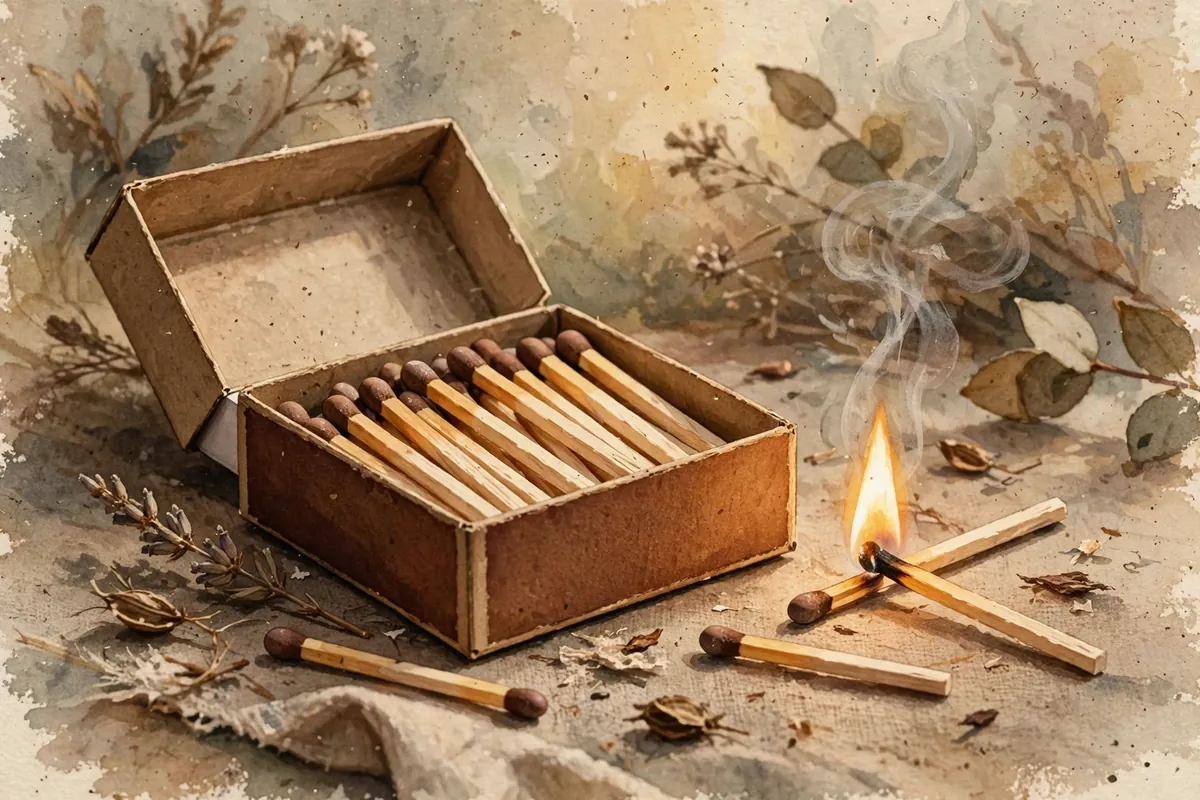
Striking a match is so simple that we hardly think about it. Scratch, flare, flame. But the little stick in your drawer is the result of nearly a century of trial and error, and some of the early versions were downright deadly.
The short answer: the first popular matches were made with white phosphorus. They could light when struck against nearly any surface, which caused accidental fires, and the chemical itself was highly toxic. Factory workers developed a terrible bone disease called phossy jaw, and one pack held enough white phosphorus to kill a person. Over time, safer chemicals and new laws replaced it.
A Happy Accident by the Hearth
The first commercially successful friction match was created by John Walker, a chemist and pharmacist in Stockton-on-Tees, England. He was mixing chemicals when a coated stick burst into flame after accidentally scraping against his hearth. His first sale was recorded on April 7, 1827.
Walker sold them as "friction lights" and never actually called them matches. He also never patented his invention. "I doubt not it will be a benefit to the public," he said, "so let them have it."
Enter White Phosphorus
Around 1830, a French chemistry student named Charles Sauria swapped in white phosphorus. The new matches lit easily on almost anything, so they had to be stored in airtight metal containers to keep them from catching fire by accident. They caught on fast. In the United States they were often called locofocos.
That easy lighting was a hazard. In London during the 1850s and 1860s, dozens of major fires broke out every year from children playing with strike-anywhere matches or from people using them carelessly.
The Horror of Phossy Jaw
The worst danger was for the people making them. Workers exposed to white phosphorus developed phossy jaw. It started with toothaches and swollen gums, then progressed to abscesses, tooth loss, and the death of the jawbone. Even worse, deaths from eating match heads became frequent. Eerily, the affected bones glowed a greenish-white in the dark.
In 1888, the women and girls at the Bryant and May match factories in London went on strike, largely over these health dangers. Activist Annie Besant wrote about their conditions, and the public donated to support them. The bad publicity pushed the industry toward change.
How Matches Got Safe
Scientists found better options. In 1850, a chemist discovered that heating white phosphorus produced a red form that didn't give off fumes. That led to the safety match, which puts red phosphorus on a special striking strip on the box instead of on the match head. In 1898, two French chemists showed that a compound called phosphorus sesquisulfide could make a strike-anywhere match that wasn't poisonous.
Then the laws caught up. Finland banned white phosphorus in matches in 1872, and an international agreement signed in Bern, Switzerland, in 1906 called for a ban. In 1910, Congress forbade shipping white phosphorus matches across state lines, and in 1913 the United States placed a tax on them so high that making them was no longer worth it. Canada banned them in 1914, and India and Japan followed in 1919.
So the next time you light a birthday candle, give a quiet thanks to the match girls who spoke up and the chemists who found a better way. That tiny flame came at a high price.