Picture a doctor's office two hundred years ago. There were no X-rays, no scans, and no fancy monitors. If a doctor wanted to hear what was going on inside a patient's chest, one of the main tools was the doctor's own ear, pressed right up against the patient's body.
That awkward method is exactly what led to the invention of the stethoscope. In 1816, French doctor René Laennec was examining a young woman with symptoms of heart disease. He wasn't comfortable placing his ear directly on her chest, and he felt the method was improper given her age and sex. So he rolled up a stack of paper into a tube, put one end on her chest and the other to his ear, and was amazed at how clearly he could hear her heart.
A Simple Trick of Sound
Laennec's idea came from a simple fact of sound that he remembered. If you scratch a pin at one end of a piece of wood, you can hear it surprisingly clearly by putting your ear to the other end. Sound travels well through solid material.
In his own words, he "was not a little surprised and pleased" to find that the paper tube let him hear the heart "in a manner much more clear and distinct" than he ever could with his ear alone. In that moment, a bit of awkwardness turned into a breakthrough.
From Paper Tube to Wooden Flute
Laennec didn't stop with rolled paper. He was also a musician who carved his own wooden flutes, and those woodworking skills helped him build a sturdier version. His first stethoscope was a simple wooden tube with a single earpiece.
He named it the stethoscope, from Greek words meaning chest and to look. In other words, a chest scope. He called the technique mediate auscultation, meaning listening through a tool placed between the patient and the doctor's ear.
His wooden tube looked a lot like the ear trumpets people of the time used as hearing aids. It was almost indistinguishable from them in both shape and function.
Two Ears Are Better Than One
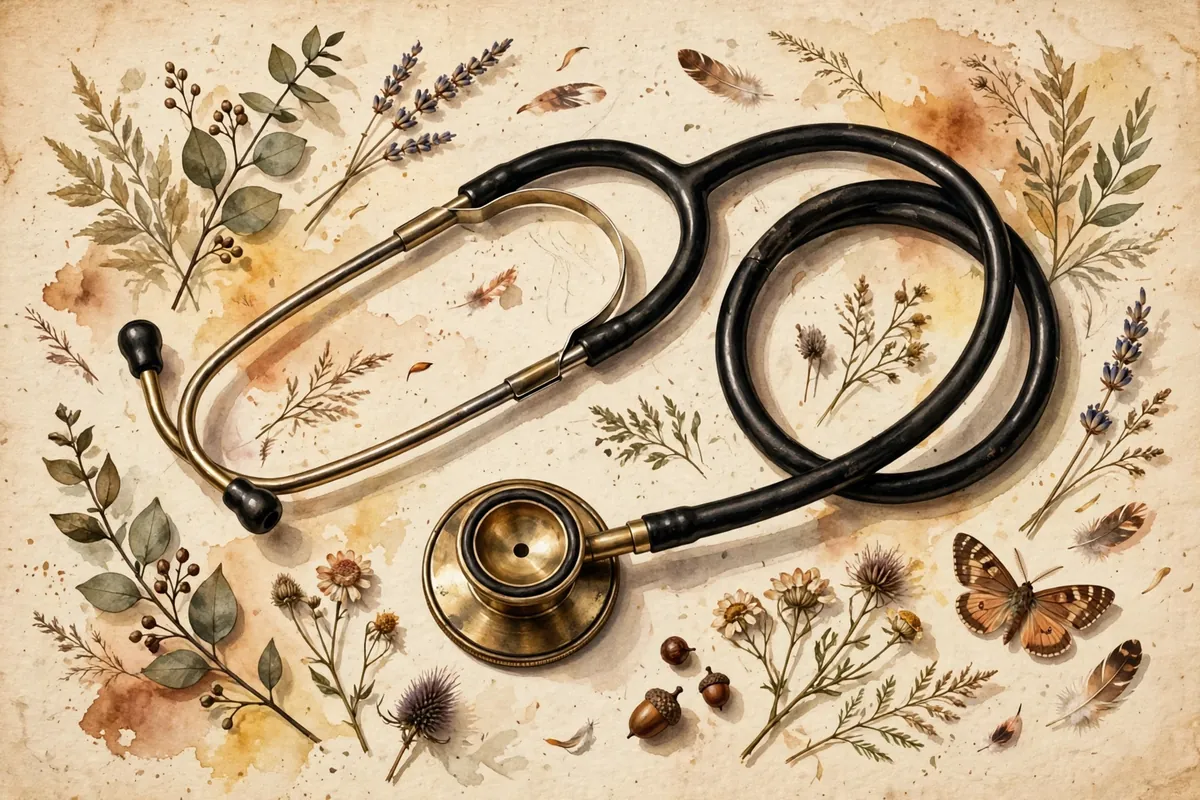
Over the following decades, other inventors improved the design. By 1840, a doctor named Golding Bird described a stethoscope with a flexible tube, though it still had just one earpiece. In 1851, Arthur Leared introduced a binaural version, meaning it used both ears, much like the ones doctors wear around their necks today.
Modern stethoscopes let doctors listen to the heart, lungs, and intestines, as well as blood flowing through arteries and veins. Paired with a blood pressure cuff, they're still used to measure blood pressure.
A Brilliant Life, Cut Short
Laennec's path to medicine wasn't straightforward. His father, a lawyer, discouraged him from becoming a doctor, and for a while he took long country walks, danced, studied Greek, and wrote poetry. In 1799 he returned to medical studies in Paris, where he was trained to use sound as a way to diagnose illness. That training set the stage for his famous idea.
Laennec went on to pioneer the use of his invention in diagnosing chest conditions. He became a professor of medicine and a lecturer at the prestigious Collège de France. Sadly, he died of tuberculosis in 1826, at just 45 years old. Tuberculosis had also taken his mother when he was a small child.
So the next time a doctor presses that cool metal disc against your chest, you can thank a polite French physician, a stack of paper, and one very awkward moment more than two centuries ago.