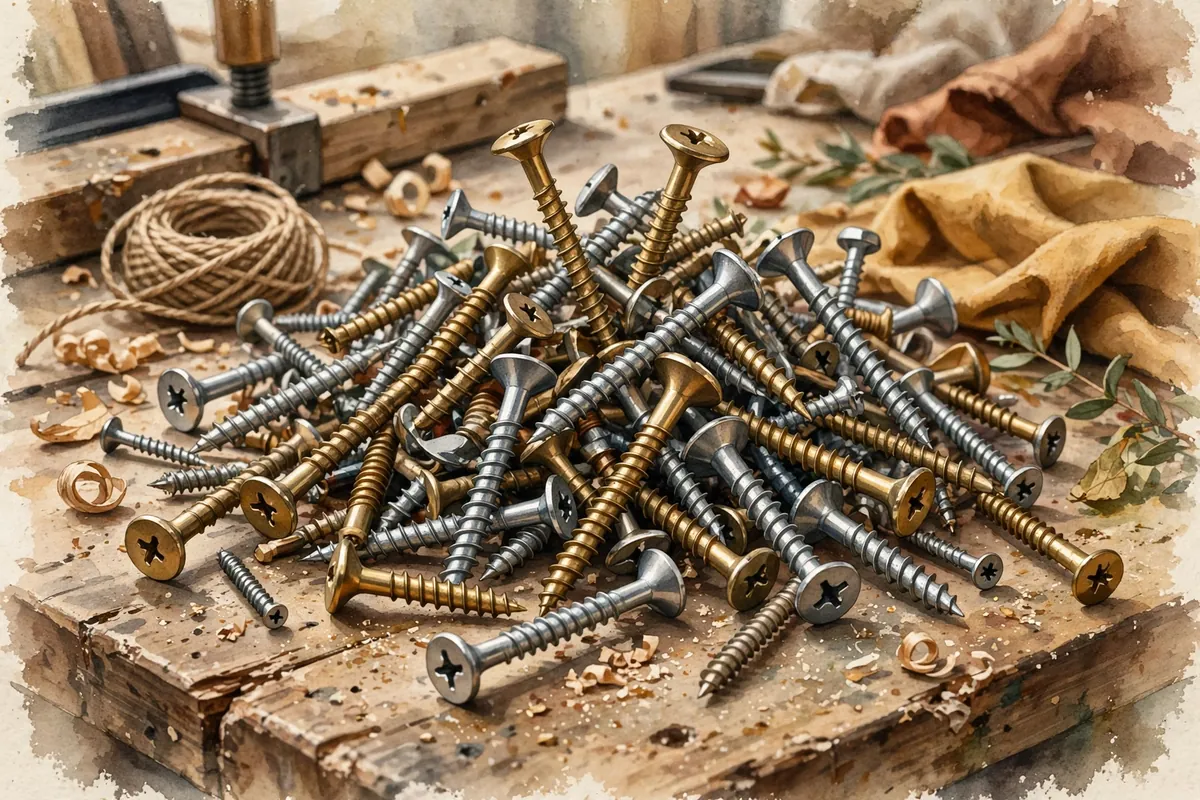
You go to tighten a loose cabinet hinge and grab a screwdriver. Wrong one. The screw has a little cross on top, not a slot. Next time, it's a square hole. Then a six-pointed star. Why can't screws just pick one shape and stick with it?
Here's the short answer. Each screw head, called a drive, was designed to solve a problem. The biggest problem is "cam-out," when the screwdriver slips out of the head as you turn it, chewing up the screw and whatever's around it. As power tools spread and jobs demanded more turning force, new shapes were invented to grip better, work faster, or even keep people out.
The Slot: Simple and Old
The single straight slot was the first screw drive ever developed. For centuries, it was the simplest and cheapest to make, since the slot can just be sawed or filed. A worn screwdriver can be reground in any workshop. Its chisel shape is so forgiving that just 9 screwdriver sizes can drive 24 sizes of slotted screws.
The trouble is power tools. A powered driver often slips out of a slot, damaging the screw and the surface around it. That's why slotted screws today mostly show up in simple carpentry, light-duty jobs, and antique restorations.
The Phillips: Built for the Assembly Line
The cross-shaped Phillips drive was created by John P. Thompson. When he couldn't interest manufacturers, he sold his design to businessman Henry F. Phillips, who formed the Phillips Screw Company, improved the design, and promoted it. The original patent dates to 1932.
The Phillips was designed to fix the slot's main headaches: slipping, the need for precise alignment, and difficulty using powered tools. Other screw makers in the 1930s first dismissed it, because the recessed cross was harder to make than a simple slot. The American Screw Company of Providence, Rhode Island, figured out how to produce it efficiently.
Watch out for its look-alike, the Pozidriv. A Phillips screwdriver will often turn a Pozidriv screw but can damage a tight one, while a Pozidriv driver will damage a Phillips screw.
The Square: Canada's Favorite
The Robertson screw has a square socket with a slight taper. That taper makes the screw cling to the screwdriver tip, so you can drive it one-handed, even if you shake it. It also resists cam-out.
Robertson screws are commonplace in Canada. Henry Ford tried them and found they saved considerable time building the Model T. But when Robertson refused to license the design, Ford worried about supply and limited their use to his Canadian division.
The Star and the Security Screw
The six-pointed star drive, best known by the brand name Torx, was developed in 1967. It was designed to transfer more turning force from the driver to the screw. It's very popular in the automotive and electronics industries because it resists cam-out and makes tool bits last longer.
Some drives exist to stop you from opening things. Security Torx has a small pin in the middle that blocks a regular bit. Tamper-resistant hex screws work the same way. Apple began using a five-pointed pentalobe screw in its products in 2009.
So that jumble of screwdrivers in your drawer isn't a conspiracy. It's a century of clever fixes, each solving a problem the last screw couldn't. Keep them all handy, and the next loose hinge won't stand a chance.