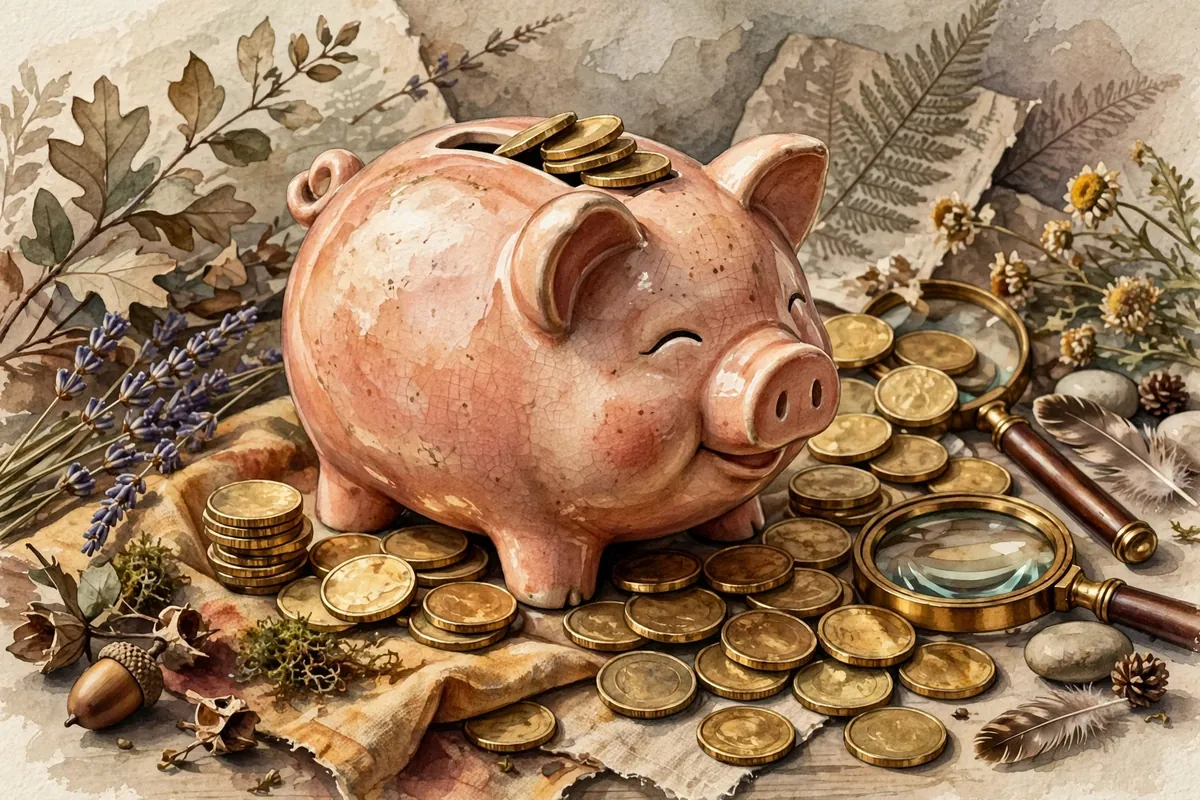
For generations, children have saved their pennies in a smiling ceramic pig. Shake it, and you can hear how much you've saved. Smash it, and you finally get to spend it. But of all the animals in the barnyard, why did a pig become the symbol of saving?
The honest answer is that nobody knows exactly how the English name piggy bank came about. But the pig shape itself is old. The earliest known pig-shaped money containers date to the 1100s on the Indonesian island of Java. In Europe, the habit may have spread from Germany, where pigs were seen as symbols of good fortune.
Money Boxes Before Pigs
People have been stashing coins in containers for a very long time. The oldest Western money box ever found comes from Priene, a Greek colony in what is now Turkey, dating to the 2nd century BC. It's shaped like a miniature Greek temple, with a coin slot in the roof.
Archaeologists have also found money boxes in the ruins of Pompeii and Herculaneum, and they turn up often at ancient sites in Roman Britain and along the Rhine River.
In England, from the 1300s to the 1600s, people used small, round, green-glazed clay pots called Tudor money boxes. They were sealed with only a narrow slot, so the only way to get the money out was to break the pot. Elizabethan theaters used them to collect ticket money.
The Boars of Java
The first known piggy banks come from Java. Archaeologists found a large number of boar-shaped coin banks at Trowulan in East Java, which may have been the capital of the Majapahit Empire. The clay pigs have slits in their backs just big enough for a coin.
The connection lives on in the language. In Javanese and modern Indonesian, the word celengan means piggy bank, money box, or savings. Its root word, celeng, means boar or pig.
Lucky Pigs in Germany
In the West, piggy banks may have caught on thanks to Germany, where pigs were treasured as symbols of good fortune. The oldest German piggy bank dates to the 1200s and was uncovered during construction work in the region of Thuringia. The pig's lucky image has stuck: many banks and financial companies still use piggy banks as logos for their savings products.
The Mystery of the Name
You may have heard a tidy story that the name comes from an old word for a kind of clay. It's a fun explanation, but it's one of several folk etymologies, and there's no clear evidence for any single origin. The earliest known uses of pig bank appear in newspaper articles from 1900, and the Oxford English Dictionary's earliest citation for piggy bank is from 1913.
Today's piggy banks come in every shape, size, and color, usually made of painted ceramic or porcelain. Many have a rubber plug underneath for getting the coins out. Others, designed to discourage spending, have no opening at all, so you have to break them to reach your savings.
Their real job hasn't changed. Coins go in easily but are hard to get out, which makes them a perfect first lesson in patience and saving. So the next time you drop a quarter into a ceramic pig, remember you're continuing a tradition that's about 800 years old.