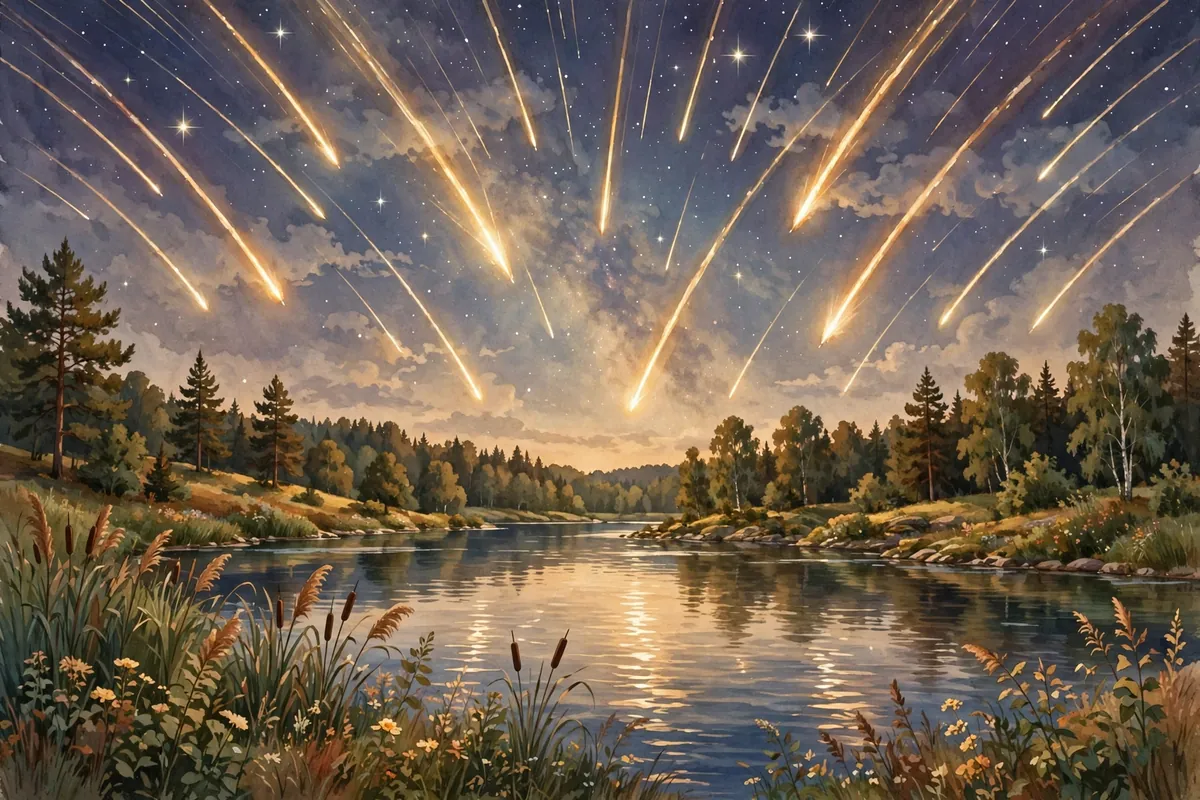
There's something magical about a summer night. The air is warm, the crickets are singing, and if you lie back on a blanket long enough, a streak of light flashes across the sky. Many of us grew up believing summer is the season for shooting stars. But is it really?
Here's the truth. Summer has one of the best-loved meteor showers of the year, the Perseids, which peak in mid-August and can produce 60 or more meteors per hour. Add warm weather that makes it easy to stay outside, and summer earns its reputation. But it doesn't actually have the most shooting stars. December's Geminids can produce up to 120 to 160 meteors an hour under ideal conditions. Summer is simply the most comfortable time to watch.
What a Shooting Star Really Is
A shooting star isn't a star at all. It's a meteor, a tiny piece of space debris called a meteoroid burning up as it slams into Earth's atmosphere at extremely high speed. Most are smaller than a grain of sand, so almost all of them disintegrate long before reaching the ground. Most Perseids burn up more than 50 miles above us.
A meteor shower happens when Earth passes through a stream of this debris. Because the particles travel in parallel paths, the meteors all seem to radiate from one point in the sky.
Comet Dust in August
The Perseids come from comet Swift–Tuttle, which circles the Sun every 133 years. As it travels, it sheds a trail of dust and particles. Every summer, Earth plows through that cloud. Most of those particles have been drifting in the cloud for about a thousand years.
The shower is visible from mid-July to late August, peaking between August 9 and 14. The meteors appear to come from the direction of the constellation Perseus, which gives them their name. Because of where Perseus sits in the sky, the Perseids are seen mainly from the Northern Hemisphere.
Some Catholics call the Perseids the 'tears of Saint Lawrence,' linked to his feast day on August 10.
When to Look
If you want to see the most meteors, set an alarm. The rate is usually highest in the hours before dawn. That's when your side of Earth is facing forward as the planet moves through space, scooping up more debris, much like a car windshield collects more bugs than the back window.
Earlier in the evening you'll see fewer, but some of them skim the atmosphere and leave long, bright trails. Now and then, one even becomes a dazzling fireball.
The Winter Rival and a Big Year Ahead
The Geminids peak around December 14 and are unusual: they come from an asteroid called 3200 Phaethon rather than a comet. They were first observed in 1862, while records of the Perseids go back to 36 AD.
The Perseids have their own big moments. When comet Swift–Tuttle swung back near Earth in 1992, observers saw outbursts of several hundred meteors per hour. One astronomer has calculated that Earth could hit an extra-thick patch of debris in 2028, possibly producing a Perseid meteor storm on the night of August 11 to 12.
So go ahead and enjoy those warm August nights under the stars. Just don't forget the bundled-up December show. Shooting stars, it turns out, are a year-round gift.