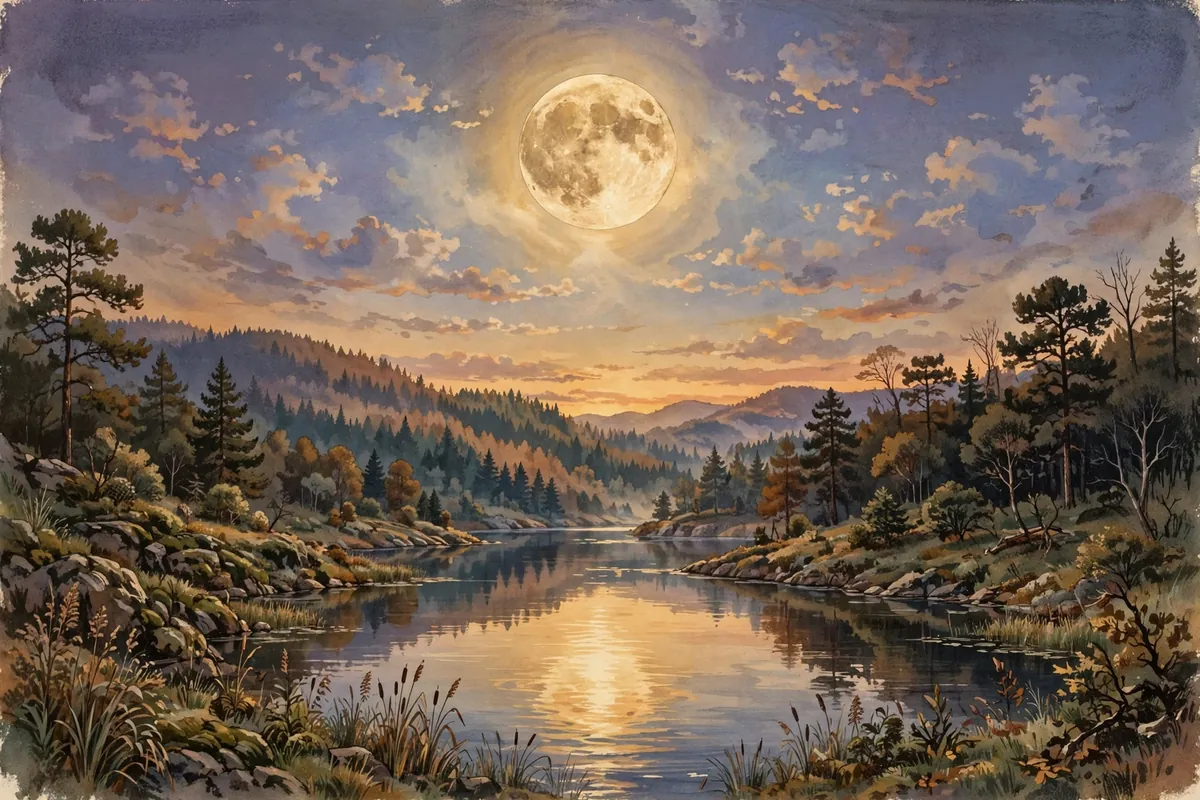
Your great-great-grandparents looked up at the same Moon you see tonight, and they saw the very same face. The same dark patches, the same craters, the same familiar "man in the Moon." It never turns to show us its back. So is the Moon simply not spinning?
The short answer is that the Moon does spin, but it turns once on its axis in exactly the same time it takes to orbit Earth once. That keeps one side pointed at us all the time. Scientists call this tidal locking, and it's the result of Earth's gravity tugging on the Moon over a very long time until its spin settled into step with its orbit.
How Gravity Put on the Brakes
Earth's gravity pulls harder on the side of the Moon that's closer to us and less on the far side. That difference stretches the Moon very slightly along the line pointing toward Earth, creating what are called tidal bulges.
Long ago, when the Moon spun at a different rate, those bulges couldn't stay lined up with Earth. The Moon's rock takes time to reshape, so the bulges were always being carried a little out of line. Earth's gravity tugged on those off-center bulges, creating a twisting force that gradually changed the Moon's spin. Eventually, the spin matched the orbit, and the tug-of-war stopped. The Moon was locked.
We Actually See a Bit More Than Half
Here's a neat wrinkle. The Moon's orbit isn't a perfect circle, so it wobbles slightly from our point of view. This gentle rocking, called libration, lets us peek around the edges. Over time, about 59 percent of the Moon's surface can be seen from Earth.
That still left most of the far side hidden. Nobody had ever seen it until October 7, 1959, when the Soviet probe Luna 3 swung around the Moon and took the first photographs of it. The first people to see the far side with their own eyes were the Apollo 8 astronauts, who orbited the Moon in December 1968.
The Dark Side Isn't Dark
The far side is often called the dark side of the Moon, but that's a misunderstanding. "Dark" here originally meant unseen, not unlit. Both sides get about the same amount of sunlight on average. When we see a new moon, the far side is actually bathed in sunshine.
The two sides also look surprisingly different. The far side is rugged and covered in craters, with few of the dark, flat plains called maria that shape the familiar face we see. It even reflects more light than the near side. In January 2019, China's Chang'e 4 spacecraft made the first landing on the far side.
Earth Is Slowing Down Too
The locking works both ways. The Moon's gravity is slowly slowing Earth's spin as well. Scientists estimate that, together with the Sun's influence, this has helped stretch Earth's day from about 6 hours long in the distant past to 24 hours today. Atomic clocks show our day is still getting longer by about 2.3 thousandths of a second per century.
The Moon isn't unusual, either. Pluto and its moon Charon are locked to each other, each always showing the other the same face. So the next time you gaze up at that familiar lunar face, you'll know it isn't shy. It has simply been holding the same pose for us for a very, very long time.