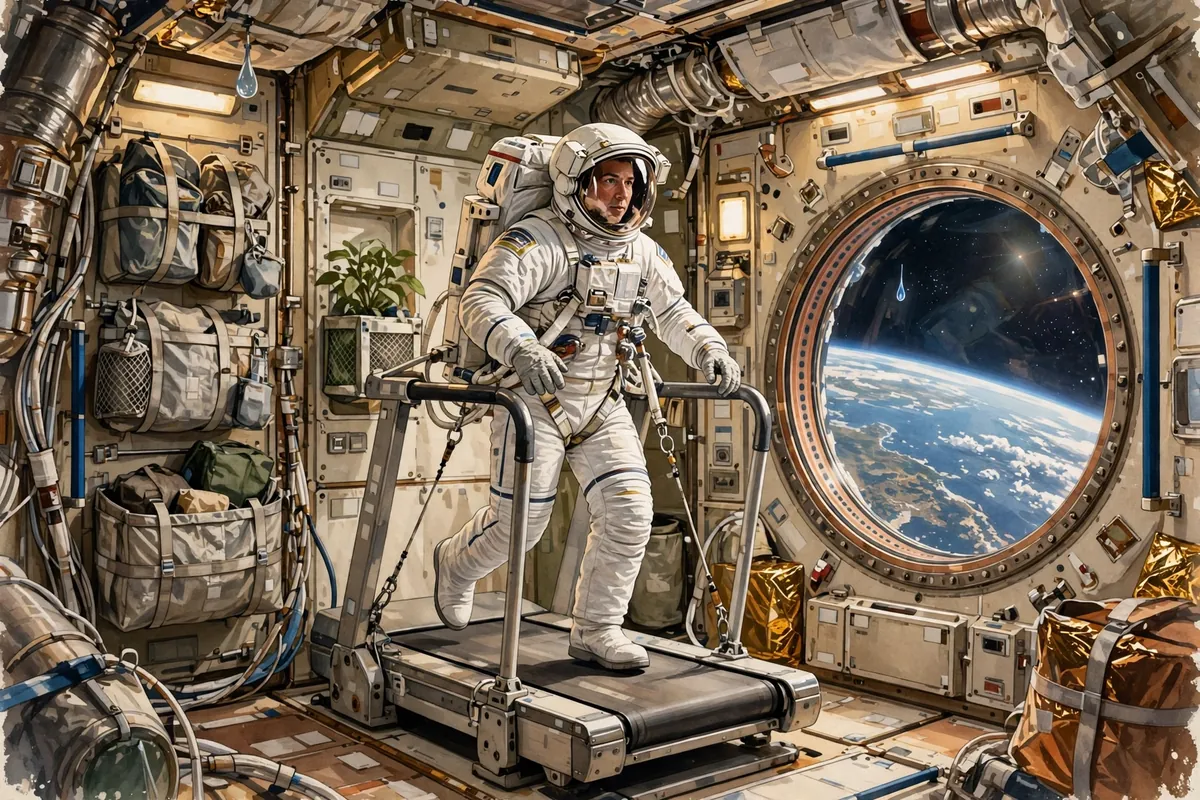
Floating around a space station sounds wonderfully relaxing. No heavy lifting, no climbing stairs, no gravity pulling you down. But that easy life comes with a serious catch, and it's why astronauts spend a big chunk of every day working out.
Here's the short answer. In weightlessness, muscles and bones barely have to work, so they weaken quickly. To fight that, each astronaut on the International Space Station exercises for at least two hours a day. They use treadmills with bungee-cord harnesses, a special weightlifting machine that uses vacuum cylinders instead of heavy weights, and a stationary bicycle.
Why Exercise Matters So Much
On Earth, our leg and back muscles work constantly just to hold us upright. In orbit, they get almost no use, so they start to weaken and shrink. Without regular exercise, astronauts can lose up to 20 percent of their muscle mass in just 5 to 11 days.
Bones suffer too. Normally, bone builds up in the directions where it carries stress. With almost no stress in space, astronauts lose bone at about 1 to 1.5 percent a month, especially in the lower spine, hips, and thighs. That's a far faster loss than healthy adults experience on the ground.
Running While Strapped Down
Running on a treadmill in space comes with an obvious problem: one good stride and you'd float right off. So astronauts use bungee cords to strap themselves to the treadmill, keeping their feet in contact with the belt.
There's another challenge. Pounding feet could shake the station and disturb delicate science experiments. That's why the station's treadmills are designed with vibration isolation systems. One goal is to put Earth-like loads on the legs without rattling the rest of the station. The design was first tested on a space shuttle mission, STS-81, where three crew members ran and walked on it for more than two hours in total.
A Treadmill Named Colbert
In 2009, NASA held an online poll to name a new station module. Comedian Stephen Colbert urged viewers of his TV show to vote for the name Colbert, and it got the most votes.
NASA found a clever compromise. It named the module Tranquility and gave Colbert's name to a new treadmill instead. Officially, it's the Combined Operational Load Bearing External Resistance Treadmill, which just happens to spell COLBERT.
Lifting Weights With No Weight
Dumbbells are useless when everything floats. So NASA designed the Advanced Resistive Exercise Device, or ARED, installed on the station in 2009. Instead of iron plates, it uses vacuum cylinders and a flywheel system to create resistance, mimicking free weights.
Astronauts use it for squats, deadlifts, and calf raises, which are especially good at protecting the lower body. It can deliver up to 600 pounds of force for bar exercises, double the capacity of the earlier device it replaced.
Even with all this effort, long missions take a toll. Astronauts can still lose around 15 percent of their overall muscle mass on a long mission, and up to 30 percent in the lower body. Researchers continue to study better exercise routines, as well as possible medications and hormone treatments.
So the next time you skip a workout, think of the astronauts strapping into their bungee harnesses hundreds of miles above Earth. In space, staying fit isn't just good for you. It's part of the job.