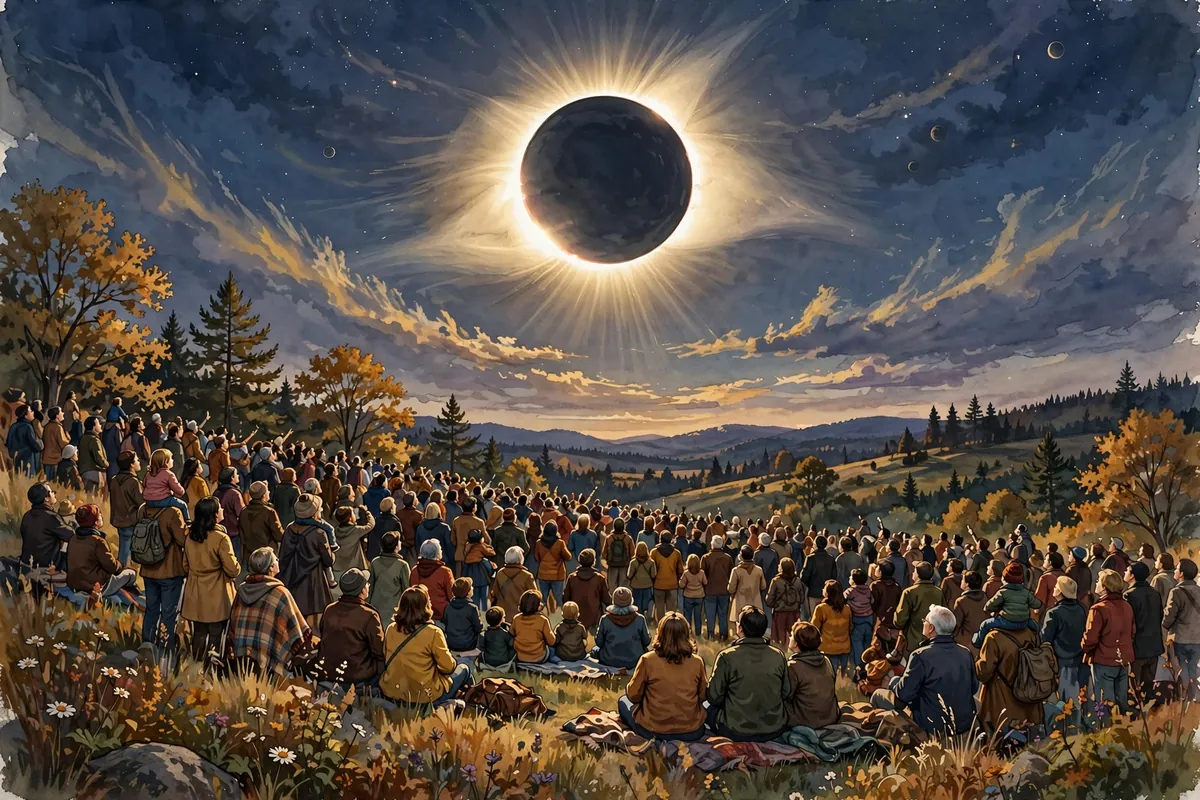
If you've ever stood under a total solar eclipse, you know it doesn't feel like a normal day. The sky darkens in the middle of the afternoon, the air cools, and a pale glowing ring appears where the Sun used to be. It feels almost magical. So how does it actually work?
A solar eclipse happens when the Moon passes directly between Earth and the Sun, blocking the Sun's light from a small part of our planet. It's total when the Moon covers the Sun's entire disk. That's only possible because of a remarkable coincidence: the Sun is about 400 times wider than the Moon, but also about 400 times farther away, so the two look nearly the same size in our sky.
Why It Doesn't Happen Every Month
The Moon passes between Earth and the Sun every month at new moon. So why don't we get an eclipse every month? The answer is a tilt. The Moon's orbit is tipped just over 5 degrees compared with Earth's path around the Sun. Most months, the new moon slips just above or below the Sun from our point of view.
An eclipse can only happen when a new moon lines up near one of the two points where those paths cross. That alignment comes around roughly every six months, during what astronomers call eclipse season.
Total, Annular, or Partial
The Moon's shadow has two parts. The dark inner shadow, called the umbra, is where the Sun is completely hidden. Only people standing in that small spot see a total eclipse. The umbra is typically just 60 to 100 miles wide, and the narrow track it traces across Earth is called the path of totality. Outside that path, people see a partial eclipse.
The Moon's orbit is also slightly oval, so its distance from Earth changes. When it's farther away, it looks a bit too small to cover the Sun completely. Then you get an annular eclipse, with a bright ring of sunlight left around the Moon's dark edge.
A Few Precious Minutes
Totality never lasts long, because the Moon's shadow races across Earth at more than 1,100 miles per hour. Right now, totality can never last more than about 7 minutes and 32 seconds. The longest eclipse calculated so far will happen on July 16, 2186, at 7 minutes 29 seconds.
In 1973, a team of observers found a clever workaround. They flew aboard a supersonic Concorde jet, chasing the Moon's shadow, and stretched totality to about 74 minutes.
Total eclipses happen somewhere on Earth about every 18 months on average. But any single spot only sees one roughly every 360 to 410 years. That's why people travel so far to stand in the path.
What You'll See, and How to Stay Safe
During totality, the Sun's faint outer atmosphere, the corona, becomes visible as a glowing halo. Just before and after, rippling "shadow bands" may flicker across the ground like light on the bottom of a swimming pool. Under trees, gaps between leaves act like pinholes and project dozens of tiny crescent suns.
Looking directly at the bright Sun, even for a few seconds, can permanently damage your eyes, and you won't feel it happening. Use proper eclipse viewers, or project the Sun's image through a pinhole onto paper. Even a kitchen colander works.
So the next time an eclipse comes to your area, it's worth stepping outside. You'll be witnessing a perfect fit between two objects that are wildly different in size, a coincidence that makes our planet's sky truly special.