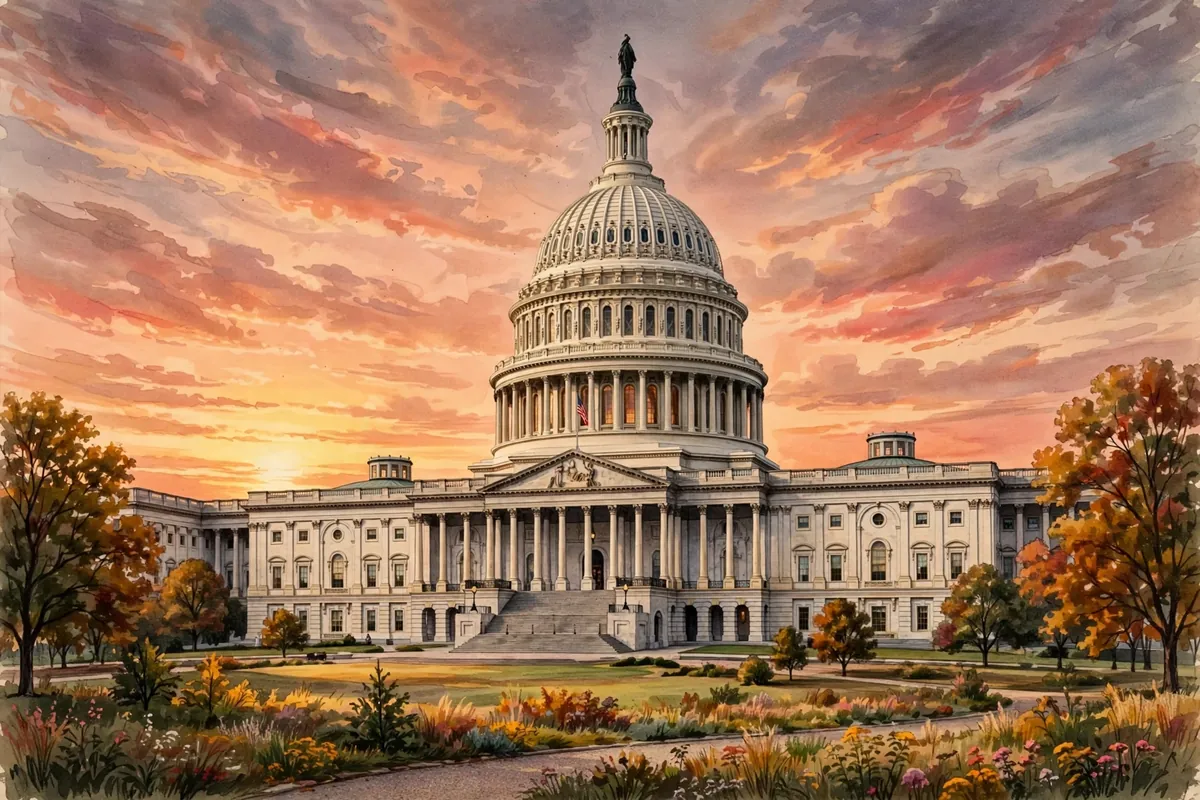
Washington, D.C. has a mayor, neighborhoods, sports teams, and hundreds of thousands of residents. It looks and acts a lot like any big American city. But it doesn't belong to Maryland or Virginia, and it isn't the 51st state either. So why does the nation's capital stand apart from all 50 states?
The short answer is that the Founders designed it that way. The Constitution calls for a federal district under the exclusive control of Congress, separate from any state. The idea was that the national government shouldn't have to depend on any single state for its safety or its operation. Whether D.C. could become a state today is still debated.
The Mutiny That Spooked Congress
A big reason goes back to 1783. In June of that year, as many as 400 Continental Army soldiers, angry that they hadn't been paid for their service in the Revolutionary War, mobbed the State House in Philadelphia where Congress met. Pennsylvania's leaders refused to step in and stop them. Congress left the city and moved temporarily to Princeton, New Jersey. The episode made clear that a national government relying on a state for protection could be left vulnerable.
In 1788, James Madison argued in Federalist No. 43 that the new federal government would need authority over its own capital to provide for its maintenance and safety. The Constitution's District Clause made that possible, allowing a federal district of up to 100 square miles.
Building a Capital From Scratch
On July 16, 1790, President George Washington signed the Residence Act, which approved a capital along the Potomac River. He was given the job of choosing the exact spot. Maryland and Virginia donated land, and the district started as a square measuring 10 miles on each side.
In 1800, the government moved in. Congress began meeting in the unfinished Capitol, and President John Adams moved into the newly finished White House. The city itself was designed in 1791 by Pierre Charles L'Enfant, and it's still divided into four quadrants that meet at the Capitol.
The district later shrank. In 1846, Congress returned the land Virginia had given, including the city of Alexandria. That's why D.C. no longer looks like a perfect square on the map.
What Residents Have, and Don't Have
Being outside any state came with a cost from the very start. Once the Organic Act of 1801 placed the district under Congress, its residents lost voting representation in Congress and in the Electoral College. Some residents protested right away, comparing their situation to the taxation without representation they had complained of under Britain.
Some things have changed since then. Thanks to the Twenty-third Amendment, passed in 1961, D.C. voters choose three presidential electors. A locally elected mayor and council have governed the city since 1973, though Congress can still overturn local laws. Residents elect a single non-voting delegate to the House of Representatives.
The Statehood Debate
Since the 1980s, the push for D.C. statehood has grown. In a 2016 referendum, 85 percent of D.C. voters supported becoming the 51st state, and the House of Representatives passed a statehood bill in 2021, though it stalled in the Senate. Supporters and opponents still disagree about whether it could be done by an act of Congress or would need a constitutional amendment.
Whatever the future holds, the reason D.C. stands apart goes back to a nervous young Congress in 1783. The next time you see a D.C. license plate reading "End Taxation Without Representation," you'll know the centuries-old story behind it.