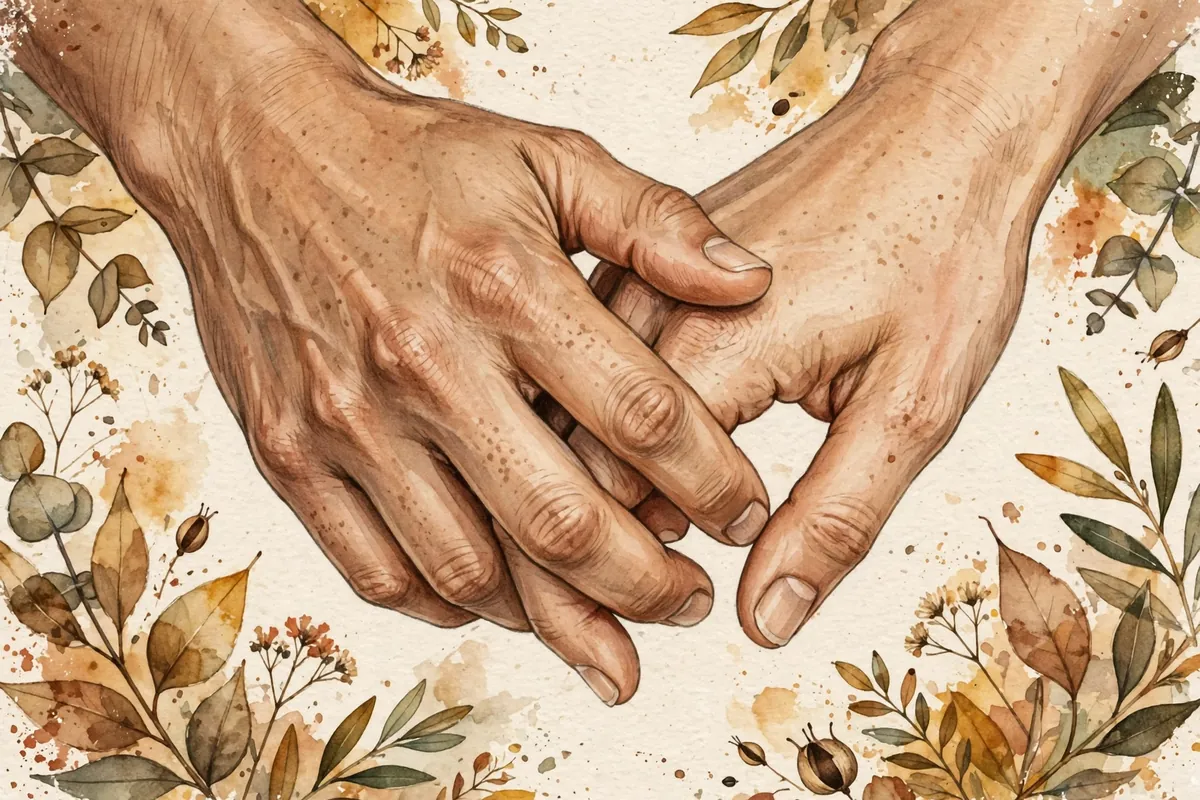
You lace your fingers together, push your palms out, and there it is: a satisfying row of pops. Some people love that feeling. Others can't stand to hear it. Either way, most of us have wondered what is actually making that noise.
The short answer is gas bubbles. Your knuckles are surrounded by a slippery liquid called synovial fluid, which has gases dissolved in it. When you stretch or bend the joint, the pressure inside drops suddenly, and some of that gas forms a bubble. The pop is linked to that bubble, not to bones rubbing or snapping.
What Happens Inside the Joint
Each knuckle is a joint where two bones meet inside a sealed capsule filled with that fluid. It's a bit like a soda bottle. As long as the cap is on, the gas stays dissolved. When the pressure drops, bubbles appear.
Cracking your knuckles pulls the joint surfaces apart and lowers the pressure inside the capsule very quickly. Gases that are naturally dissolved in the fluid, thought to be mainly carbon dioxide, oxygen, and nitrogen, come out of solution and form a bubble. Scientists call this process cavitation.
Scientists Are Still Arguing About the Pop
For decades, researchers weren't sure what made the sound. Ideas included stretching ligaments and breaking tiny bits of tissue inside the joint. The bubble explanation gained the most support, but there was still a debate over exactly when the noise happens.
The classic view was that the pop comes from the bubble collapsing. Then in 2015, research found that bubbles were still in the fluid after a joint cracked, suggesting the sound happens when the bubble forms instead. In 2018, a team in France used a mathematical simulation and concluded that the sound comes from bubbles collapsing after all, with only part of each bubble collapsing. Because that was a computer model rather than a physical experiment, many scientists aren't convinced yet.
So the honest answer is that gas bubbles are at the heart of it, and the finer details are still being worked out.
Why You Can't Crack the Same Knuckle Twice
If you've ever tried to crack the same knuckle again right away, you know it doesn't work. After the pop, the joint enters what's called a refractory period. It takes about 20 minutes for the gases to slowly dissolve back into the fluid.
Once that happens, the joint is ready to make another bubble, and another pop. Some research also suggests that people with looser ligaments may find it easier to crack their joints.
Does It Cause Arthritis?
Many of us grew up hearing that cracking your knuckles leads to arthritis. There's no scientific evidence for that old warning. A 2011 study looked at hand X-rays of 215 people between 50 and 89 years old and found knuckle cracking didn't cause hand osteoarthritis, no matter how long or how often people did it. Some critics noted the study couldn't rule out every other factor.
One American doctor, Donald Unger, ran a very personal experiment. For more than 50 years he cracked the knuckles on his left hand every day but not his right. Neither hand developed arthritis. He published the results in 2004 and won the 2009 Ig Nobel Prize in Medicine, a tongue-in-cheek award for research that makes people laugh, then think.
So go ahead and enjoy your morning stretch, pops and all. If a joint ever hurts or swells when it cracks, though, that's a different story, so talk to your doctor.