Watch an owl for a minute and it will do something that makes you wince. Its body stays perfectly still, and then its face slowly swings around until it's looking almost straight behind it. Try that yourself and you'll get about halfway before your neck protests.
Here's the short answer. Owls can't move their eyes, so they move their heads instead, and they're built for it. An owl can swivel its head roughly 270 degrees in either direction, thanks to a neck with twice as many bones as ours and blood vessels designed not to get pinched.
Eyes That Can't Roll
Owls have enormous eyes for the size of their skulls. To fit eyes that big into a small head, the eyes evolved into a long tube shape rather than a ball. They sit locked inside bony tubes, so an owl can't roll its eyes to the side the way we can.
That's where the flexible neck comes in. If you can't glance sideways, you need to turn your whole head. Owls also have forward-facing eyes, more frontally placed than any other group of birds, which gives them great depth perception for hunting in low light but a narrower view of the world. A swiveling head makes up for it.
Fourteen Bones Where We Have Seven
Humans have seven vertebrae in the neck. Owls have 14. More bones means more joints, and more joints means a lot more bend and twist spread along the neck.
But flexible bones are only half the trick. Twisting a neck that far would normally squeeze the arteries that feed the brain. Owls have several adaptations that keep the blood flowing while they turn.
The Plumbing Is the Real Secret
In owls, the small openings in the neck bones that the arteries pass through are about ten times wider than the arteries themselves. In humans, those openings are about the same size as the artery. That extra room gives the vessels space to move instead of getting pinched.
The arteries also enter the neck bones higher up than in other birds, which leaves them some slack. And the main arteries join in a very large junction, the largest of any bird's, so blood can keep reaching the brain even while the neck is twisted. Extra connections between other arteries back this up.
It's a bit like having a garden hose with plenty of loose length and a few backup lines. Twist it, and the water still gets through.
Not Quite All the Way Around
Cartoons sometimes show owls spinning their heads in a full circle. That part is a myth. About 270 degrees is the limit, which is three quarters of a full turn. Because an owl can turn that far in either direction, though, it can still easily see what's directly behind it.
Keeping the body still has a bonus. Less movement means less noise, which helps an owl stay hidden while it waits for a mouse to give itself away.
Built for Silent Hunting
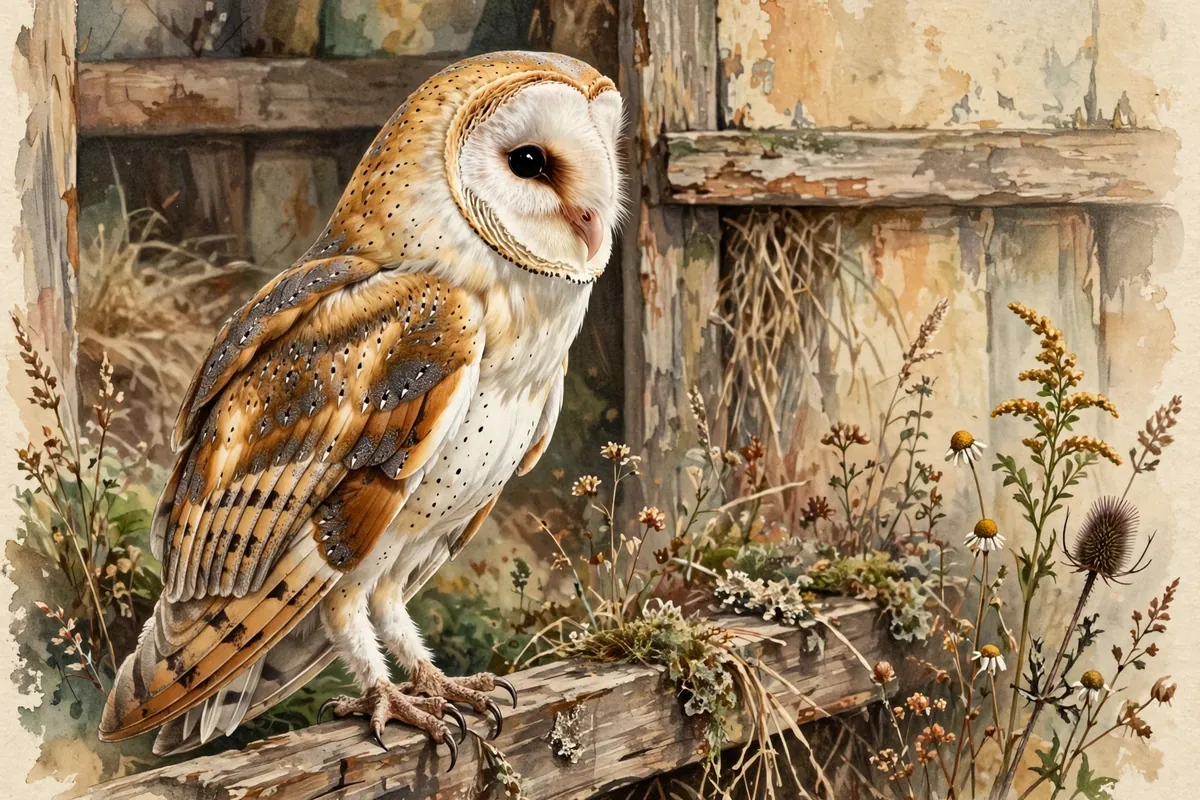
The swiveling head works together with some of the best hearing in the bird world. In some owls, like barn owls, the ear openings sit at slightly different heights on the skull. A sound reaches one ear a tiny fraction of a second before the other, and the owl turns its head until the sound arrives at both ears at once. Then it's facing its target.
Their feathers help too. Owl flight feathers have soft, comb-like edges and a velvety surface that muffle the sound of flapping, so prey often doesn't hear them coming.
So the next time an owl gives you that slow over-the-shoulder stare, you can admire the engineering behind it. Fourteen neck bones, roomy arteries, and backup blood lines all add up to one very impressive look.