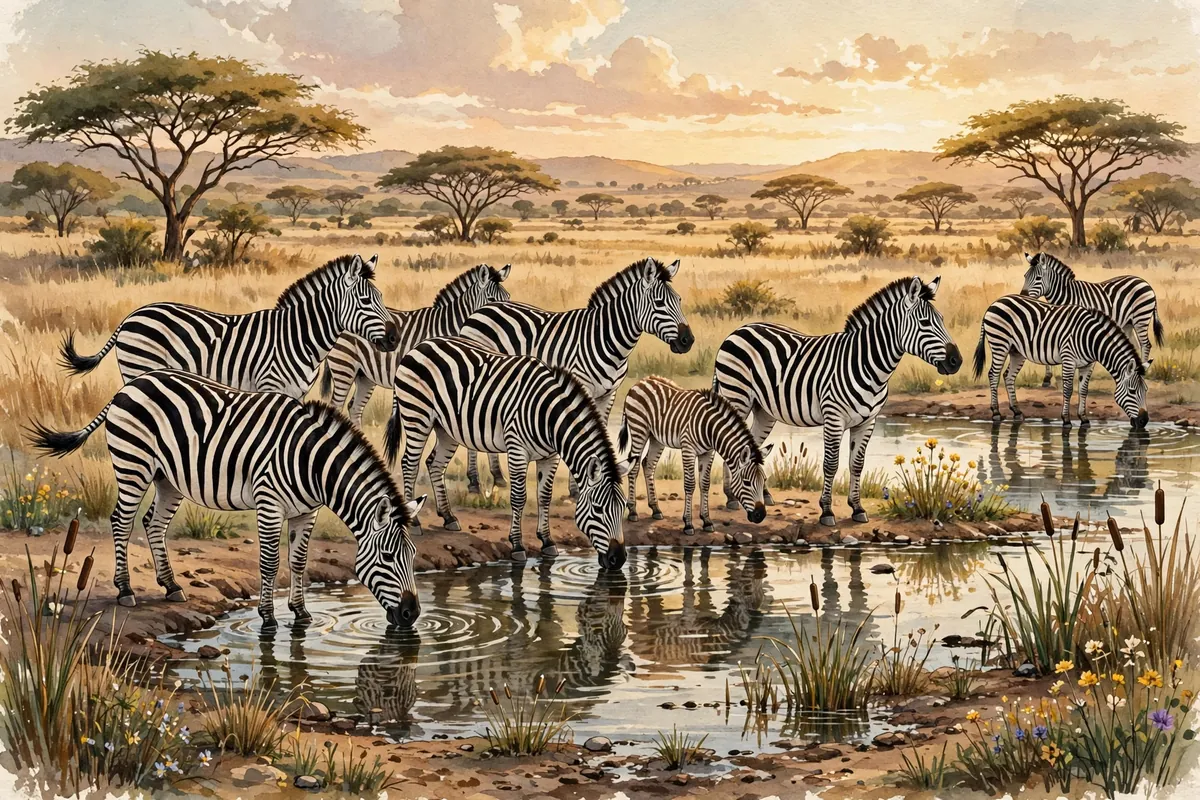
Few animals are as easy to recognize as a zebra. Those bold black-and-white stripes make it stand out on the open grassland like a barcode on a box. Which raises an obvious question: why would an animal that lions love to eat wear the loudest outfit on the savanna?
The short answer is that scientists still aren't completely sure, but one idea has pulled ahead. Most of the evidence suggests the stripes help keep biting flies away. Zebras live where horse flies and tsetse flies are common, and those insects seem to have real trouble landing on a striped coat.
The Fly Theory Takes the Lead
The idea goes back further than you might think. In 1930, a biologist named R. Harris noticed that flies preferred landing on solid-colored surfaces over black-and-white striped ones. Decades later, in 1981, researchers suggested this might be what zebra stripes are for.
Later work added weight to it. A 2014 study found that striping lines up with where horse flies and tsetse flies are found. Then in 2019, Tim Caro and colleagues watched captive zebras and horses side by side. The stripes didn't scare flies off from a distance, but they did stop flies from landing, both on zebras and on horses dressed in zebra-print coats.
That matters, because horse flies can spread diseases that are deadly to members of the horse family. Zebra hair is also about as long as these flies' mouthparts, so a short coat isn't much of a shield on its own.
Nobody Knows Exactly How It Works
Here's where it gets murky. One 2012 study suggested stripes scramble the polarized light that flies use to find water, but later studies disputed that. Stripes don't seem to work like a spinning barber pole either, since checkered patterns also repel flies.
Newer ideas are still being tested. One team suggested that in sunlight, the warmer dark stripes and cooler white stripes hide the warm blood vessels underneath. Another concluded that the sharp contrast and thin stripes make it hard for a fly to pick a landing spot. Even a 2025 review that called the fly idea the best-supported warned that it doesn't explain why other African grazers never evolved stripes.
The Ideas That Didn't Hold Up as Well
The oldest theory was camouflage. But zebras graze in the open, they're noisy and social, and they don't freeze when a predator is near. A 2016 study found lions and hyenas can't even make out the stripes from a distance, so the pattern doesn't help a zebra blend in on the plains.
Another popular idea is that a running herd of stripes confuses predators. Yet lions seem to have little trouble catching zebras, usually by ambush at close range. A cooling theory has had mixed results too. One experiment wrapped water-filled metal barrels in horse, zebra, and cattle hides and found the stripes made no difference to temperature.
Even Charles Darwin weighed in. In 1871 he wrote about the stripes possibly playing a role in attracting mates. Alfred Russel Wallace, his fellow naturalist, thought they might help zebras recognize one another. Researchers since then haven't found much support for either idea.
Black Skin, Unique Patterns
Here's a twist. A zebra's coat looks like white with black stripes, and the pale belly and legs back that up. But underneath, the zebra's skin is actually black.
Every zebra's pattern is also one of a kind, a bit like a fingerprint, and the pattern is passed down in families. Foals are born brown and white, and the brown darkens as they grow. Unusual zebras turn up too, including spotted ones and pale, blond-striped albinos recorded in the forests of Mount Kenya.
So the next time you see a zebra, think of those stripes as a high-contrast bug shield, at least according to the best guess we have today. It's a good reminder that some of nature's most famous designs still hold a few secrets.