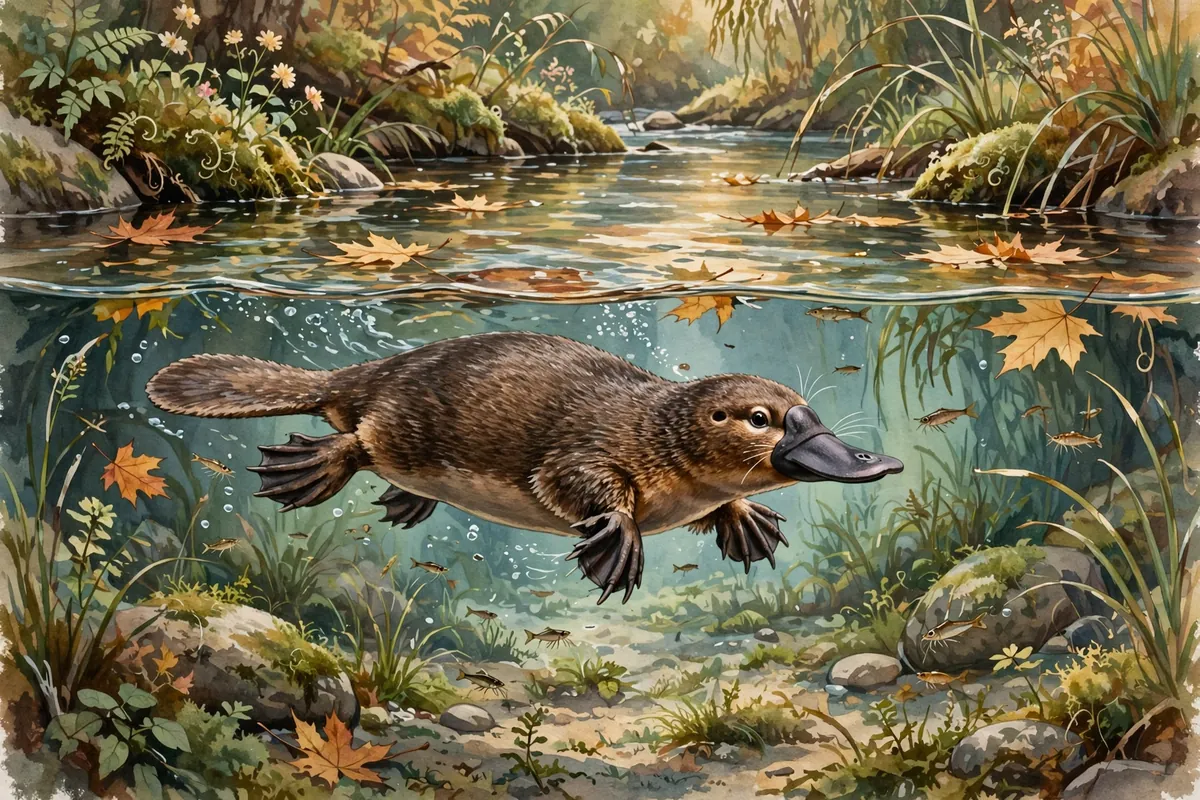
Mammals are supposed to follow a simple rule. They have fur, they feed their babies milk, and they give birth to live young. Then along comes a furry little animal from Australia with a bill like a duck, a tail like a beaver, and a habit of laying eggs.
That animal is the platypus, a semiaquatic mammal found in eastern Australia, including Tasmania. It belongs to a tiny group called monotremes, the only living mammals that lay eggs instead of giving birth. The platypus isn't alone, though. Its four cousins, the echidnas, lay eggs too.
The Animal Nobody Believed
When European scientists first examined a preserved platypus in 1799, they decided it was a fake. They judged it to be several animals sewn together, the kind of trick a prankster might pull.
Even after people accepted the platypus was real, the egg part was hard to swallow. Early European naturalists simply didn't believe the female laid eggs. It took until 1884 for William Hay Caldwell to confirm it.
How a Platypus Mom Does It
A female platypus retreats into a nesting burrow made of grass, which can stretch as long as 30 meters, or about 98 feet. There she normally lays two small, leathery eggs, each about 17 millimeters long, a little under three-quarters of an inch.
The eggs spend about 28 days developing inside her before they're laid. Then she curls her body around them for roughly ten more days of incubation. The babies that hatch are blind and hairless.
Here's where the platypus proves it's a true mammal. The mother feeds her young milk. But she has no teats. Instead, the milk comes out through pores in her skin, and the babies lap it up from her fur. They drink milk for around four months.
The Echidna's Built-In Pocket
Echidnas, the spiny cousins of the platypus, have their own version. A female echidna lays a single soft, leathery egg and places it directly into her pouch. The egg weighs only about 1.5 to 2 grams.
After about ten days, the baby opens the shell using a reptile-like egg tooth. A baby echidna is called a puggle. It stays in the pouch for 45 to 55 days, drinking milk from patches of skin, until it starts to grow spines.
A Sixth Sense and a Venomous Kick
Laying eggs is only the start of the platypus's surprises. When it dives, it closes its eyes, ears, and nose. It finds food using electrolocation, sensing the tiny electric currents made by the muscles of its prey.
Its bill holds about 40,000 of these electric sensors arranged in rows. In experiments, a platypus even reacted to an artificial shrimp when a small electric current was passed through it.
The male also packs a weapon. He has a spur on each hind foot that delivers an extremely painful venom, making the platypus one of the few venomous mammals in the world.
A Living Link to the Past
Scientists study the platypus closely because its family split off very early from other mammals. Its genetic code, first published in draft form in 2008, contains both reptile-like and mammal-like elements. It even has genes linked to egg-laying that it shares with birds.
So the platypus isn't a mistake or a mash-up. It's a reminder that nature doesn't always stick to the rules we write for it. Sometimes a mammal lays an egg, and the world is a little more wonderful for it.