Imagine walking through a quiet forest in southeastern Australia. Birds are chirping, leaves are rustling, and then, out of nowhere, you hear the whine of a chainsaw. You look around for a logging crew, but there's nobody there. Just a brown bird scratching around on the forest floor.
That bird is a lyrebird, and yes, lyrebirds really have been recorded imitating chainsaws. They're among the most gifted mimics on the planet. Along with the songs of other birds, they have copied car alarms, camera shutters, crying babies, and mobile-phone ring tones. But there's a twist: experts say these human-made sounds get far more attention than they deserve. Most of the time, a lyrebird is imitating nature.
A Living Sound Recorder
There are two species of lyrebird, the superb lyrebird and Albert's lyrebird, and both live only in Australia. Their song is a mix of their own calls and spot-on copies of the sounds around them. They can reproduce the individual songs of other birds with remarkable accuracy, and even the chatter of a whole flock.
They don't stop at birds. Lyrebirds also mimic other animals, including possums, koalas, and dingoes. The list of human sounds they have been recorded copying is just as impressive: a mill whistle, a cross-cut saw, car engines, fire alarms, rifle shots, barking dogs, music, and even the human voice.
In 2013, a recording of a superb lyrebird mimicking an electronic shooting game, workmen, and chainsaws was added to the Sounds of Australia registry at Australia's National Film and Sound Archive. Not many birds can claim a spot in a national sound collection.
How Much Is Real?
Here's the honest part. While lyrebirds really can copy machine noises, the idea that they do it all the time is exaggerated. Parts of a lyrebird's natural song simply happen to sound like electronic effects, which has led to an urban legend that they routinely imitate video games and movie sound effects.
Their copying is learned from whatever they hear around them, including other lyrebirds. One striking example comes from Tasmania. Lyrebirds there still sing the calls of birds that aren't even native to the island, passed down from bird to bird, mixed with some local Tasmanian songs they picked up along the way.
The Tail That Fooled a Museum
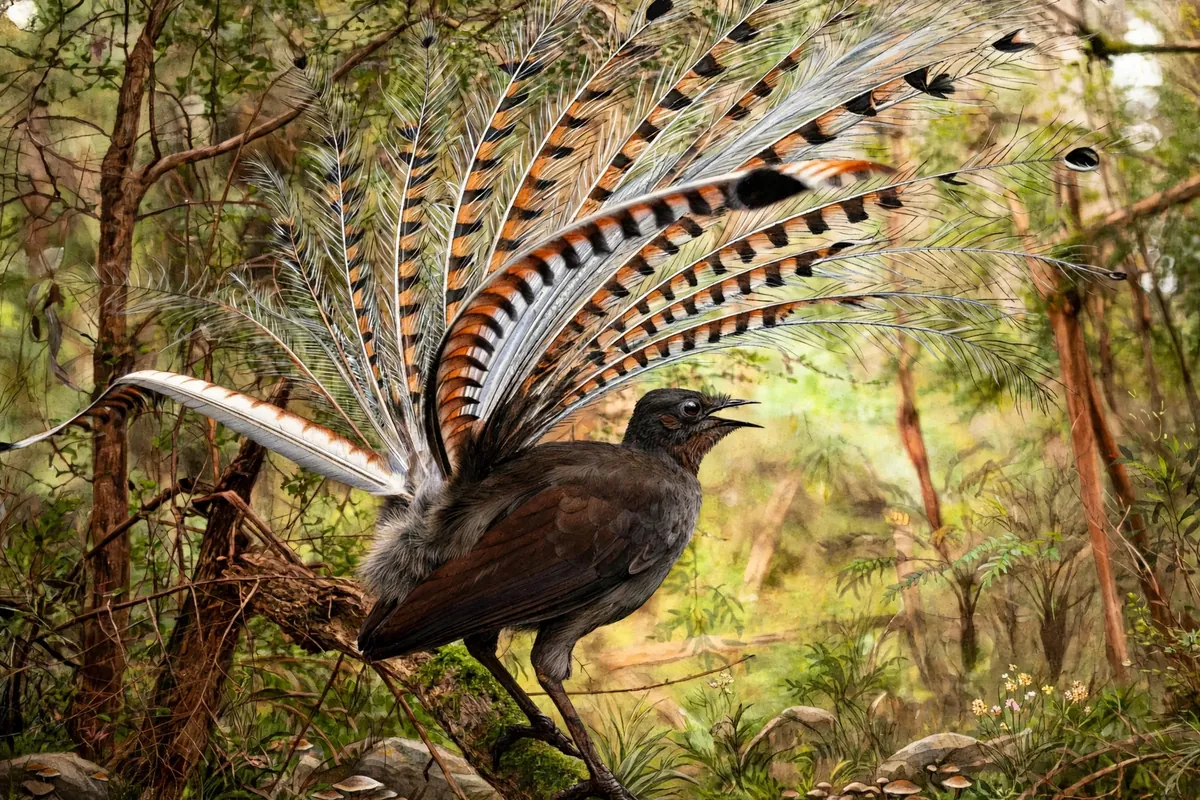
The lyrebird got its name from the male's spectacular tail, made of 16 specially shaped feathers. It was once thought to look like a lyre, the small harp of ancient Greece. That idea started in the early 1800s, when a specimen was shipped to England and prepared for display at the British Museum by a taxidermist who had never seen a live lyrebird.
He guessed the bird would hold its tail upright like a lyre, much as a peacock does, and arranged the feathers that way. The famous artist John Gould, who had also never seen one alive, then painted it from that museum display. In real life, a courting male fans his tail forward over his body until it completely covers his head and back.
Song, Dance, and a Very Long Life
Males are serious performers. During the peak of the breeding season, from June to August, they may sing for four hours a day, which is almost half the daylight. A superb lyrebird male clears a mound of bare soil to use as his stage, where he sings and dances for the females.
These are big, ground-loving birds, up to about 39 inches long including the tail. They have strong legs but short, rounded wings, and they rarely fly except to glide downhill. They can also live as long as 30 years.
So if you ever find yourself in an Australian forest and hear a chainsaw where no chainsaw should be, take a closer look at the ground. The quiet brown bird nearby might just be the most talented impressionist you'll ever meet.