Ask any dog owner and they'll tell you about the nose. It's cold, it's damp, and it has a habit of finding your hand, your cheek, or the back of your knee at the worst possible moment. But why is it wet in the first place?
The short answer: a damp nose helps a dog track smells. The moist surface works like a wind detector. As air moves across it, the moisture evaporates and cools the skin, and tiny cold sensors tell the dog which way the breeze is blowing. Knowing where the air comes from tells the dog where a scent is coming from.
Meet the Rhinarium
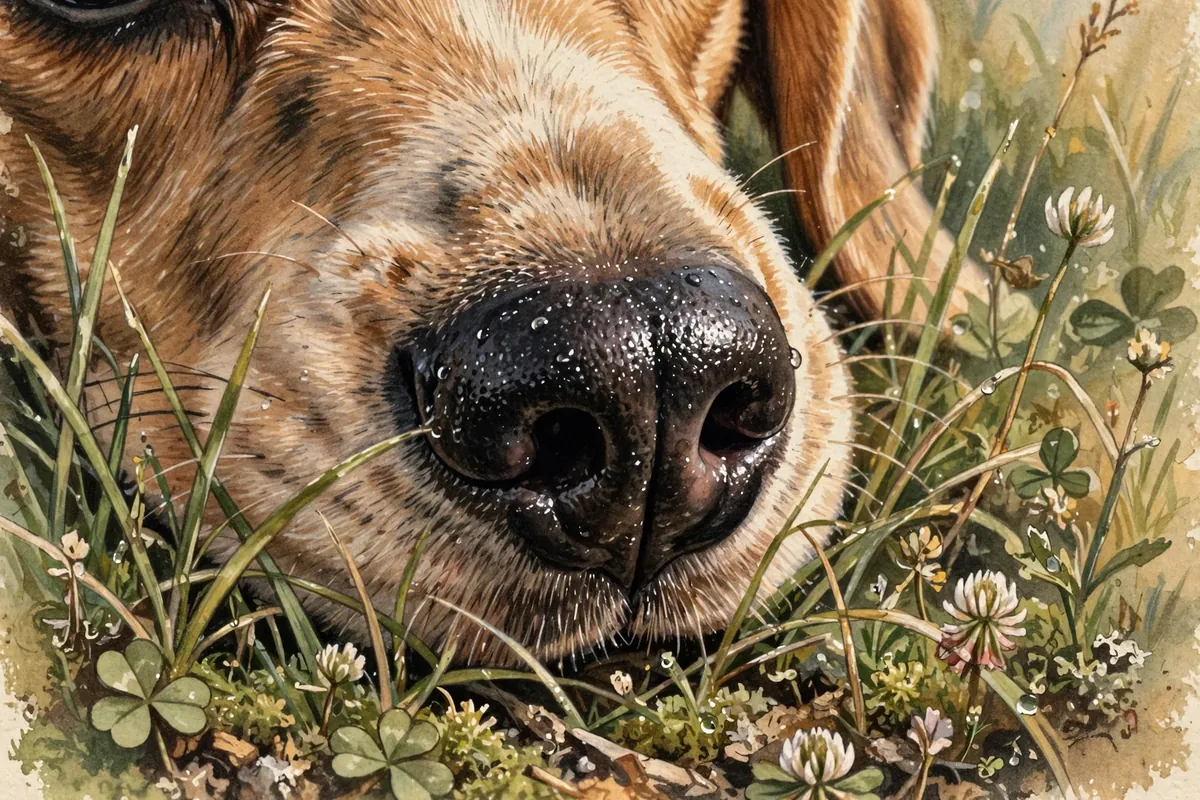
That leathery, hairless tip of a dog's nose has a scientific name: the rhinarium. It's the furless skin around the nostrils found in many mammals. Dog and cat breeders sometimes call it nose leather, and it's informally known as the wet nose because it's moist in healthy dogs and cats.
Look closely and you'll often see a groove running down the middle, called the philtrum, plus a wrinkled, pebbly surface. Those wrinkles may increase the nose's sensory area, though scientists caution that it varies a lot from one kind of mammal to another.
A Nose That Tastes the Wind
The wind-direction trick is surprisingly simple. Wet skin cools fastest on the side where the breeze hits it hardest. Cold receptors in the rhinarium pick up that difference, so a dog can turn toward the source of an interesting smell.
The rhinarium is also its own kind of sense organ. It works by touch and chemistry together. When a dog touches its nose to a scent-marked spot, large scent molecules called pheromones can be carried down that center groove and through tiny ducts in the roof of the mouth to a special scent organ called the vomeronasal organ. Dogs use it mainly for social signals.
What about the mucus itself? Here, researchers admit they aren't sure. It's unclear whether the moisture helps trap odor molecules or is a leftover from an ancient system for carrying chemical signals. It may be one of those mysteries that sits right under our noses.
Why Your Nose Is Dry
Humans don't have a wet nose, and neither do apes. Scientists actually split primates into two groups partly based on this feature. Lemurs and their relatives keep the old-style wet nose, while apes and humans belong to the dry-nosed group.
That difference lines up with how much each animal depends on smell. Mammals with a rhinarium tend to have a sharper sense of smell, and losing it in our branch of the family is linked to relying less on our noses.
A Super Sniffer
A dog's nose is an extraordinary tool. Dogs have roughly 40 times more smell receptors than people, from about 125 million to nearly 300 million in breeds like bloodhounds. Those receptors cover an area about the size of a pocket handkerchief. Ours have about 5 million, packed into an area the size of a postage stamp.
Even their breathing is designed for sniffing. When a dog sniffs, air splits into two paths. Most of it heads toward the lungs, while a separate upper path carries air to the scent receptors. Because exhaled air leaves by the lower route, odor molecules can keep building up on those receptors.
Dogs even seem to sniff with a preferred side. They often start with the right nostril, then switch to the left once they're comfortable with a smell. Researchers think this reflects how the two halves of a dog's brain handle new and familiar information.
So the next time a cold, wet nose nudges you awake, you can forgive it. That damp little bump is a weather vane, a chemical sensor, and a greeting all at once. And if you ever have questions about your own dog's health, your vet is the best person to ask.