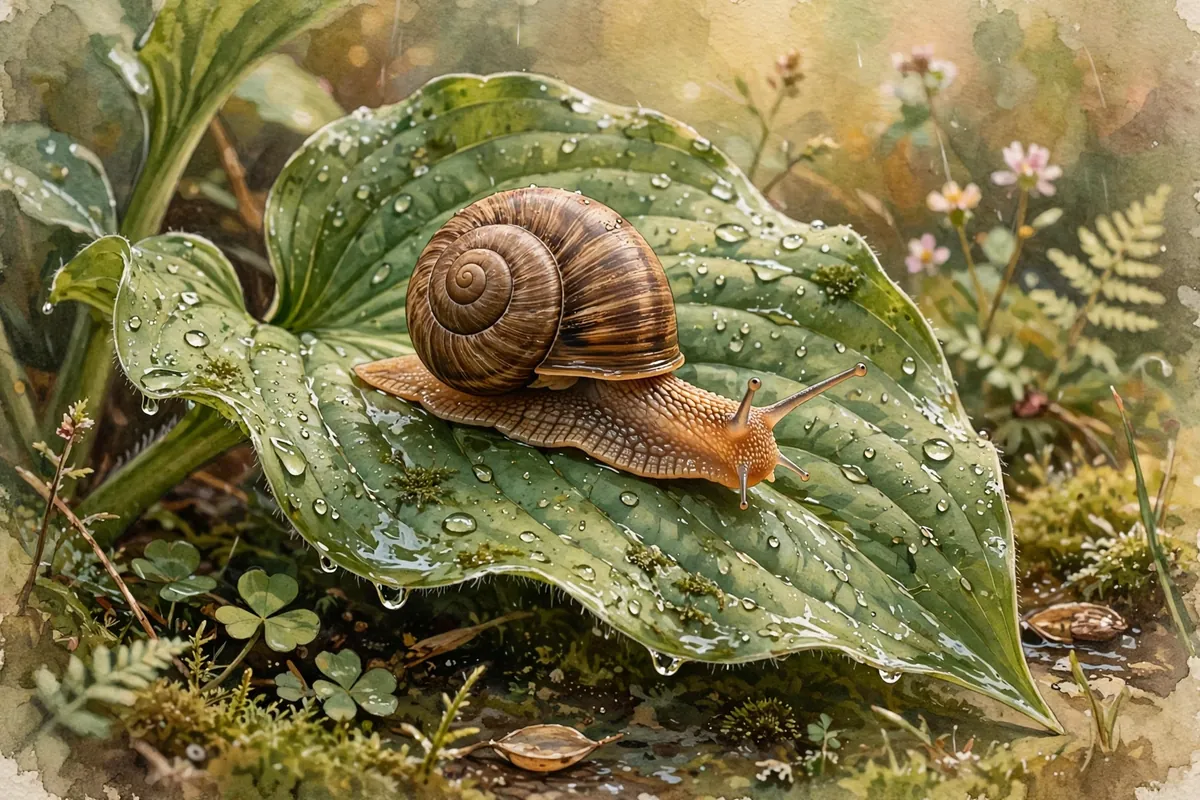
Snails don't seem like they're in a hurry about anything. But some of them take resting to a whole new level. When the weather turns against them, a snail can pull into its shell, seal the door, and simply wait. So how long can a snail stay "asleep"?
The short answer is months at a time, and in rare cases, years. What snails do isn't quite sleep in the way we think of it. It's a deep resting state, called aestivation when it's hot and dry and overwintering or hibernation when it's cold. The most famous case is a desert snail that spent four years glued to a card in the British Museum before anyone realized it was alive.
Sealing Themselves In
A land snail's biggest enemy is drying out. When heat or drought sets in, many land snails find a shady spot under plants or rubble. Others climb up posts, fences, bushes, and even crops, which is one reason some introduced snail species have become farm pests.
Once settled, the snail pulls inside and covers the opening of its shell with a thin membrane of dried mucus called an epiphragm. In some species, like the Roman snail, this seal is strengthened with calcium carbonate, the same stuff found in chalk. It still has a tiny hole that lets a bit of oxygen through. Inside, the snail slows its body way down and loses water much more slowly.
The Snail That Fooled a Museum
In March 1846, a specimen of a desert snail from Egypt, a species now called Eremina desertorum, was glued to an index card at the British Museum. Everyone assumed it was dead. In March 1850, four years later, staff discovered it was very much alive.
The Canadian writer Grant Allen later described what happened next with real delight. The museum gave the snail a warm bath, and the snail, waking at the touch of moisture, poked its head out of its shell, crawled to the top of the basin, and began looking around with its four tentacles. Allen compared the recovery to the legend of the Seven Sleepers of Ephesus.
The story has a happy ending, too. The snail was reportedly moved to a large glass jar, where it lived for about two more years, mostly on cabbage leaves. During that time, it went into its deep rest and came out of it once more.
Even Longer Than That
Later experiments showed that this desert species could last even longer without food or water. In 1904, 40 of these snails were placed in a tin box. Around eight years later, in 1912, 10 of them were found to still be alive. That's a remarkable feat for an animal you could hold in your palm.
Garden Snails Have Tricks Too
The common garden snail you might find on your porch has its own survival skills. It rests through hot, dry spells and also through winter. While overwintering, it changes the makeup of its body fluids so ice doesn't form in its tissues, which lets it survive temperatures as low as 23 degrees Fahrenheit.
It also has a strong homing instinct and readily returns to the same spot to spend the winter. It can even adjust how much water passes through its skin, so it doesn't dry out or soak up too much water during those long months of rest.
So if you spot a snail stuck to a fence post on a hot summer day, don't assume it's given up. It's probably just waiting for the next good rain, sealed inside its own little bedroom with the door shut tight.