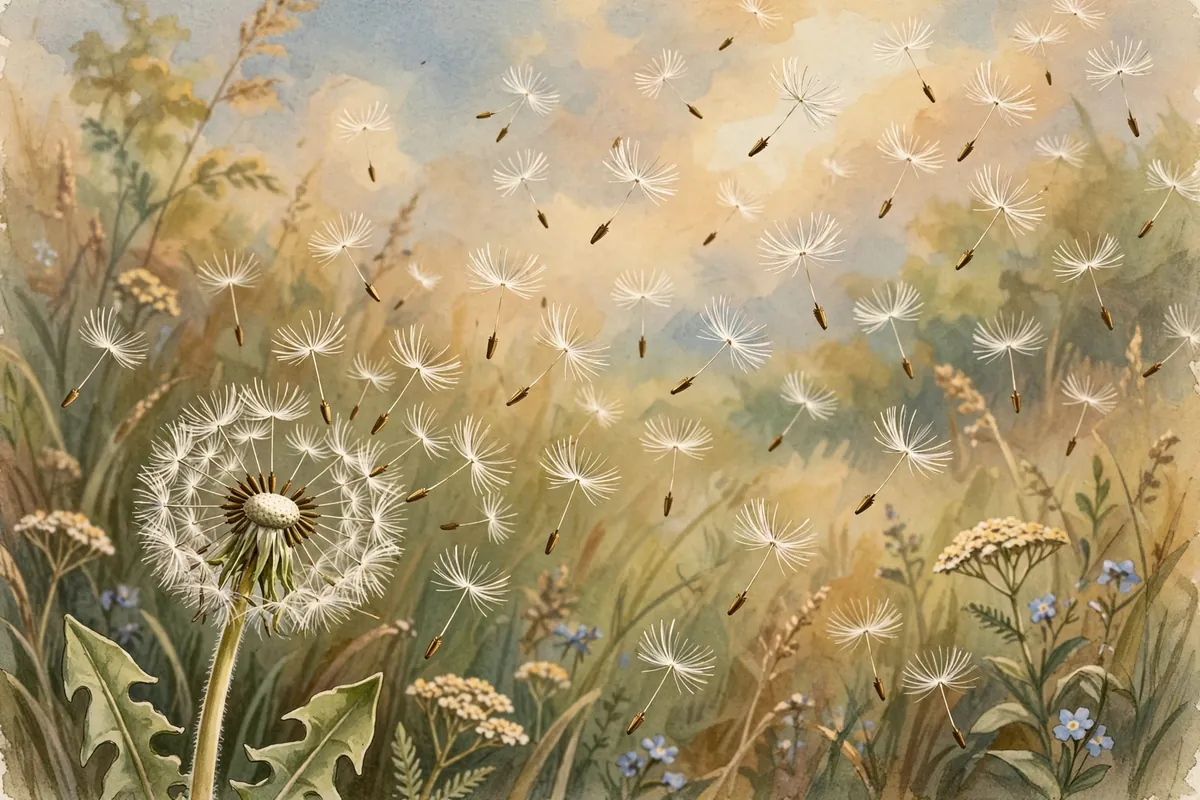
Few things are as simple and joyful as blowing on a dandelion puff. A quick breath and dozens of tiny white parachutes drift off into the sky. Kids make wishes on them. Gardeners grumble about them. But few of us stop to wonder how such a tiny seed can fly so well.
Here's the short answer. Each dandelion seed hangs beneath a parachute of fine, hair-like bristles called a pappus. As air flows through the bristles, it forms a special swirl of air, a vortex ring, that stays just above the seed and helps hold it up. Scientists only worked out this trick in 2018. Some seeds can travel up to about 62 miles, the farthest known passive flight among plants.
From Yellow Flower to Fluffy Clock
A dandelion's sunny yellow head is actually lots of tiny flowers packed together. The flower heads tend to open in sunlight or on warmer days and close at night.
A week or two after blooming, the flower turns into a round seed head, sometimes called a blowball or a clock. The yellow petals fall away, and the ball opens into a perfect sphere of fluffy parachutes. Each parachute carries one seed, and each seed weighs only about half a milligram in spring.
The Secret Swirl
For years, people assumed the fluffy pappus worked like a regular parachute. In 2018, researchers discovered something more surprising. The bristles create what's called a separated vortex ring, a doughnut-shaped swirl of air that stays attached above the seed instead of drifting away behind it.
The exact shape and spacing of the bristles create this effect. Researchers were even able to copy it using tiny engineered silicone discs. It's a bit like the seed carries its own invisible cushion of air wherever it goes.
The pappus has another clever skill. It can change shape depending on how moist the air is. In damp conditions, the plume can close up, so the seed is less likely to break away until conditions are better for flying and sprouting.
How Far Do They Really Go?
Most dandelion seeds don't travel far at all. A 2003 study found that over 99% of seeds landed just a few meters from the plant. But a tiny fraction, about 0.014%, traveled more than a kilometer, or roughly two-thirds of a mile.
That's plenty to spread dandelions far and wide. Many dandelions can also make seeds without pollination, producing offspring that are genetic copies of the parent. Put those together, and it's no wonder they pop up in yards, along roads, and in pastures across much of the world.
Engineers Are Taking Notes
The dandelion's flying skill has inspired inventors. In the 2010s, scientists at the University of Edinburgh built prototype drones based on the pappus. In 2022, researchers at the University of Washington created battery-free wireless sensors that float on the wind like dandelion seeds.
Not bad for a plant most of us call a weed. Dandelions are also an important early spring food source for many pollinators, and the whole plant is edible. Even their name is charming: dandelion comes from the French dent de lion, or "lion's tooth," for the jagged leaves.
So next time you spot a fluffy dandelion clock, go ahead and make a wish. You're launching one of nature's finest little aircraft.