Some haunting photographs have made one African lake famous. They show birds and other animals perched by the water, stiff and pale like stone statues. They helped spread a spooky idea: a lake that turns animals to stone.
The truth is a bit less like a horror movie, but still remarkable. Lake Natron, in Tanzania, doesn't turn living animals to stone. What its extremely salty, alkaline water can do is calcify and preserve the bodies of creatures that die in it. And those famous lifelike poses? The photographer collected the preserved carcasses and posed them as if they were still alive.
Behind the Famous Photos
The pictures were taken by photographer Nick Brandt for a series called The Petrified. He gathered the bodies of animals that had died in the lake and posed them in lifelike positions, as though they were still perched there. The result is beautiful and eerie, which is exactly why the images spread so widely.
So the creatures weren't turned to stone in an instant. They died, and the lake's unusual chemistry preserved their remains.
Why the Water Is So Harsh
Lake Natron sits in the East African Rift, with its northern tip crossing into Kenya. It's very shallow, less than about 10 feet deep, and the surrounding area is extremely hot. Air temperatures often top 104°F, and the water itself can reach about 140°F. The lake is fed mainly by the Southern Ewaso Ng'iro River, which rises in central Kenya, and by mineral-rich hot springs.
As the water evaporates, it leaves behind minerals, including natron, a natural form of sodium carbonate. The lake can reach a pH above 12, which is strongly alkaline. The surrounding volcanic rock is rich in carbonate but low in calcium and magnesium, which helps the lake become a caustic brine. Only specialized organisms can survive in it.
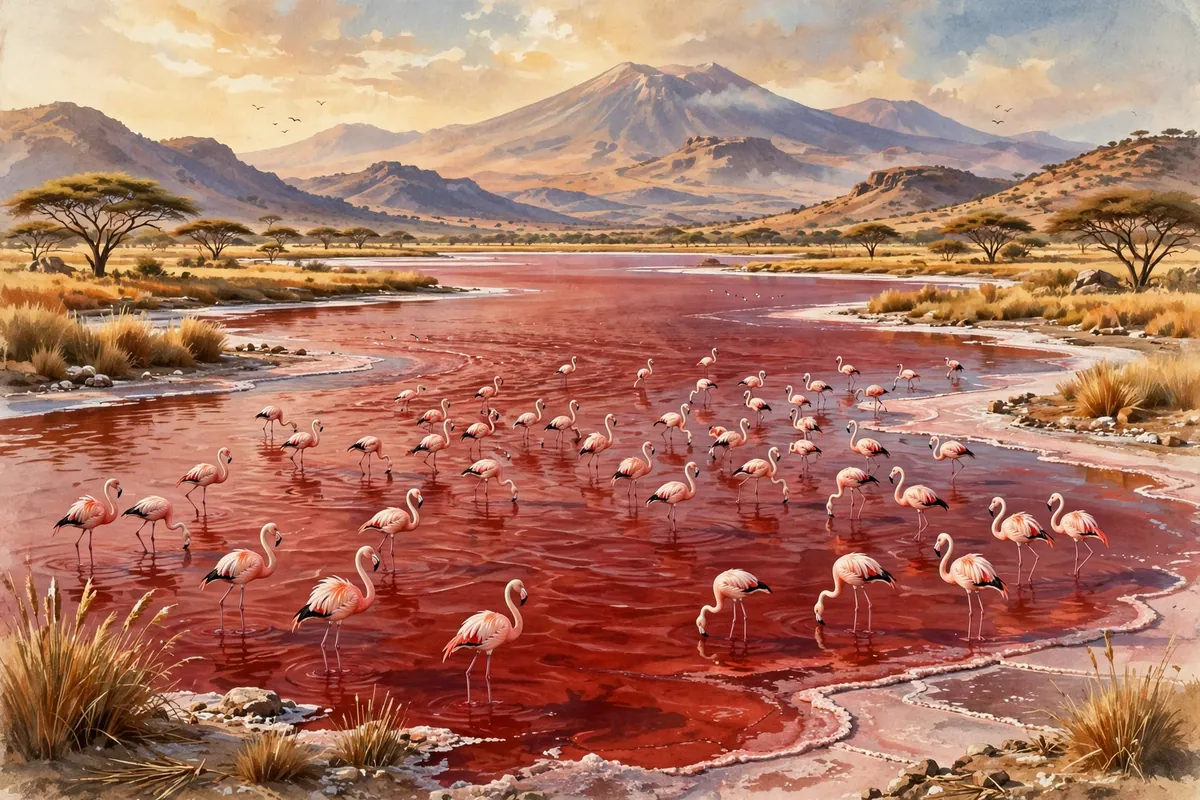
The lake's dramatic red and orange colors come from salt-loving microorganisms. Some of them are cyanobacteria with red pigments, and they thrive as the water gets saltier.
An Ancient Egyptian Connection
The mineral that gives the lake its name has a long history with preservation. Ancient Egyptians used natron during mummification because it absorbs water and dries things out. When it gets wet, it also raises the alkalinity, creating a hostile environment for bacteria.
That helps explain why bodies left in Lake Natron can be preserved instead of quickly decaying. It's the same basic chemistry the Egyptians put to work thousands of years ago.
A Safe Haven for Flamingos
Here's the twist: this deadly-sounding lake is a nursery for millions of birds. Lake Natron is the only regular breeding area in East Africa for about 2.5 million lesser flamingos. Their dependence on this single site is one reason the species is listed as near threatened.
The harsh water actually protects them. It forms a barrier that keeps predators away from the nests, which the flamingos build on islands that form as the water evaporates. The flamingos feed on Spirulina, a blue-green algae with red pigments, in nearby salty lakes.
That delicate balance could be at risk. The lake has no formal protection, and more logging in its watersheds and a planned hydroelectric plant upstream in Kenya could bring in silt and fresh water. Diluting the lake could threaten the very conditions that keep the flamingo nests safe.
So Lake Natron isn't a Medusa among lakes. It's a fierce, strange, and beautiful place, where hard chemistry preserves the dead and shelters the living. That's a better story than any myth.