Stand on a beach and look out at the waves, and it's hard to picture what's under all that water. The ocean covers most of our planet, yet its deepest places are still among the least explored spots on Earth. So just how far down does it go?
Here's the short answer. The average depth of the ocean is about 12,100 feet, or roughly 2.3 miles. But the deepest known point, the Challenger Deep in the western Pacific, plunges to about 35,876 feet according to a 2021 study. That's nearly 7 miles straight down.
Deeper Than Everest Is Tall
To put that in perspective, Mount Everest stands about 29,032 feet above sea level. If you could set Everest on the floor of the Challenger Deep, its peak would still be well over a mile underwater.
The Challenger Deep sits at the southern end of the Mariana Trench, a huge crescent-shaped gash in the seafloor. The deepest part is a relatively small, slot-shaped depression made up of three basins. The nearest land is a small island about 178 miles away, and Guam is about 189 miles off.
It's named after two British Royal Navy ships called Challenger. The first located it during an expedition from 1872 to 1876, and the second established its record-setting depth in the early 1950s.
Visiting the Bottom
The first visit came on January 23, 1960, when Jacques Piccard and U.S. Navy Lieutenant Don Walsh rode a bathyscaphe called the Trieste all the way down. It was the first time any vehicle had reached the bottom. Their cabin was a steel sphere with walls 5 inches thick. The descent took almost five hours, and they stayed only about twenty minutes on the bottom because they spotted a crack in the outer window.
In 2012, filmmaker James Cameron made a solo dive in a sub called Deepsea Challenger. He spent a little over two and a half hours on the bottom before a leaking fluid line clouded his view and cut the trip short. He described landing on a very soft, almost gelatinous flat plain. As of July 2022, just 27 people had ever descended to the Challenger Deep.
Dark, Cold, and Crushing
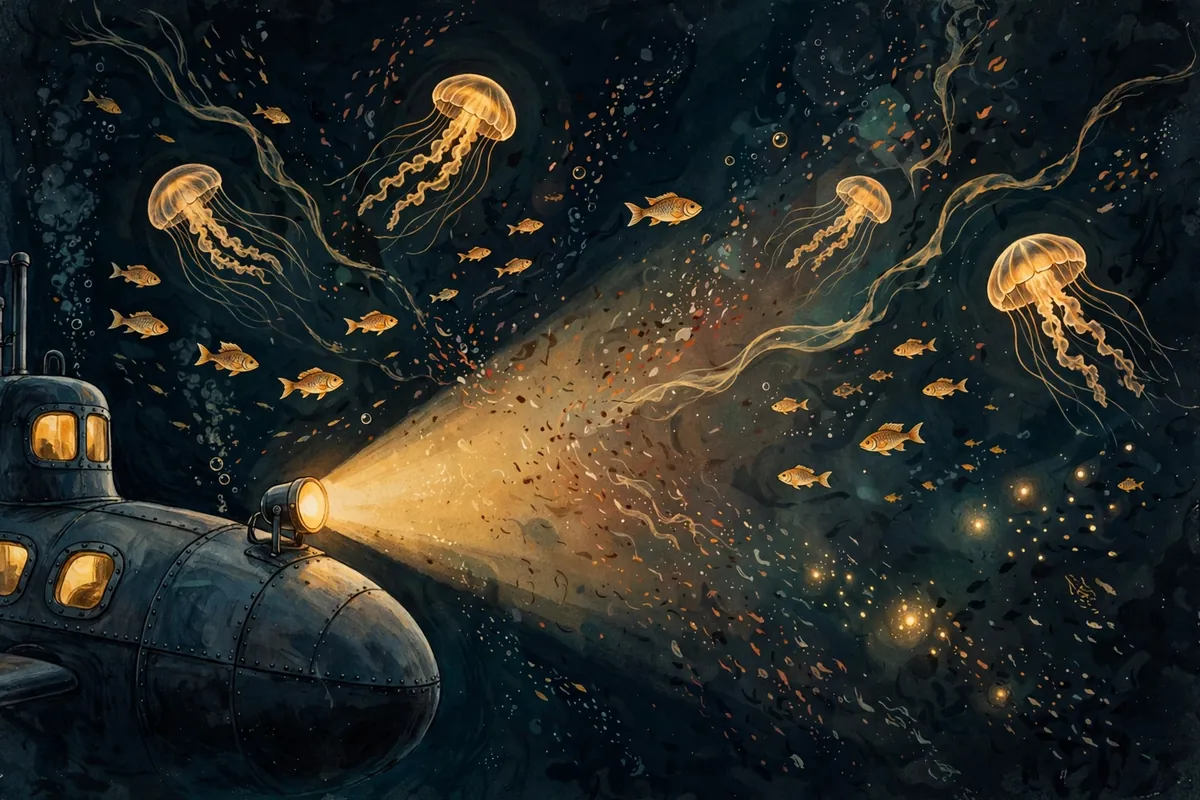
Sunlight fades quickly with depth. The top layer of the ocean, where enough light reaches for plants and algae to grow, ends at around 650 feet in the open ocean. Faint light reaches a little deeper, but not much. Below that, the water is cold and completely dark.
In fact, most of the ocean is deep. Nearly half of the world's ocean water lies more than about 9,800 feet down. Water deeper than 650 feet, considered the deep ocean, covers about two-thirds of Earth's surface.
Life at the Very Bottom
Even at the bottom of the Challenger Deep, there's life. Samples have turned up hundreds of species of tiny single-celled creatures called foraminifera, most with soft shells. Hard shells made of calcium carbonate have trouble forming at such depths, because the high-pressure water dissolves it easily.
Cameron said he didn't see any fish or any creature more than an inch long, only small shrimp-like amphipods. The Trieste crew, though, reported seeing what looked like a flatfish on the seabed.
So the next time you dip your toes in the surf, remember what's out there. Beneath those friendly waves lies a world deeper than the tallest mountain is high, and we've barely begun to explore it.