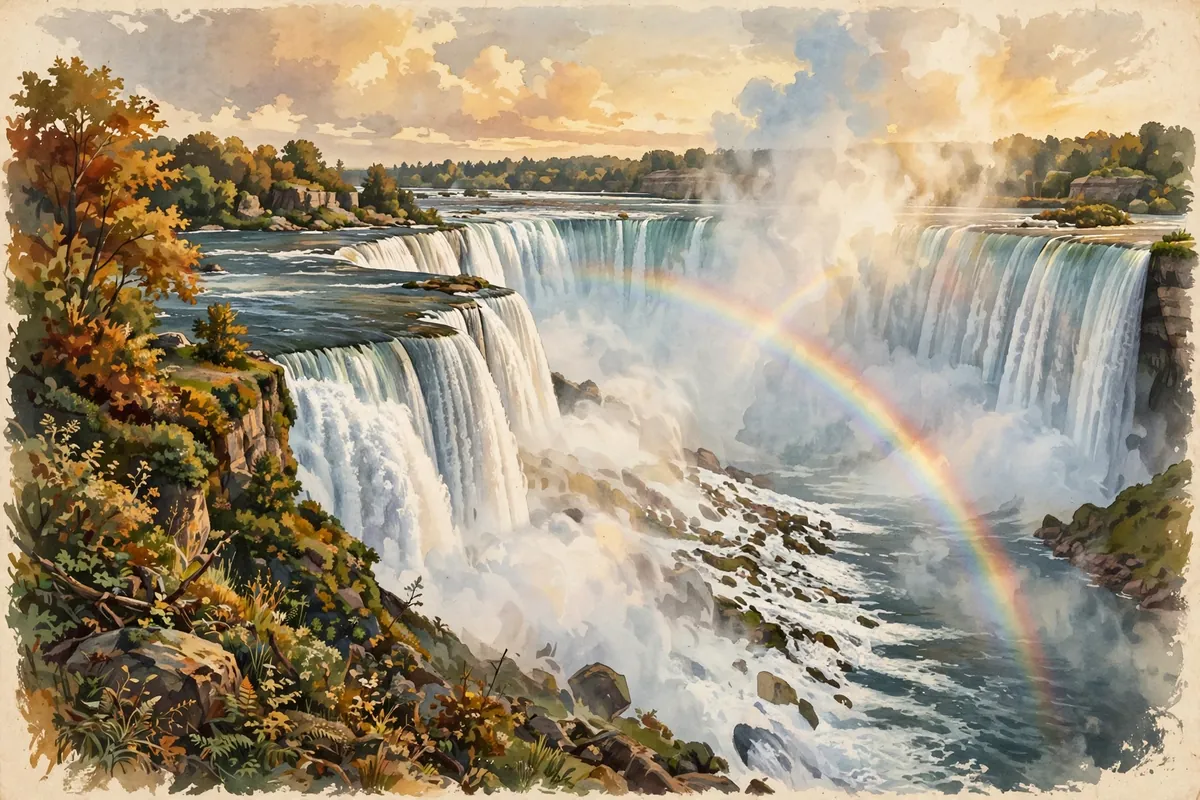
Stand at the railing beside Horseshoe Falls and the roar fills your chest. Mist drifts up, rainbows flicker, and an endless wall of water pours over the edge. It feels as if it has been here since the beginning of time.
In fact, Niagara Falls is surprisingly young. It formed after the last ice age, when retreating glaciers left behind the Great Lakes, and the features that became the falls date back about 10,000 years. Around 10,900 years ago, the falls stood nearly 7 miles downstream from where they are now. They've been slowly working their way upstream ever since.
Born From the Ice Age
As the ice sheets of the last ice age melted, huge amounts of meltwater filled the basins the glaciers had carved, creating the Great Lakes. The upper lakes emptied into the Niagara River, which found its way across a long rocky ridge called the Niagara Escarpment on its way to the Atlantic.
Over time, the river cut a gorge into that cliff. The rock didn't wear away evenly. A hard cap of limestone and dolomite sits on top, and it erodes more slowly than the softer rock layers beneath it. Scientists also think an older valley, called St. David's Buried Gorge, lies hidden under glacial debris near where the Welland Canal runs today.
A Waterfall on the Move
Since the falls began near today's Queenston, Ontario, and Lewiston, New York, erosion has pushed them back about 6.8 miles. Along the way, Horseshoe Falls changed shape, from a small arch to a horseshoe bend to its current V shape.
For at least the last 560 years, the falls retreated an average of about 3 to 5 feet a year. Thanks to engineering, today's rate is closer to a foot a year. At that pace, in about 50,000 years the falls will have worn back the remaining 20 miles to Lake Erie and will cease to exist.
People have even turned part of the falls off. In June 1969, engineers built a temporary dam that diverted the river away from the American Falls for several months, so they could study the riverbed and bolt and strengthen weak spots in the rock. The dam was blasted away that November.
The Day the Falls Went Quiet
Nature shut the falls off once, too. On March 29, 1848, an ice jam stopped the river, and for as long as 40 hours little or no water fell. Waterwheels stopped turning, and mills and factories shut down for lack of power. In 1912, the American Falls froze solid, though the other two kept flowing, and partial freezes have happened in years like 2014, 2017, and 2019. In some winters, a thick ice bridge formed at the base of the falls, and people once used it to cross the river before bridges were built.
Niagara has its daredevils, as well. On October 24, 1901, 63-year-old schoolteacher Annie Edson Taylor became the first person to go over the falls in a barrel. She survived, bleeding but otherwise unharmed, and said, “No one ought ever do that again.” Today it's illegal on both sides of the border.
So Niagara Falls is a youngster in Earth's long story, and a restless one at that. Enjoy the view while you can. By geological standards, it won't be here forever.