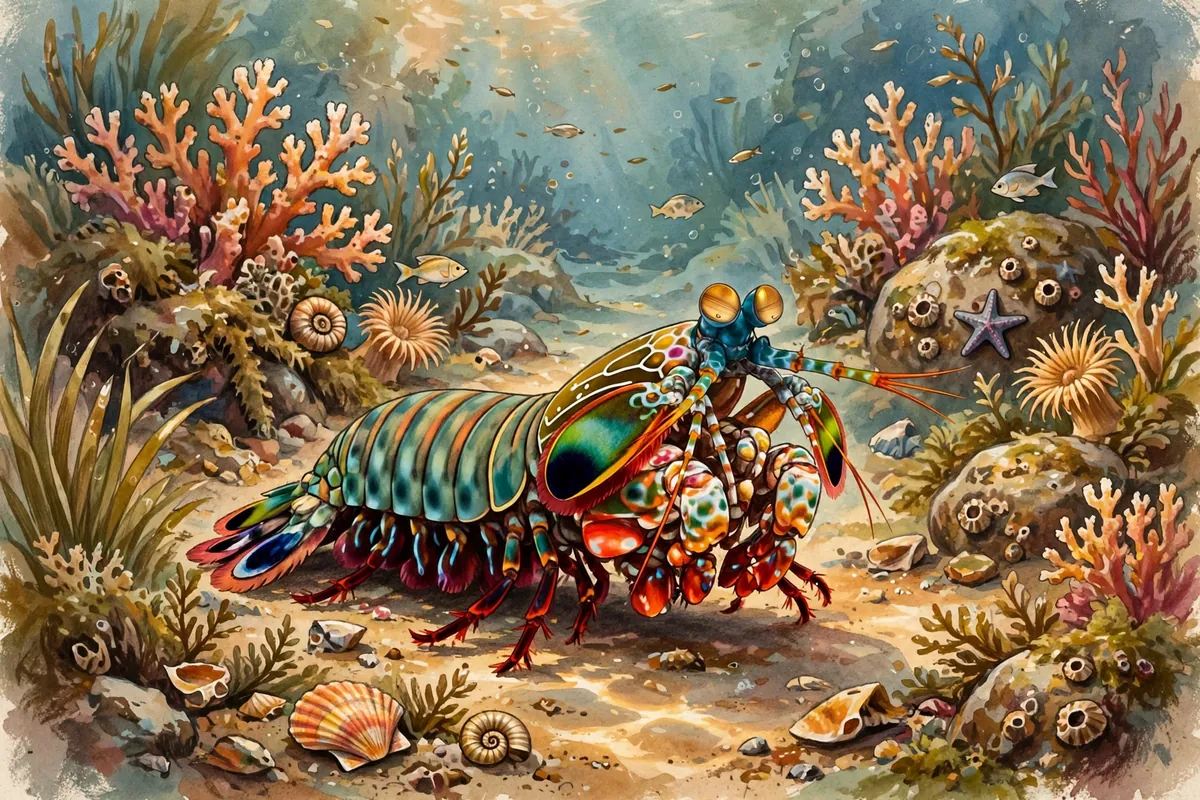
Somewhere on a tropical reef, a creature about the length of your finger is waiting in its burrow. When a crab or snail wanders close, it unleashes a strike so fast your eyes couldn't follow it. The mantis shrimp has become an internet legend, often described as punching harder than a bullet.
Here's the honest answer: that comparison goes too far. The fastest mantis shrimp strike on record reaches about 68 miles per hour, while a 9mm pistol bullet leaves the barrel at roughly 749 miles per hour. Even in acceleration, the bullet comes out about three times ahead. But don't feel sorry for the shrimp. Its punch is still one of the most extreme moves in the animal kingdom.
The Real Numbers
The record holder is a species called Gonodactylus smithii. Its strike hits about 68 mph with an acceleration of roughly 150,000 meters per second squared. For comparison, a 9mm bullet fired from a Beretta pistol accelerates at about 441,000 meters per second squared. So the bullet idea is a big exaggeration, but the shrimp is in a league no ordinary animal can touch.
The peacock mantis shrimp, a colorful species popular in photos, swings its club at around 51 mph from a standing start. That's an acceleration of about 10,400 times the pull of gravity. Each impact can deliver around 1,500 newtons of force, which is more than 300 pounds, from an animal that usually grows to about 4 inches long.
One Punch, Two Hits
The most surprising part isn't the speed. It's what happens in the water. The club moves so quickly that it creates bubbles filled with vapor between itself and the target. These are called cavitation bubbles, and when they collapse, they produce their own burst of force.
That means the prey gets hit twice by a single strike, once by the club and again by the collapsing bubbles. Even if the club misses, the shock wave can be enough to stun or kill. The collapsing bubbles even give off a tiny flash of light, an effect called sonoluminescence.
How does a small animal swing that fast? Its arm works like a loaded spring held back by a latch. When the latch releases, the stored energy snaps the club forward. The strike is actually faster than the shrimp's own nerves can send signals, so once it starts, it can't be steered. The aim has to be set up beforehand.
Eyes That Outdo Ours
The mantis shrimp's eyes are almost as famous as its punch. Humans have four types of light-sensing cells in their eyes. Mantis shrimp have between 12 and 16. Each eye is split into three regions, which gives a single eye its own depth perception.
Handle With Care
Ancient Assyrians called them sea locusts, and in Australia they've been called prawn killers. Today some people call them thumb splitters, because they can give a painful wound to anyone who handles them carelessly.
They sometimes turn up as surprise guests in home aquariums, hitching a ride inside pieces of live rock. Stories of mantis shrimp breaking aquarium glass do exist, but they are rare and usually involve a shrimp kept in too small a tank.
So the mantis shrimp may not be a living bullet. Instead it's a finger-sized boxer with a spring-loaded arm, a punch that lands twice, and eyes that see the world in ways we can only imagine. Honestly, that's an even better story.