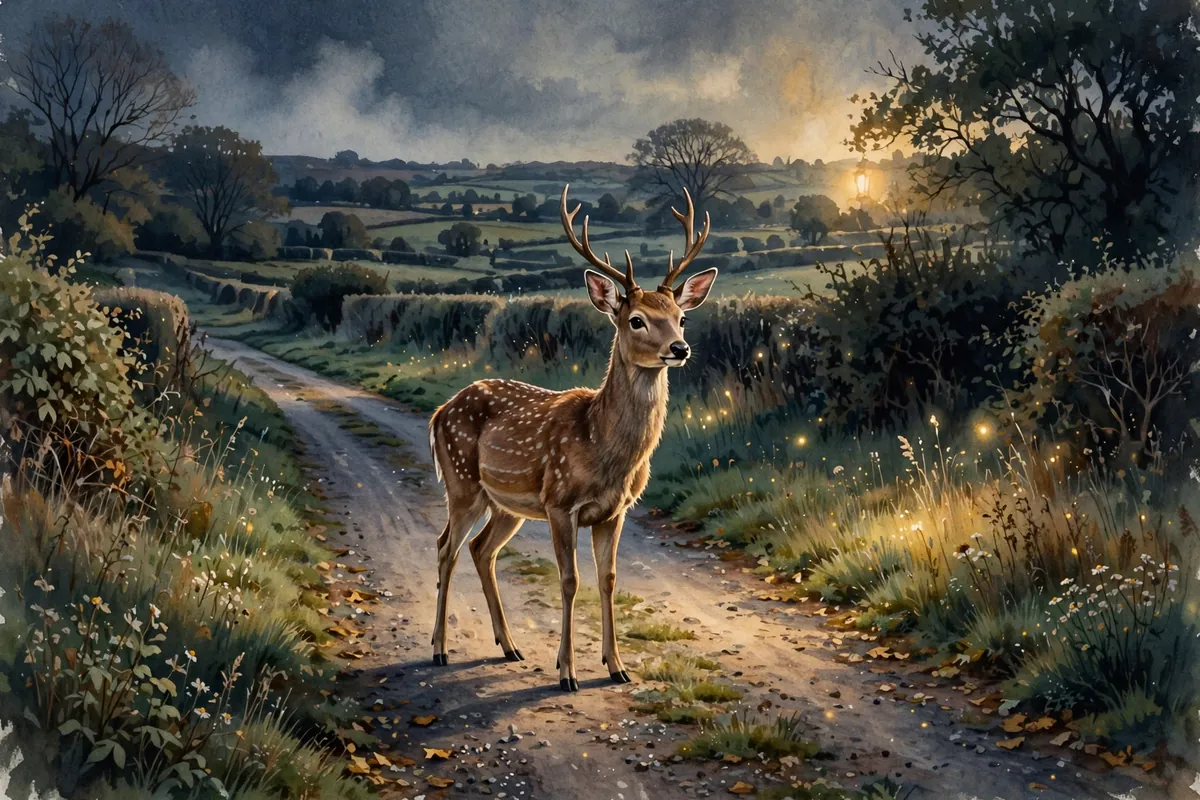
Anyone who drives country roads at night knows the scene. Your headlights catch two glowing eyes, and a deer just stands there, staring, as if it has forgotten how to run. It's such a familiar sight that "a deer in the headlights" became an everyday way to describe someone frozen in surprise.
The short answer: scientists don't point to one single cause, but two things likely work together. Deer eyes are built for dim light, so a sudden blast of brightness can overwhelm them. And like many prey animals, deer have a built-in instinct to freeze when something startles them.
Eyes Made for Dusk
White-tailed deer see the world very differently than we do. Their horizontally slit pupils give them good night vision, and they are better than humans at spotting motion in low light. They also process images much faster than we can.
Like many animals, deer have a reflective layer at the back of the eye called the tapetum lucidum. It bounces light back through the eye to help them see in the dark. It's also why their eyes seem to glow in your headlights. That eyeshine can even appear in a simple flashlight beam.
Eyes tuned to gather every bit of faint light are great at dusk. But when a pair of headlights suddenly floods them, one common explanation is that the deer is briefly dazzled and can't judge where to go.
Fight, Flight, or Freeze
We usually talk about "fight or flight," but researchers describe the full set of reactions as fight, flight, or freeze. Freezing is common in prey animals and can happen before or after an animal decides to fight or run.
For a deer in a forest, standing still often makes sense. A motionless animal can be harder for a predator to notice. The trouble is that a car is not a wolf, and freezing in the middle of a road is the worst possible choice.
Why This Matters Behind the Wheel
In Europe and North America, deer are the animal most likely to be killed by vehicles. In the United States, an estimated 1.25 million insurance claims are filed each year because of collisions with deer, elk, or moose.
Timing matters. Deer tend to move at dusk and dawn, which are the times of highest collision risk. They are especially active during their October to December mating season, and again in late March and early April.
Safety experts recommend slowing down and scanning both sides of the road at night. Often you'll see the shine of an animal's eyes before you see the animal. If you do spot a deer, expect others nearby, because they often travel in groups.
Do Deer Whistles Help?
You may have seen small whistles that mount on a car's bumper and claim to scare deer away. The evidence isn't encouraging. In one study, animals behaved no differently whether the whistles were on or off, which casts doubt on how well they work.
The general advice for a large animal in the road is to brake and stay in your lane if you can, rather than swerving suddenly and losing control.
A Night-Shift Animal in a Daylight World
So that frozen stare isn't stubbornness. It's a creature with eyes made for twilight and instincts shaped by predators, suddenly facing something it never evolved to understand.
Next time you see those glowing eyes up ahead, ease off the gas and give the deer a moment. It's probably just as surprised as you are.