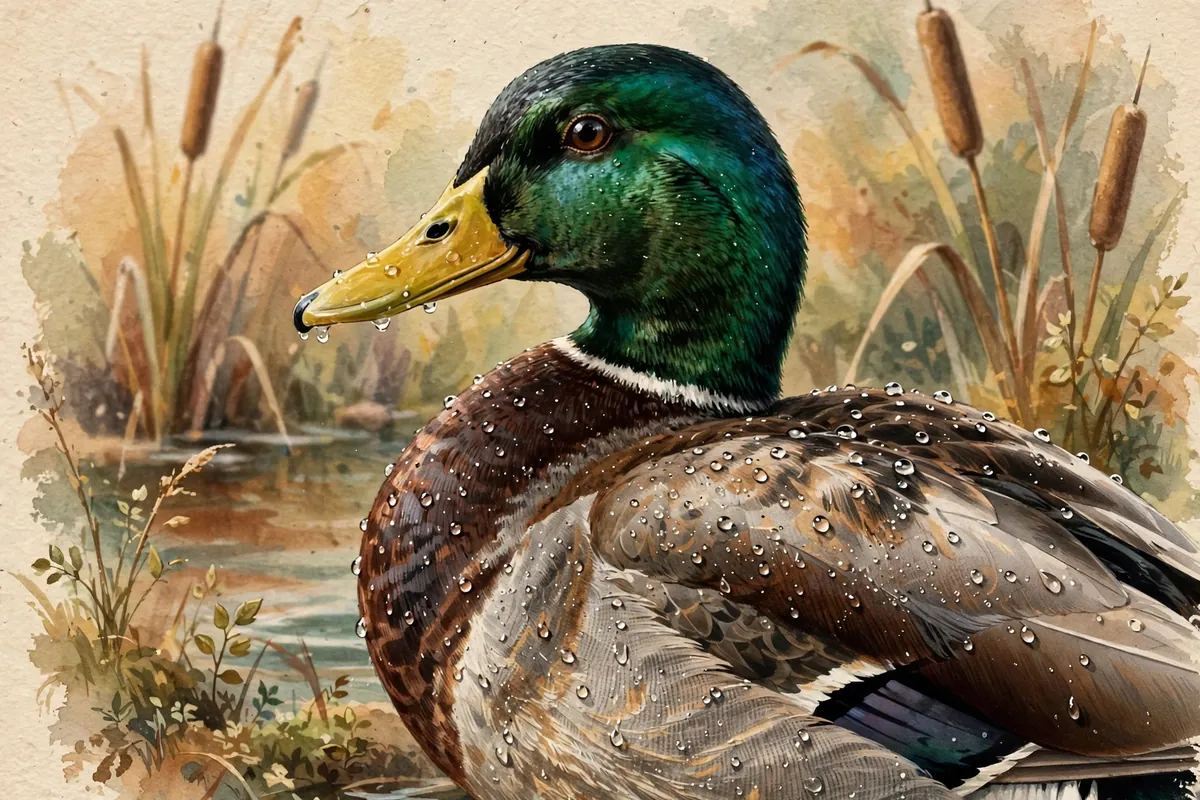
There's a reason we say criticism rolls off someone like water off a duck's back. Watch a mallard paddle through a cold pond, dunk its head, and shake. The water beads up into tiny droplets and slides right off. Somehow, the duck stays snug and dry underneath.
The secret is a combination of feather design and constant care. A duck's outer feathers have tiny hooks, called barbules, that lock together into a tight barrier that helps repel water. Ducks keep that barrier in top shape by preening, spreading oil from a special gland near the tail across their feathers. The oil helps keep the feathers flexible and the barbules from breaking, so the waterproof layer stays intact.
The Oil Gland at the Base of the Tail
Most birds have a preen gland, also called the oil gland or uropygial gland. It sits on the back at the base of the tail. In some species, a small tuft of feathers at the gland's opening works like a wick for the oil. The gland is especially well developed in many waterbirds, including ducks, pelicans, and petrels.
When a duck preens, it rubs its bill against the gland, then works the oil through its feathers. Ducks also have a comb-like edge along their bills, called a pecten, which helps strain food from water and is also used to preen. That's why you'll often see ducks fussing with their feathers for long stretches. It's not vanity. It's maintenance.
Zipped-Up Feathers
Oil isn't the whole story. When the interlocking barbules are in good condition, the feather surface forms a barrier that water has trouble getting through. Scientists have found the gland's size doesn't neatly match how much time a bird spends in water, which suggests feather structure matters a great deal too.
Beneath those outer feathers sits a layer of fluffy down. Feathers insulate birds from both water and cold, and that soft, dry down traps warmth close to the body. It's why duck down has long been prized for pillows and jackets.
When the System Fails
The waterproofing isn't indestructible. Pollution containing emulsifying agents, chemicals like detergents that break up oils, can strip it away. Then feathers become waterlogged, and a bird can even sink. Birds caught in oil spills are very difficult to clean and rescue, because their feathers are so badly fouled.
Interestingly, not every water bird wants to stay dry. Cormorants have feathers that soak up water. That makes them less buoyant, which helps them swim underwater while hunting fish.
More Clever Feather Tricks
Feathers are surprisingly heavy. A bird's plumage weighs two or three times more than its skeleton, since many bird bones are hollow.
Some birds, like herons, pigeons, and parrots, grow special powder down feathers. Their tips break into a fine powder that sifts through the plumage and acts as a waterproofing agent and conditioner. Cockatoos may even use their heads like powder puffs to spread it.
Preen oil has a colorful use in flamingos too. During breeding season, greater flamingos spread more of it across their feathers, and since it contains pink pigments, it brightens their color. Scientists have compared it to putting on makeup.
So the next time you see a duck bob up from a dive looking perfectly dry, give it a little credit. It has spent hours oiling and arranging every feather to make that look easy.