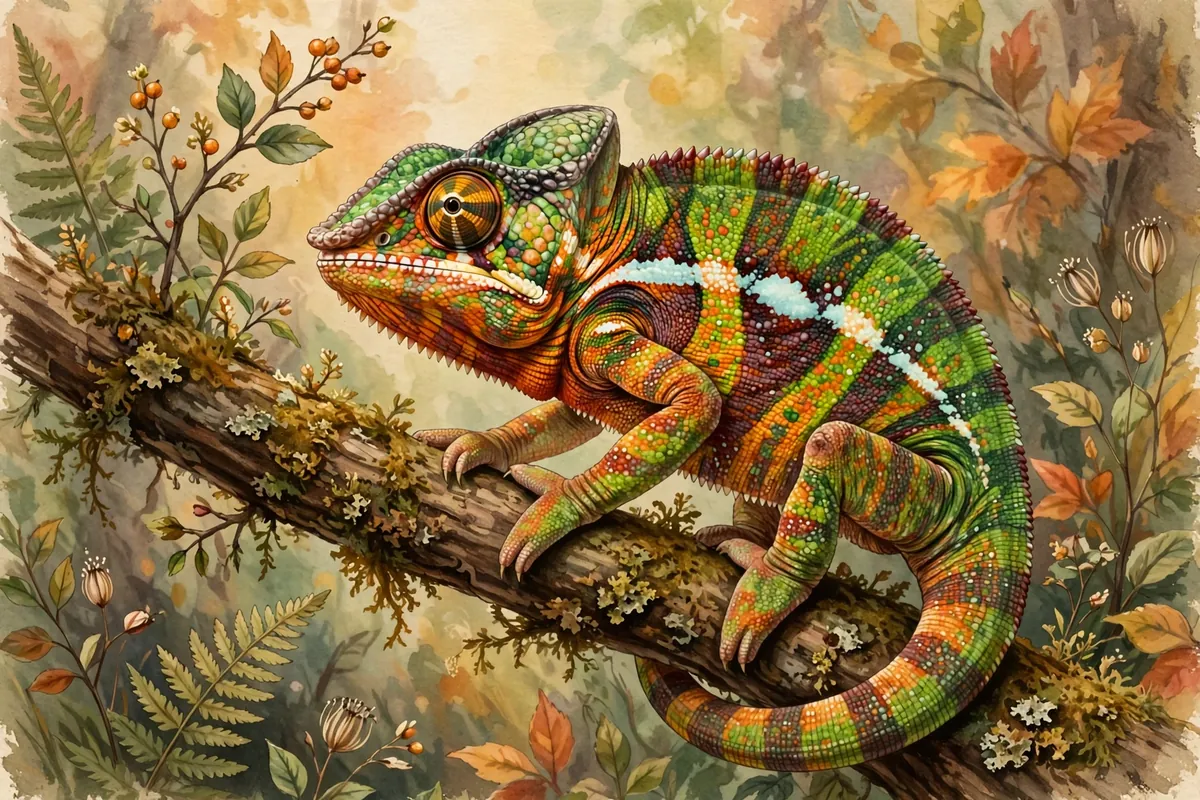
Most of us grew up hearing that chameleons change color to blend in with whatever they're sitting on. Set one on a leaf and it turns green, set it on a log and it turns brown. It's a great story. The real one is even better.
Here's the short answer: chameleons don't mix pigments like a painter. Much of their color comes from tiny crystals in their skin that reflect light. By changing the spacing between those crystals, a chameleon changes which colors bounce back. And while camouflage is part of it, color change is most often about sending messages to other chameleons and coping with temperature.
Tiny Crystals Do the Trick
Chameleon skin is built in layers. Near the surface are cells holding yellow and red pigments. Below them is a layer of cells called iridophores, packed with microscopic crystals made of guanine. At the bottom are cells filled with dark melanin. The color you see is light interacting with all of those layers at once.
The crystals are the real stars. They create what scientists call structural color. Instead of the color sitting inside a pigment, it comes from the way light waves interact with a precisely spaced pattern of crystals.
From Green to Orange in Moments
When a chameleon is relaxed, its crystals sit close together. That tight arrangement reflects blue light. The blue then passes through the yellow pigment cells above it, and the mix comes out as the ordinary green we all picture.
When the animal gets excited, the spacing between the crystals changes. Now the layer can quickly reflect yellow, orange, or red instead, and it can shift back to blue again. Combined with the pigments in the other layers, that produces the bold colors you see. A deeper layer of larger crystals reflects light more broadly, especially near-infrared light that our eyes can't detect.
It's Mostly About Mood, Not Matching
So why bother? Camouflage is one reason, but it isn't the most common one. Chameleons mostly use color change for social signaling and to react to temperature and other conditions. Their colors tell other chameleons how they're feeling and what they intend to do.
Chameleons tend to show brighter colors when they're being aggressive toward a rival, and darker colors when they submit or give up. Because they're cold-blooded, they can also turn darker to soak up light and heat, or lighter to reflect it and keep from overheating.
Hiding still matters, though. Chameleons can't easily run from danger, so staying unseen is their main defense. Some, like Smith's dwarf chameleon, even adjust their camouflage depending on whether the threat is a bird or a snake. And not every species is a showoff. For some, the change is mostly a shift between lighter and darker shades of brown.
More Chameleon Superpowers
Their eyes are just as remarkable. Each one can pivot and focus on its own, so a chameleon can watch two different things at the same time and see in a full circle around its body. When it spots a meal, both eyes swing forward together.
Then comes the tongue. Chameleons catch insects by shooting out a long tongue, often said to be one and a half to two times the length of the body. Smaller chameleons actually have proportionally bigger tongue machinery and can fire their tongues more than twice their body length.
Sizes vary wildly, too. The male Brookesia nana tops out at about 22 millimeters, less than an inch, which makes it one of the smallest reptiles in the world. At the other end, the male Furcifer oustaleti can reach about 27 inches.
So the next time you see a chameleon flash from green to orange, it's probably not trying to match the flowerpot. It may be warming up, cooling down, or letting a rival know exactly how it feels about him.