Your heart beats about once a second, every second, for your whole life. One heart, one job. Now imagine needing three of them just to get through an ordinary day. That's life for one of the strangest animals in the ocean.
The animal is the octopus. It has three hearts: one main heart that pumps blood around the body, and two smaller hearts that pump blood through its two gills. Its close cousin, the squid, has the same three-heart setup. And yes, the blood they pump is blue.
Three Hearts, Three Jobs
The main heart is called the systemic heart. It pushes blood out through the octopus's body, much like ours does. The other two are called branchial hearts, or gill hearts, and they sit beside the gills.
Here's the loop. Blood travels around the body and returns through large veins. The two gill hearts then pump it through the gills, where it picks up oxygen from the water. From there, the fresh blood flows back to the main heart, which sends it out on another trip.
Like us, octopuses have a closed circulatory system, meaning the blood stays inside blood vessels. They even have arteries, capillaries, and veins. Many of their veins can squeeze on their own, which gives the hearts a helping hand.
Why the Blood Is Blue
Our blood is red because it uses iron-based hemoglobin to carry oxygen. Octopus blood uses a different protein called hemocyanin, which is rich in copper. Instead of riding inside blood cells, the hemocyanin floats freely in the blood, and it gives the blood a bluish color.
Hemocyanin has a real advantage in the ocean. In cold water with little oxygen, it carries oxygen more efficiently than hemoglobin does. But it also makes the blood thick, and thick blood takes a lot of pressure to push around. That's one big reason the extra hearts come in handy.
The Catch: Swimming Wears Them Out
Here's a surprising twist. When an octopus swims, its main heart stops working. Jetting through the water takes so much pressure inside the body that it can stop the heart from beating.
That means a swimming octopus runs low on oxygen and tires out fast. So most of the time, octopuses crawl along the sea floor instead. They save the speedy jet for emergencies, like escaping a hungry predator.
More Reasons the Octopus Is So Odd
The hearts are just the start. An octopus has more than 500 million neurons, about the same as a dog. Two-thirds of them are in its arms, not its brain. That lets the arms act with some independence, and a severed arm can still move and respond to touch.
Its body is almost entirely soft, with no skeleton. Even large octopuses can squeeze through a gap little more than an inch across. And when danger gets close, many can shoot out a cloud of dark ink, colored by melanin, to cover their getaway.
For all those smarts, most octopuses live fast and die young. Most species grow quickly, mature early, and have short lives. A mother octopus lays her eggs in a den and cares for them until they hatch. After that, she dies, which makes her den-side devotion all the more remarkable.
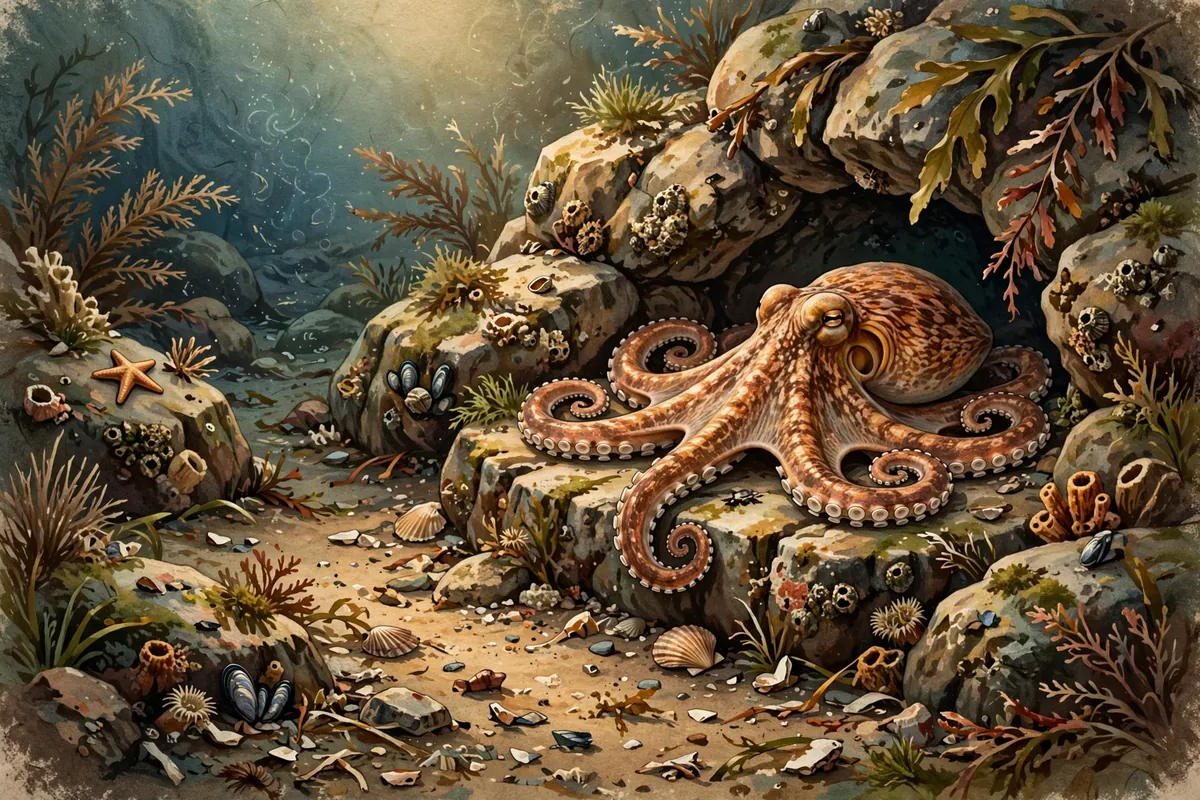
So the next time you see an octopus tucked into a rocky den, picture what's going on inside. Three hearts are pumping thick blue blood, and eight clever arms are sensing the world around them. It may be the most unusual neighbor on the sea floor.