You drop a bit of cookie on the patio, and before long a neat line of ants is marching straight to it. They seem to know exactly where to go. But ants have no voices and no words. So how does the news spread through the colony so fast?
The short answer: ants communicate mainly with chemicals called pheromones, along with touch and sound. A forager that finds food lays down a scent trail on its way home, and other ants follow it. They also pass along information by touching antennae, sharing food, and in some species, making squeaking sounds.
Scent Trails to Dinner
Since most ants live on the ground, they use the soil surface like a message board. In species that forage in groups, an ant that finds food marks a trail with pheromones on the way back to the nest. Other ants follow that trail to the food, and when they return with their own loads, they add more scent, strengthening the path.
When the food runs out, returning ants stop marking the trail, and the scent slowly fades away. That keeps the colony from wasting time on empty routes.
The system is surprisingly smart. If something blocks the path, foragers spread out to explore new routes. An ant that succeeds leaves a fresh trail marking the shortest way back. The best routes attract more ants, get more scent, and become the main highway.
Chemical Alarms and Tricks
Pheromones aren't just for food. When an ant is crushed, it releases an alarm pheromone that sends nearby ants into an attack frenzy and calls in reinforcements from farther away.
Some species even use "propaganda pheromones" to confuse enemy ants and get them fighting among themselves. In colonies with queens, the queen's chemical signals matter too. When the dominant queen stops producing a certain pheromone, workers start raising new queens.
Each colony also has its own signature smell, made from a cocktail of chemicals on the ants' bodies. Workers use this "colony odor" to tell nestmates from strangers, almost like checking an ID at the door.
Feelers, Food, and Squeaks
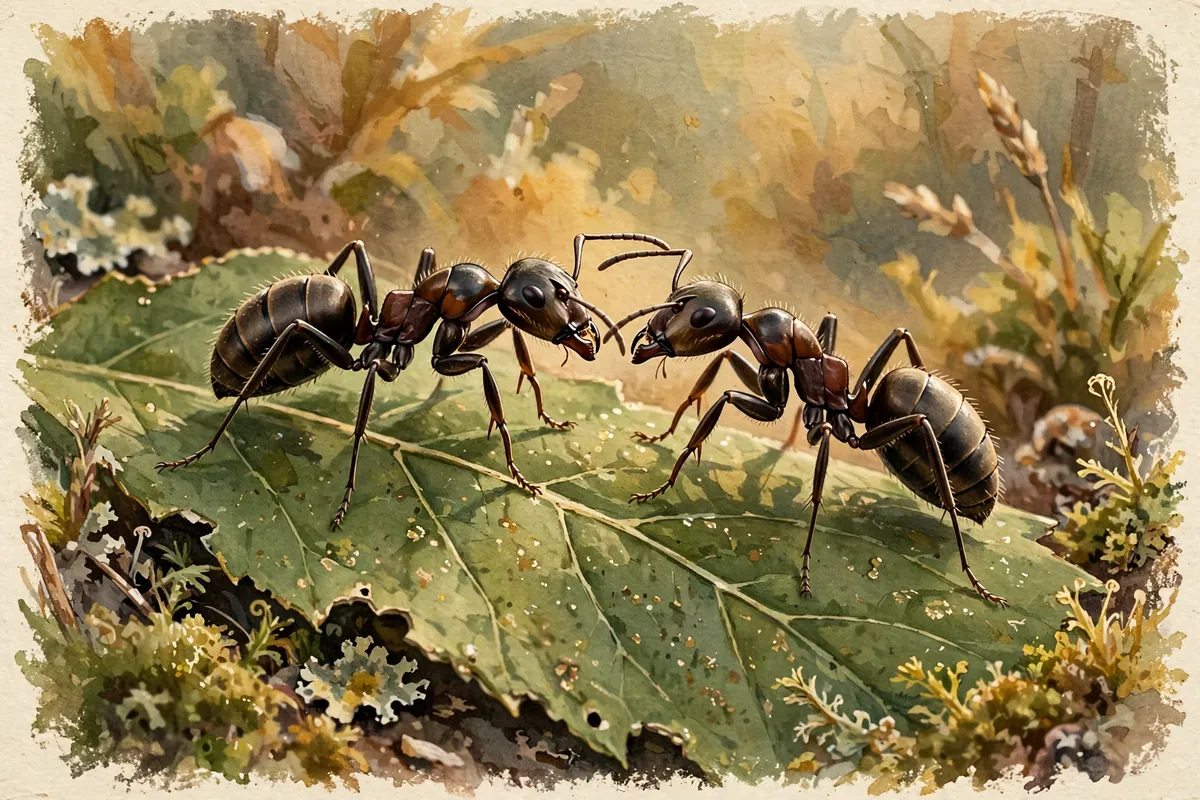
Ants have two elbowed antennae that work like super-sensitive feelers. They detect chemicals, air currents, and vibrations, and ants use them to send and receive signals through touch.
Food carries messages, too. Ants share liquid food mouth to mouth, a process called trophallaxis, from a so-called "social stomach." Pheromones mixed into that food help ants know which job group, such as foraging or nest repair, other members belong to.
Some ants also make sounds by rubbing parts of their bodies together, a process called stridulation. These sounds can be used to communicate with colony members or even with other species.
Ants That Teach
Here's one of the most remarkable discoveries. In one species, an experienced forager can lead a newcomer to food through a process called tandem running. The leader pays close attention, slowing down when the follower lags behind and speeding up when it gets too close. Ants may be the only animals besides mammals in which this kind of interactive teaching has been seen.
So the next time you spot a line of ants heading for your picnic, take a moment to admire the teamwork before you sweep them away. They're having a conversation, just not one we can hear.