Moving to a bigger house is a hassle for people. For hermit crabs, it's a matter of life and death. They can't grow their own shells, so every time they outgrow their home, they have to find a new one. Some species have worked out a surprisingly orderly way to do it.
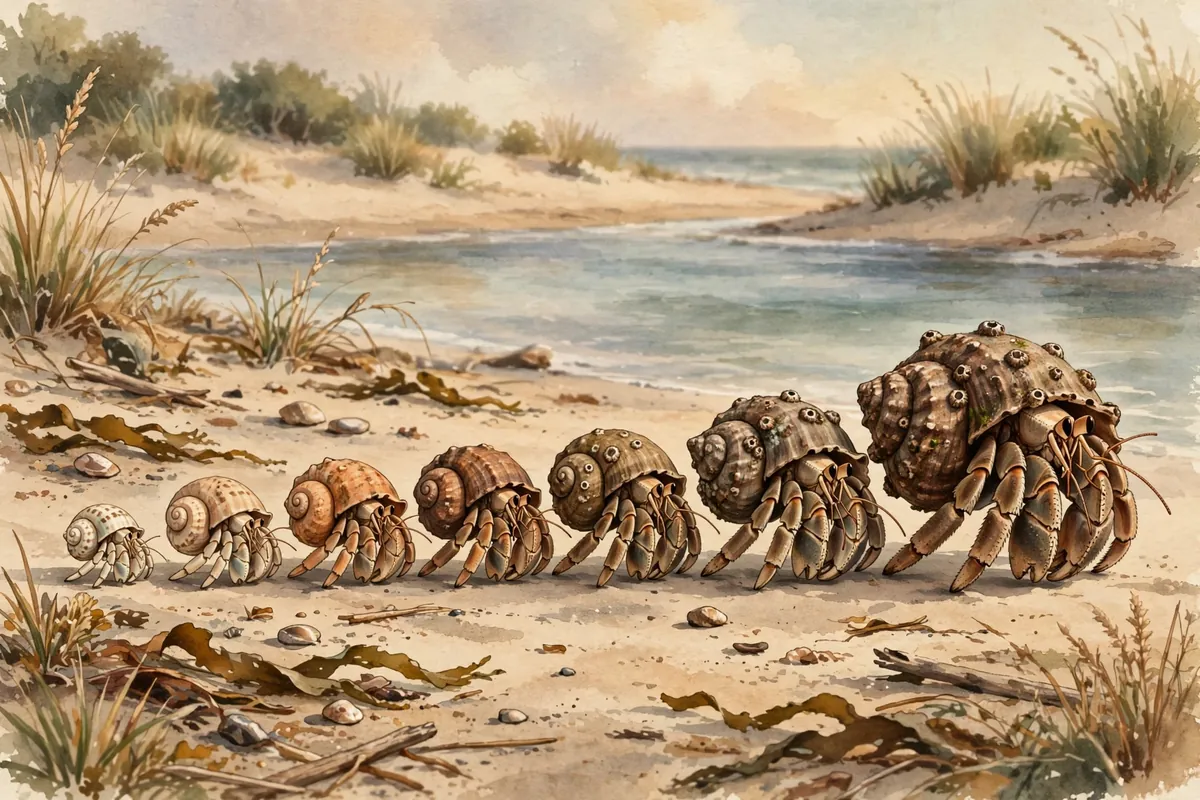
Here's the short answer. Several kinds of hermit crabs, on land and in the sea, have been seen forming what scientists call a vacancy chain. When an empty shell turns up that's too big for the crab that found it, the crab waits nearby. Others gather and line up from largest to smallest. When a crab the right size arrives and moves in, everyone in line quickly swaps into the next-larger shell.
Why Hermit Crabs Need Borrowed Homes
Unlike most of their crustacean relatives, hermit crabs have a soft, unprotected abdomen. To stay safe, they tuck it into an empty shell, usually one left behind by a sea snail. The tip of the crab's abdomen is specially shaped to grip the inside of the shell tightly.
There are over 800 species of hermit crabs. Most carry their shells everywhere, and they can pull their whole bodies inside when danger comes near. Some species even use other shelters, such as hollow pieces of wood or stone.
As a hermit crab grows, it needs a bigger shell. Good shells can be scarce, so competition can be fierce. Crabs with shells that are too small grow more slowly and are more likely to be eaten, since they can't fully hide.
The Great Shell Shuffle
When a crab finds a new empty shell, it climbs out of its own and checks the new one for size. If it's too large, the crab goes back to its old shell and waits beside the empty one, sometimes for up to 8 hours.
As more crabs arrive, they check the shell too. If it's too big for them, they join the group. Up to 20 crabs may gather, holding onto each other in a line from the biggest to the smallest.
Then the right-sized crab shows up, the one scientists jokingly call the "Goldilocks" crab. It moves into the empty shell, leaving its old one free. Instantly, the crabs in line swap shells in sequence, each moving up one size. In moments, nearly everyone has a roomier home.
Not Always So Polite
Hermit crabs aren't always well-mannered. Crabs kept together may fight, or even kill, a competitor to get the shell they want. Fights are rare, though, when the crabs are very different in size.
Sometimes the shell that starts a chain was taken from another crab. When that happens, the victim is usually left without a shell, which makes it easy prey.
A Modern Housing Crisis
When natural shells are hard to find, hermit crabs will move into almost anything, including tin cans and other trash. That can be deadly. Crabs can climb into slippery plastic debris but can't climb back out. In 2024, researchers reported that 10 of 16 land hermit crab species had been seen using artificial shells, including plastic waste, broken bottles, and even light bulbs.
So if you visit the beach, consider leaving empty seashells where you find them. To a hermit crab, that shell might be the perfect next home, and the start of a whole neighborhood's moving day.