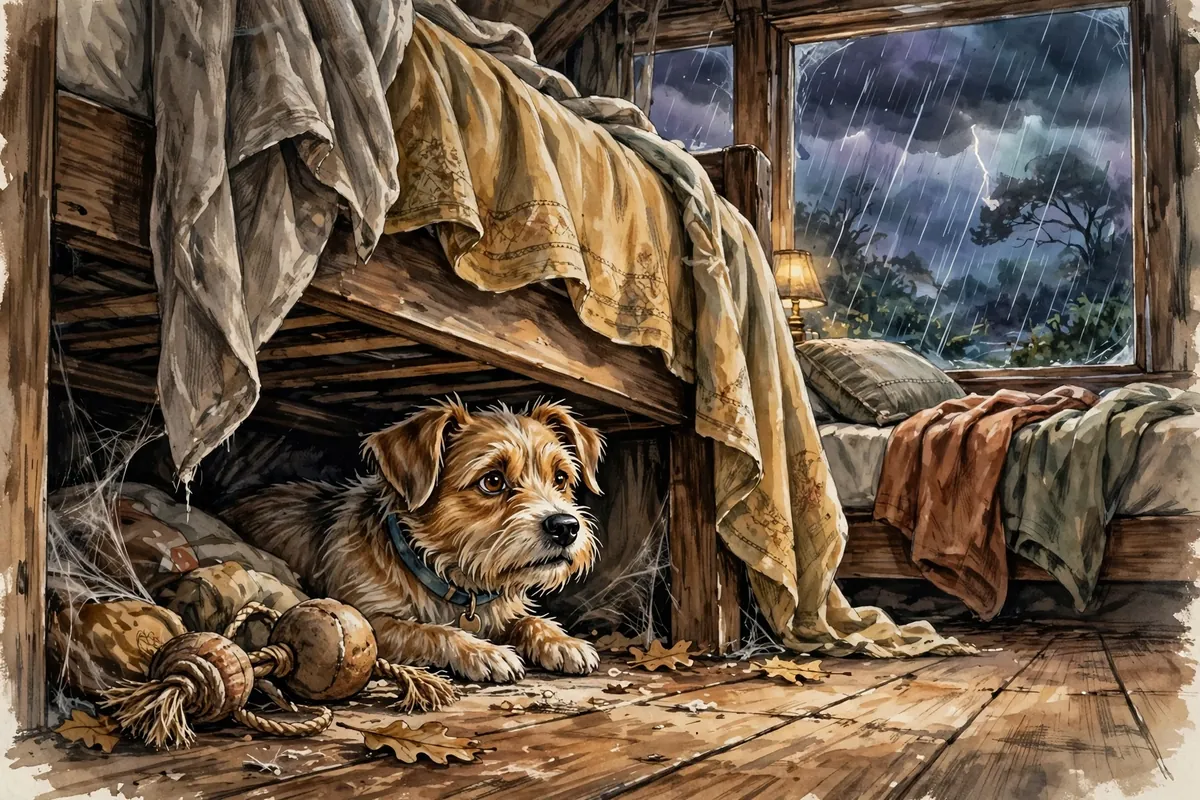
For some dogs, a thunderstorm is no big deal. They snooze right through it. Others pant, pace, tremble or squeeze themselves under the bed long before the storm even arrives. If your dog is one of the worried ones, you've probably wondered what's going on in that furry head.
The short answer is that many dogs are naturally sensitive to loud noises, and thunder is one of the loudest. Between 15 and 30 percent of dogs may experience severe anxiety during thunderstorms, and research has confirmed high levels of the stress hormone cortisol in dogs during and after storms. Genes, sharp hearing and the clues that come before a storm may all add to the fear.
Ears Built for Faint Sounds
Dogs hear much better than we do. Depending on breed and age, their hearing usually ranges from about 67 hertz up to 45,000 hertz, reaching much higher pitches than human ears can catch.
Their ears are built to collect sound, too. A dog's ears are controlled by at least 18 muscles, letting them tilt and rotate toward a noise. Many breeds have upright, curved ears that direct and amplify sound. With hearing like that, a booming thunderclap can be a lot to handle.
It's Not Just Thunder
Dogs often fear loud noises in general. Noise anxiety can be set off by fireworks, thunderstorms, gunshots and even loud or sharp bird calls. In fact, most dogs show distress, fear and anxiety around fireworks. Fireworks worry dog owners so much that in 2016, after a petition signed by more than 100,000 Britons, the British House of Commons debated a motion to restrict their use.
Here's the fascinating part. Over time, a dog can learn to link other signals with the scary sound. A change in air pressure, for example, may come to mean a thunderstorm is on its way. That can make a dog anxious before the first rumble, a kind of anticipatory anxiety.
Some of It Is in the Genes
Why are some dogs so much more fearful than others? Part of the answer may be genetic. Researchers comparing behavior across breeds found that noise fear is among the traits with a genetic basis, along with things like excitability and barking. A 2019 study concluded that a large share of the behavior differences between breeds comes down to genetics.
That doesn't mean a dog's fate is sealed. It just means that some dogs may start out more sensitive than others, much like people.
Helping a Scared Pup
Fear of thunder and lightning even has a name, astraphobia, and it can affect both people and animals. Fearful people often hide under a bed or in a closet, cover their ears and seek comfort from others, which sounds a lot like what many dogs do. In 2007, scientists found it was the third most common phobia in the United States.
For dogs, treatments include behavior training that slowly helps them get used to storm sounds, anti-anxiety medications and a synthetic version of a calming scent released by nursing mother dogs. Talk to your veterinarian about what's right for your dog.
In the meantime, a quiet, cozy hiding spot and your calm company can go a long way. Your dog doesn't know the storm will pass, but you do. Stay close, and ride it out together.