Many Americans remember exactly where they were on the morning of January 28, 1986. Classrooms across the country had tuned in to watch a teacher launch into space. Her name was Christa McAuliffe, and she had been chosen to be the first teacher to fly in space.
She is often remembered as the teacher who went to space, but sadly she never got there. The Space Shuttle Challenger broke apart 73 seconds after launch, killing McAuliffe and all six of her crewmates. More than two decades later, her backup, teacher Barbara Morgan, became the first teacher by profession to reach space.
A Teacher Who Dreamed of Space
Sharon Christa Corrigan was born in Boston on September 2, 1948, and went by her middle name. As a teenager, she was inspired by Project Mercury and the Apollo program. The day after John Glenn orbited Earth, she told a friend she hoped people would someday go to the Moon, maybe even by bus, and that she wanted to go.
She became a teacher, working in Maryland and then New Hampshire. By 1983, she was teaching social studies at Concord High School. On her NASA application, she wrote that she had watched the Space Age being born and wanted to take part.
Chosen From 11,000
In 1984, President Ronald Reagan announced the Teacher in Space Project. NASA wanted an ordinary person, a gifted teacher who could talk with students from orbit. More than 11,000 people applied.
On July 19, 1985, Vice President George H. W. Bush announced that McAuliffe had been selected. NASA officials praised her infectious enthusiasm. She appeared on morning shows and The Tonight Show, where she said that if you're offered a seat on a rocket ship, don't ask what seat, just get on.
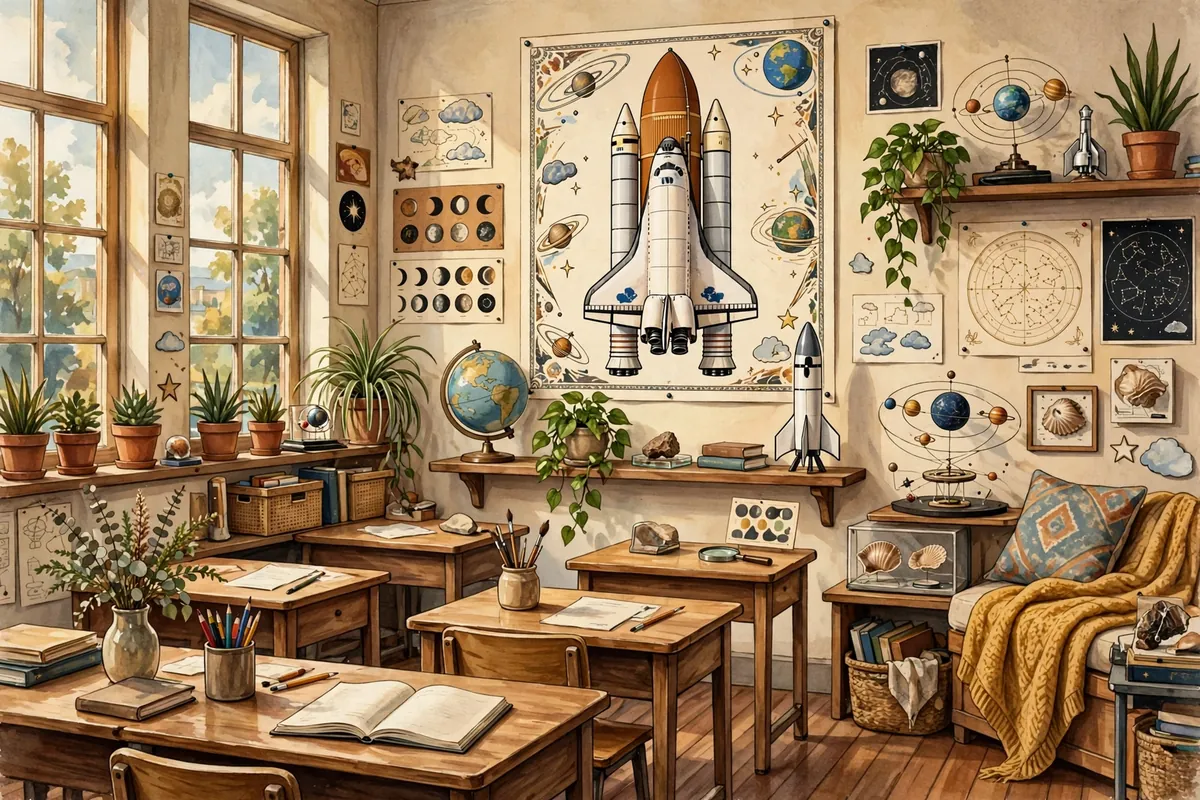
As a member of mission STS-51-L, she planned to conduct experiments and teach two lessons from space.
What Went Wrong
The morning of the launch was record cold. The low temperatures stiffened rubber seals called O-rings in a joint of one of the shuttle's solid rocket boosters. Soon after liftoff, the seals failed, hot gas escaped, and the shuttle was torn apart.
A presidential commission later criticized NASA's decision-making. Problems with the O-rings had shown up in tests and earlier flights, and engineers' warnings about launching in the cold had not been passed up the chain. The shuttle program was grounded for 32 months.
A Legacy That Lives On
Barbara Morgan, McAuliffe's backup, later became a NASA astronaut. In August 2007, she flew to the International Space Station aboard Endeavour on mission STS-118, finally carrying a teacher into space. During the flight, she answered questions from young people by radio. She also took part in an education event with the Challenger Center for Space Science Education, hosted by June Scobee, widow of Challenger's commander, Dick Scobee.
McAuliffe has been honored in many ways. About 40 schools around the world bear her name, as do an asteroid, a crater on the Moon, and a crater on Venus. In 2004, she and the other astronauts lost on Challenger and Columbia received the Congressional Space Medal of Honor.
In 2024, a statue of her was unveiled at the New Hampshire State Capitol, the first statue of a woman on the grounds. Its pedestal carries her own words, a fitting tribute to every teacher: I touch the future, I teach.