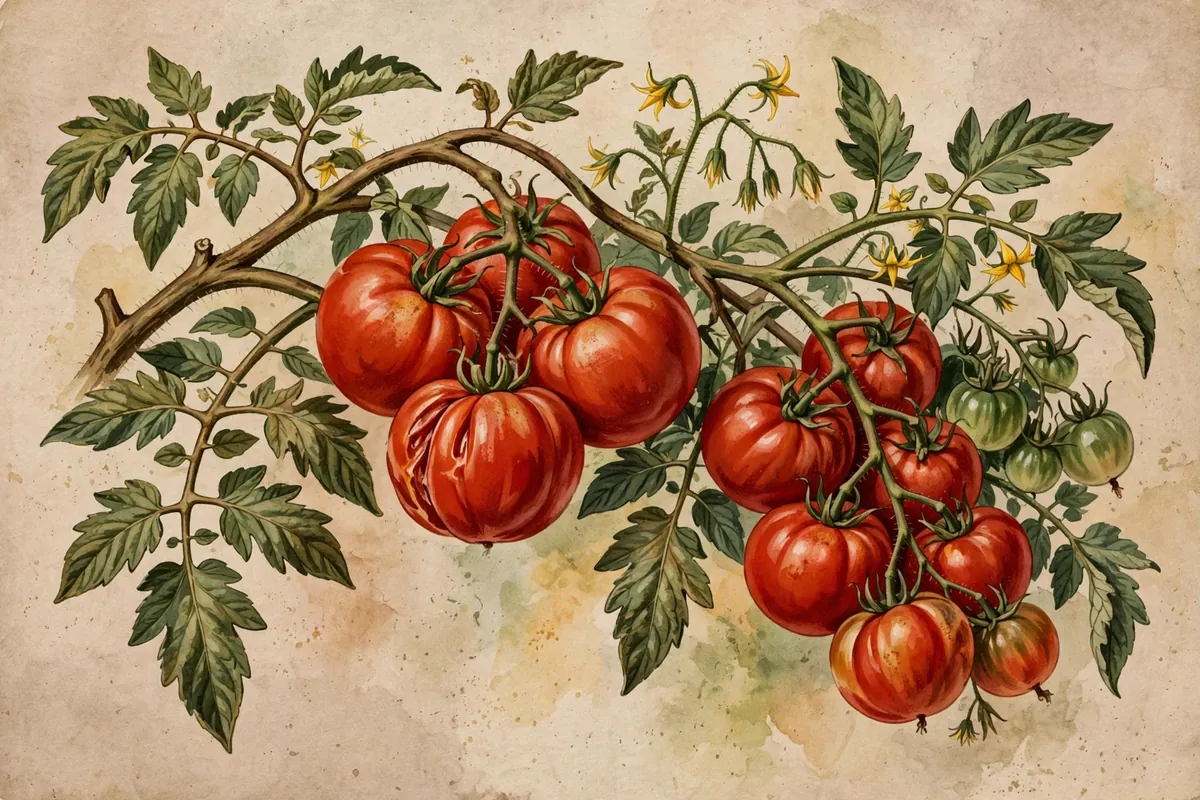
The tomato has a reputation as a food with a shady past. Depending on who tells the story, it was feared as poison, banned outright, or made legal only after some brave soul ate one in public. It makes a great tale to share over a summer salad. But how much of it is true?
Here's the short answer: tomatoes were never illegal in the United States. What is true is that in parts of Europe, and for a while in Britain and its American colonies, many people believed tomatoes were poisonous and grew them mainly as decorations. And in 1893, the tomato really did go to the U.S. Supreme Court, not to be banned, but to settle whether it counted as a fruit or a vegetable for tax purposes.
Why People Feared Tomatoes
Tomatoes come from the Americas. The word itself traces back to tomatl, from the Nahuatl language of Mexico. The Spanish brought them to Europe, where they became part of Spanish cooking.
Elsewhere in Europe, the tomato was often grown as an ornamental plant. People recognized it as a relative of the nightshades, a plant family that includes deadly nightshade and mandrake, and assumed it was poisonous too. Even its scientific name, lycopersicum, means "wolf peach."
In England, a barber-surgeon named John Gerard wrote about tomatoes in his 1597 herbal. He knew people in Spain and Italy ate them, yet he still believed they were poisonous. His opinion carried weight, and for years tomatoes were considered unfit to eat in Britain and its North American colonies.
Americans Came Around Sooner Than You'd Think
The fear wasn't as widespread as the legend suggests. Tomatoes were being grown in what is now South Carolina by 1710, and by the mid-1700s they were cultivated on some Carolina plantations. Thomas Jefferson ate tomatoes in Paris and sent seeds home. By 1820, they were described as being "in great abundance" in vegetable markets and "used by all our best cooks."
The claim that Americans thought tomatoes were poisonous right up into the 1820s mostly appeared after 1860, and in fact the belief was never widespread.
The Man Who Didn't Eat a Basket of Tomatoes
The most famous tomato tale stars Colonel Robert Gibbon Johnson of Salem, New Jersey. Supposedly, in 1820, he ate a basket of tomatoes on the courthouse steps as a crowd waited for him to drop dead. In some versions, a woman in the crowd fainted.
It's a fun story, but it's apocryphal. The first written claim linking Johnson to tomatoes dates only to the early 1900s. The dramatic version was popularized in books in the 1940s and even re-enacted on CBS radio in 1949.
Fruit or Vegetable? Ask the Court
Here's where the law really comes in. The Tariff Act of 1883 taxed imported vegetables but not fruit. A New York produce company argued that, botanically, the tomato is a fruit, so it shouldn't be taxed. In the 1893 case Nix v. Hedden, the Supreme Court unanimously disagreed.
Justice Horace Gray agreed that tomatoes are botanically a fruit. But in everyday language, he said, they're vegetables, because people usually eat them with the main course rather than for dessert. So the next time someone at the table insists a tomato is a fruit, you can tell them they're right, and so is the Supreme Court.