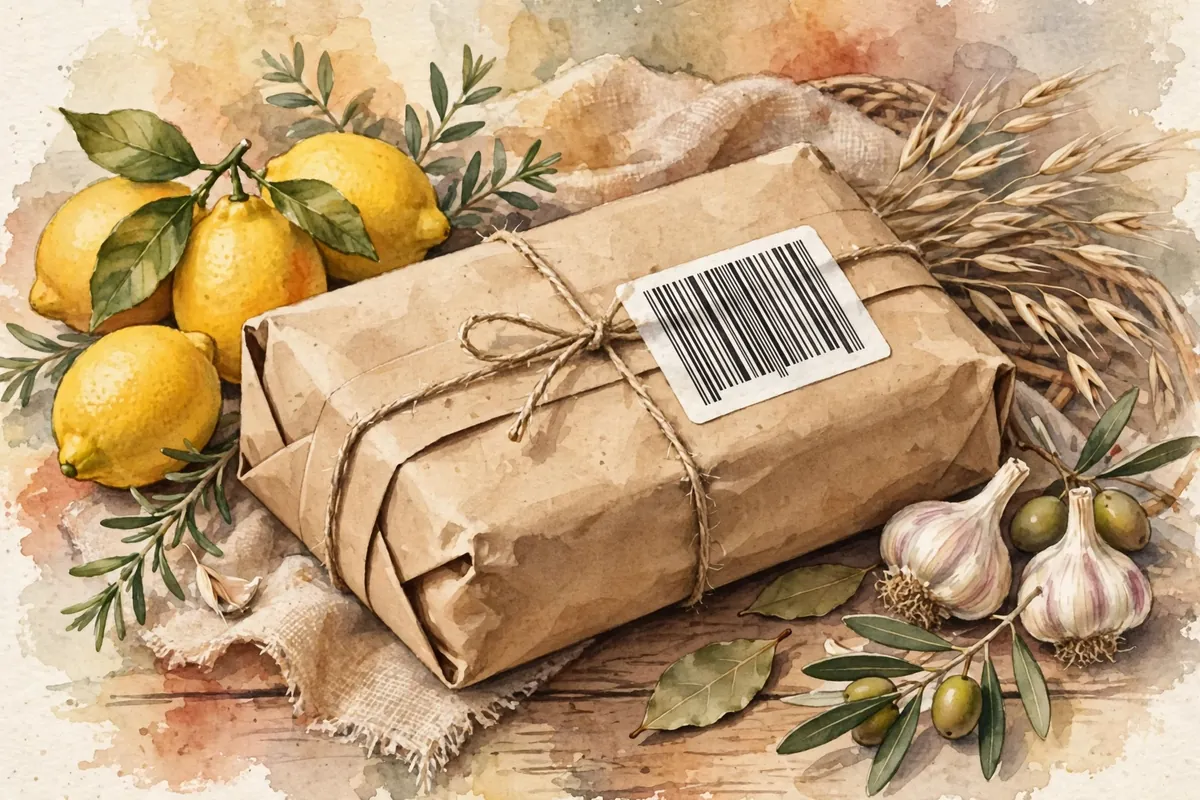
You see them on nearly everything you buy: a neat block of black and white stripes, with a row of numbers underneath. The cashier slides it past a red light, there's a beep, and the price appears. But why lines? Why not dots, squares, or circles?
The short answer: the barcode began as stretched-out Morse code. Inventor Norman Joseph Woodland took Morse code's dots and dashes and drew them downward into narrow and wide lines. Later, when grocers chose a standard design in 1973, straight vertical bars won out because they printed more reliably than a competing circular design. Each digit is coded in the widths of the bars and the spaces between them.
An Overheard Conversation
The story starts in 1948 in Philadelphia. Bernard Silver, a graduate student at the Drexel Institute of Technology, overheard the president of a local food chain asking a dean to research a way to read product information automatically at checkout. Silver told his friend Woodland, and the two got to work.
Their first try used ultraviolet ink, but it faded too easily and cost too much. Woodland left Drexel and moved into his father's apartment in Florida to keep working on the problem.
Morse Code in the Sand
On the beach, inspiration struck. Woodland drew his first barcode in the sand. "I just extended the dots and dashes downwards and made narrow lines and wide lines out of them," he later explained.
To read the lines, he borrowed technology from movie projectors, which read soundtracks printed on film using light. His setup shone a 500-watt bulb through the paper onto a light-sensitive tube taken from a movie projector. He then decided the code might work better as a circle, like a bull's-eye, so it could be scanned from any direction. Woodland and Silver patented their invention in 1952.
It was ahead of its time. It took more than twenty years for barcodes to become a commercial success. Railroads experimented in the meantime. By 1962, British Railways had a system that could read codes on train cars passing at 100 miles per hour without a mistake.
Why Straight Lines Won
In 1973, a grocery industry council chose a barcode design developed by engineer George Laurer. Laurer's version used vertical bars, and it printed better than the circular bull's-eye. That design became the Universal Product Code, or UPC.
There's clever math in those stripes. A standard UPC holds 12 digits, and each digit is drawn as two black bars and two white spaces of varying widths. The original plan used ten digits. Laurer and mathematician David Savir added extra digits for error checking, and today the last digit is a check digit that helps catch scanning or typing mistakes.
The left and right halves are also coded differently, so the scanner can tell whether it's reading the code forward or upside down. That's why the cashier can swipe your groceries in either direction.
The First Beep
The first UPC-labeled item ever scanned at a checkout was a 10-pack of Wrigley's Juicy Fruit gum. It happened at 8:01 a.m. on June 26, 1974, at the Marsh supermarket in Troy, Ohio, and the register rang up 67 cents.
Today barcodes are everywhere, and their square cousins, QR codes, became popular with the rise of smartphones. So the next time you hear that familiar beep, remember it all began with a man drawing lines in the sand.