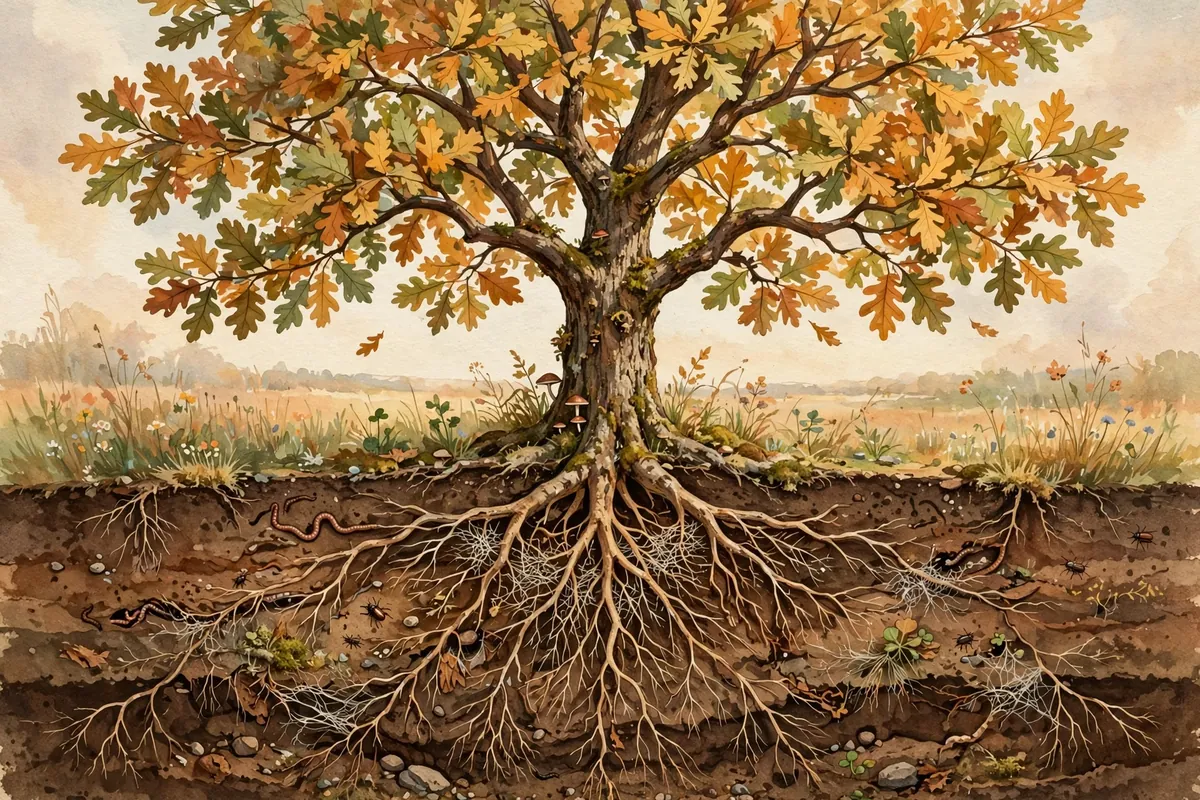
When we look at a tree, we see only half of it. The trunk, branches, and leaves get all the attention, while a hidden network spreads out in the dark beneath our feet. It's natural to wonder just how far down that hidden half really goes.
For most trees, the answer is surprisingly shallow. The majority of roots on most plants stay fairly close to the surface, where nutrients and air are easiest to find. But some roots can reach astonishing depths. The deepest living root ever directly observed was at least 200 feet underground, found while digging an open-pit mine in Arizona. And reports from South Africa describe tree roots going even deeper.
Why Most Roots Stay Near the Top
Roots need oxygen to breathe, just like the rest of the plant's living cells. Deep, packed-down soil has little air, and solid rock or waterlogged ground can stop roots in their tracks. Only a few trees, like mangroves and the pond cypress, can live with their roots permanently underwater.
So most trees spread out rather than down. A young tree starts with a taproot that grows straight down. Within a few weeks, side roots branch off and grow horizontally through the upper soil. In most trees, the taproot eventually withers away, and those wide-spreading side roots do the main work.
The Champions of the Deep
The deepest roots tend to show up in deserts and in temperate coniferous forests. In dry places, water may lie far below the surface, and the plants that survive are the ones that can reach it. Some roots can even grow as deep as their tree is tall. By contrast, the shallowest roots are found in tundra, northern forests, and grasslands.
Different sources name different record holders. A wild fig tree growing in Echo Caves near Ohrigstad, South Africa, is reported to have roots reaching about 400 feet deep, the deepest known for any tree. Another South African tree, the shepherd's tree, is also described as having one of the deepest root systems of any plant, at about 223 feet.
The shepherd's tree is a fascinating survivor. It lives in hot, dry parts of southern Africa like the Kalahari and usually stays well under 33 feet tall, yet its roots can go many times deeper than the tree is high.
Wide as Well as Deep
Some roots win by spreading rather than diving. A famous dragon tree on Tenerife in Spain's Canary Islands, known as El Drago Milenario, is reported to have shallow roots about 660 feet long.
Roots also get help from friends. In the soil, they meet threadlike fungi, and many of these fungi form partnerships with tree roots called mycorrhiza. Both sides benefit, and some trees struggle to thrive without their fungal partners.
How a Root Pushes Through the Ground
Every root tip wears a protective cap that helps it push through soil. As the root grows deeper, the cap sheds cells, leaving a slimy coating that works like lubricant. Just behind the tip, new cells form and stretch, driving the root forward.
Farther back, tiny root hairs, each just a single cell, press against soil particles to soak up water and minerals. So the next time you sit under a shady tree, remember that there's a whole hidden world below you, quietly working away in the dark.