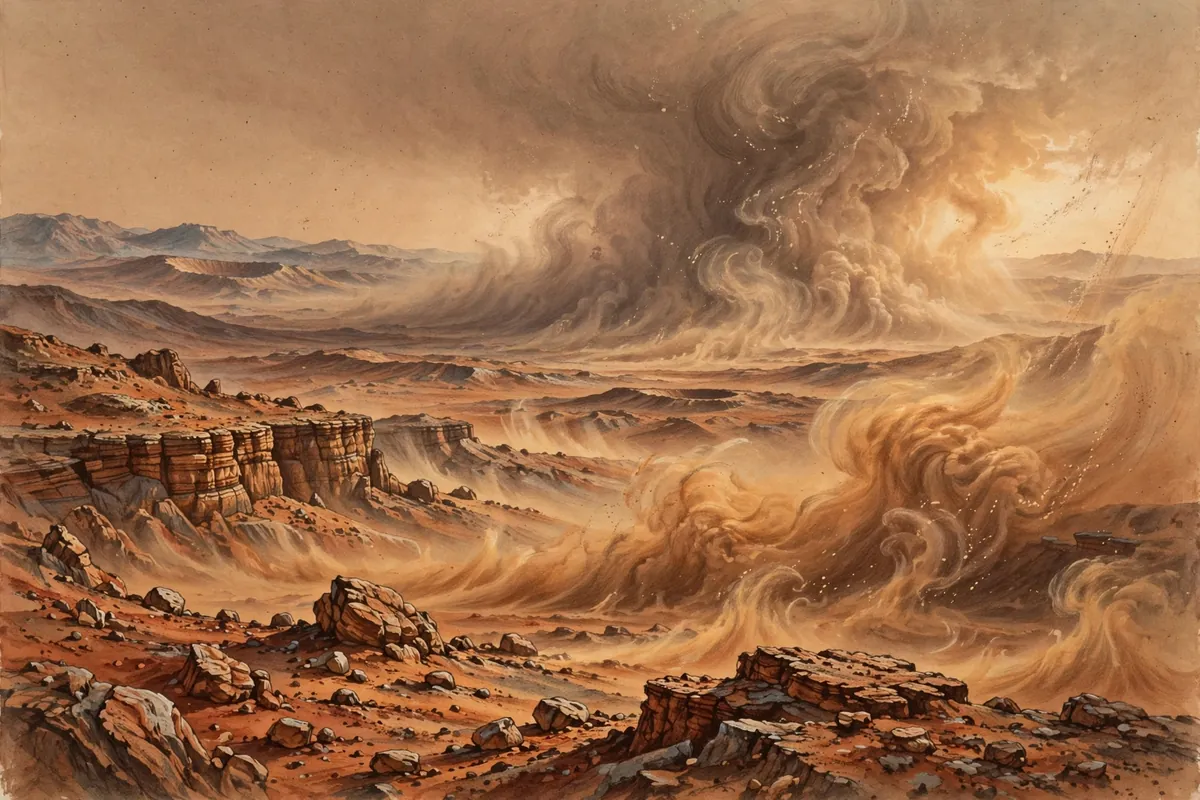
When the Mariner 9 probe reached Mars in 1971, scientists expected crisp new views of the surface. Instead, the planet was wrapped in a nearly global dust storm. Only the peak of the giant volcano Olympus Mons rose above the haze. The storm lasted about a month, and scientists have since learned that this kind of thing is quite common on Mars.
So why are Martian dust storms so enormous? In short, Mars is extremely dry and has no rain. On Earth, rain quickly washes dust out of the air. On Mars, once dust gets lifted, it can stay in the atmosphere far longer. When sunlight heats the planet strongly, the winds stir up more and more dust, and a regional storm can spread until it encircles the entire planet.
How a Martian Storm Gets Going
Martian dust storms start when sunlight warms the atmosphere and gets the air moving, lifting dust off the ground. Big temperature differences, like those near the equator during the Martian summer, make storms more likely.
Timing matters too. Mars's orbit is more stretched out than Earth's, and when it is closest to the Sun, it gets about 40 percent more sunlight than when it is farthest away. Dust storms are most common during that close approach, when the extra heat strengthens the winds. The biggest, global storms can last for months.
Dust also carries things upward. Fine particles kicked up by storms can help clouds form as high as about 62 miles above the surface.
Huge, but Not as Fierce as the Movies
If you've seen a movie where a Martian windstorm topples equipment and nearly knocks astronauts over, the real thing is gentler. Mars's atmosphere has only about 1 percent of the pressure of Earth's. Winds can reach around 60 miles per hour, but in such thin air they push with far less force, so Martian storms never reach the punch of an Earth hurricane.
That thin air is also why it takes strong winds, around 40 to 50 miles per hour, to lift dust off the surface in the first place. Once it's up, though, the dust can linger and spread. When the Viking landers sat through a global storm, the daily temperature swing narrowed sharply as the dust blocked sunlight by day and held in warmth at night.
The Storm That Ended a Rover
Martian dust storms have real consequences. The rover Opportunity was built for a 90-day mission but kept going for more than 14 years, powered by solar panels. In late May 2018, a dust storm began building, and by June 20 it covered the entire planet.
With sunlight blocked, Opportunity's solar panels couldn't produce enough power. Its last contact came on June 10, 2018. The team hoped a windy season might clean dust off its panels, but after more than 1,000 signals went unanswered, NASA declared the mission complete in February 2019.
Storms That Change the Planet
These storms may even help explain why Mars is so dry today. During global storms, water vapor gets carried very high into the atmosphere, where sunlight can break it apart and the hydrogen can escape into space. One study suggested dust storms may be behind about 10 percent of Mars's water loss.
People have been watching these storms for a long time. In 1809, the French astronomer Honoré Flaugergues spotted what he called yellow clouds on Mars, the first known observation of Martian dust storms.
So next time a dusty wind kicks up on a dry day, imagine that times a whole planet, with no rain coming to settle it. That's an ordinary stormy season on Mars.