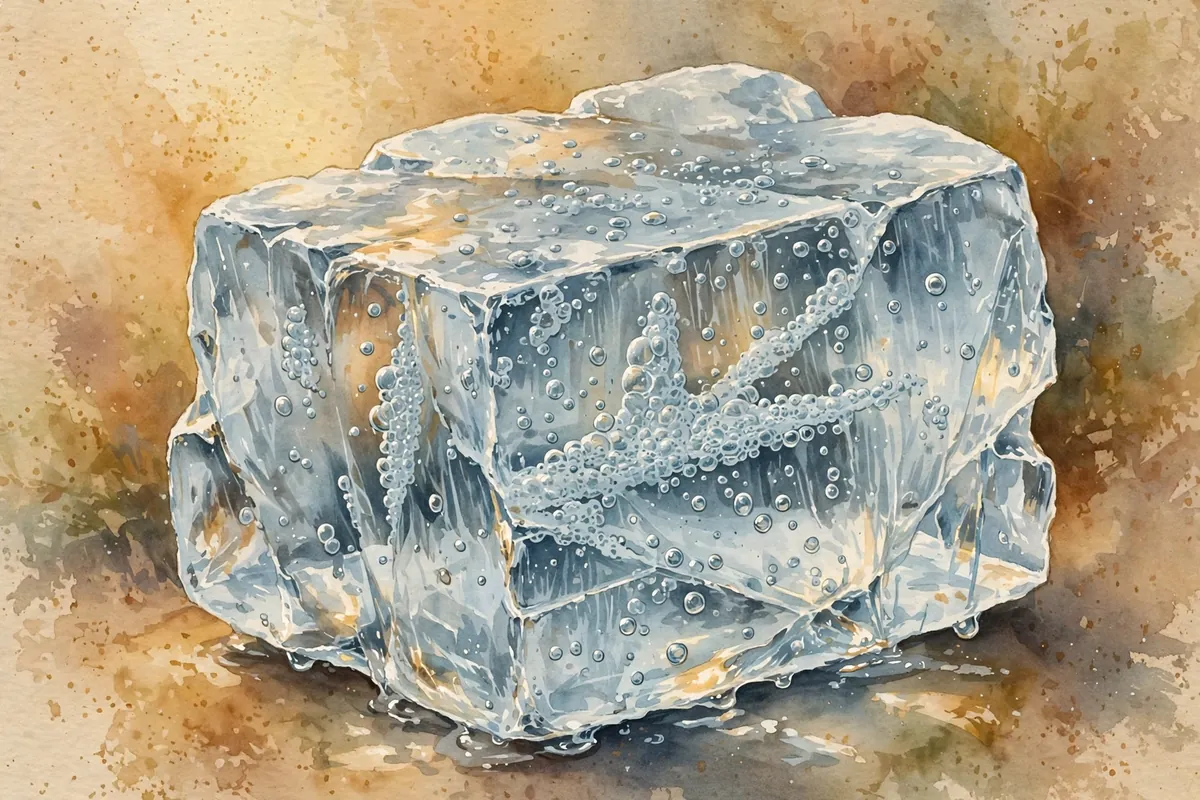
What did the air smell like 100,000 years ago? How much carbon dioxide drifted over the world when mammoths roamed? It sounds impossible to know. There was no one around taking samples. But nature has been quietly saving them for us, frozen in ice.
Here's the short answer. In places like Antarctica and Greenland, snow piles up year after year and slowly gets squeezed into solid ice. As it does, little pockets of air get sealed inside as bubbles. Scientists drill out long columns of ice called ice cores, release the trapped air, and measure gases like carbon dioxide and methane from long ago.
From Snowflake to Sealed Bubble
Fresh snow is fluffy and full of air. As more snow falls on top, the weight presses the lower layers into a denser, grainy material called firn. At first, firn is still loose enough for air to move through it.
Deeper down, the firn becomes dense enough to turn into true ice, and the air inside gets locked into bubbles. In Greenland and Antarctica, this happens somewhere between about 210 and 380 feet below the surface. From then on, each bubble holds a sample of the atmosphere from around the time it was sealed.
Here's a curious twist. Because the air keeps mixing until the bubbles close, the trapped air is younger than the ice around it. At Summit Camp in Greenland, the ice is about 230 years old by the time it seals. At a site in Antarctica called Dome C, it's about 2,500 years old. Scientists account for that gap when they date their samples.
Reading the Layers
Ice cores work a bit like tree rings. Each year adds new layers, so deeper ice is older. In central Greenland, summer layers have bigger bubbles than winter layers, so the stripes can be counted to find the age of each layer.
Other clues are frozen in too. Dust blown in during cold, dry periods, ash from volcanoes, soot from forest fires, and sea salt all leave their marks. Big volcanic eruptions spread material around the globe, leaving signatures that help scientists match up cores drilled in different places.
How Far Back Can We Go?
Ice cores can be drilled more than two miles deep. In the 1990s, a European project called EPICA drilled at Dome C in East Antarctica, reaching bedrock at about 10,700 feet. Its record stretched back about 800,000 years and revealed climate cycles lasting roughly 100,000 years.
In 2016, researchers found a spot in Antarctica's Allan Hills where very old ice lay near the surface. One core there contained ice about 2.7 million years old, by far the oldest ever dated from a core. Scientists are now hunting for continuous cores that reach back more than 1.2 million years.
Bubbles That Disappear
Deep enough, around 5,000 feet down, the crushing pressure changes the ice's crystal structure. The air molecules move into the crystals themselves, the bubbles vanish, and the ice turns clearer.
In between, there's a tricky zone where the bubbles are under so much pressure that cores can crack when brought to the surface. Drilling crews have to handle that ice with special care.
So the next time you drop an ice cube into a glass and notice its tiny bubbles, give it a little respect. Out on the polar ice sheets, bubbles just like those are holding onto the air our distant ancestors once breathed.